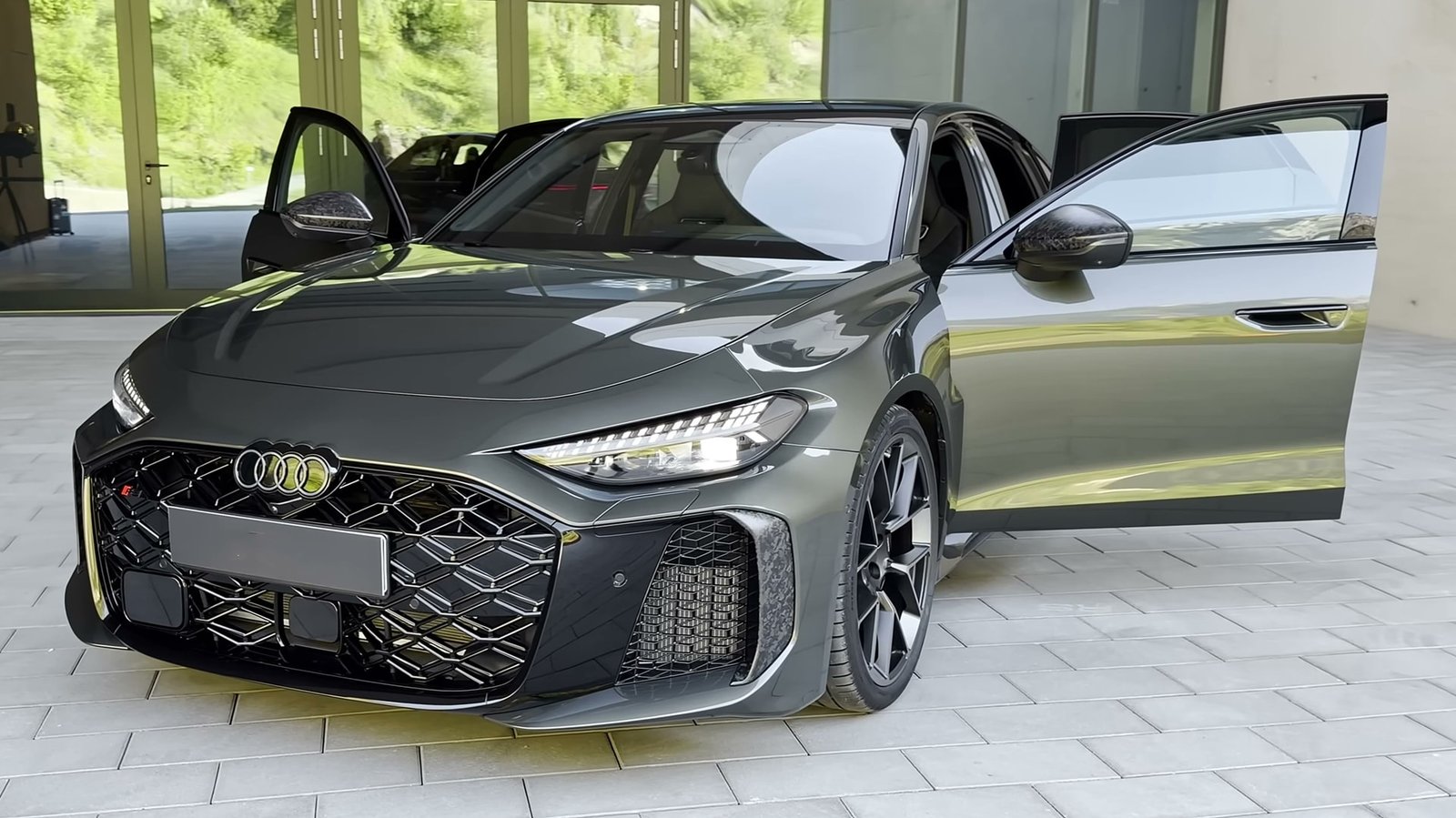
Audi has completely reinvented the RS 5 for 2027. This generation marks the first time an RS model uses plug-in hybrid power. It combines a twin-turbo 2.9-liter V6 with an electric motor to produce 630 horsepower and 609 lb-ft of torque. The car is significantly quicker than before, offers meaningful electric range for daily use, and introduces Audi’s most advanced rear torque-vectoring system yet.
The main compromise is weight. The new RS 5 is roughly 1,000 pounds heavier than its predecessor. Whether the gains in performance, refinement, and usability outweigh the added mass is the key question.
Powertrain Breakdown
The 2027 RS 5 uses a hybrid system built around an updated 2.9-liter twin-turbo V6 and a powerful electric motor mounted between the engine and the 8-speed automatic transmission.
Powertrain Component Specifications
| Component | Type | Output | Torque | Notes |
|---|---|---|---|---|
| 2.9L Twin-Turbo V6 | Gasoline | 503–510 hp | 443–442 lb-ft | Revised for hybrid integration |
| Electric Motor | Permanent magnet synchronous | 174 hp | 339 lb-ft | Integrated in 8-speed transmission |
| Combined System | Plug-in Hybrid | 630 hp | 609 lb-ft | Peak output with boost |
| Transmission | 8-speed automatic | — | — | Paddle shifters standard |
| Drivetrain | Quattro AWD | — | — | New electromechanical rear vectoring |
Performance Figures
Acceleration & Top Speed
| Metric | Value | Context |
|---|---|---|
| 0-60 mph | 3.6 seconds | Manufacturer claim with launch control |
| Top Speed | 155 mph | Electronically limited |
| Boost Mode Power | Full 630 hp | Available for up to 10 seconds |
| Electric-Only Top Speed | 87 mph | Engine remains off below this speed |
Battery, Charging & Electric Range
Hybrid System & Efficiency
| Specification | Details | Real-World Notes |
|---|---|---|
| Battery Capacity | 25.9 kWh gross / 22 kWh usable | Mounted under cargo floor |
| Electric-Only Range | 40–54 miles (est.) | Depends on conditions and testing cycle |
| Max Electric Speed | 87 mph | Useful for highway EV driving |
| AC Charging Speed | Up to 11 kW | Full charge in ~2.5 hours |
| DC Fast Charging | Not available | PHEV limitation |
| Hybrid Mode Efficiency | Strong when battery is charged | Excellent for short trips and commuting |
Weight & Practicality Impact
The hybrid components add substantial mass. This is the most noticeable change from the previous RS 5.
Weight & Cargo Comparison
| Measurement | 2027 RS 5 | Previous RS 5 (approx.) | Change |
|---|---|---|---|
| Curb Weight | 5,192 lbs | ~4,200 lbs | +~1,000 lbs |
| Cargo Behind Rear Seats | 11.7 cu ft | Higher | Reduced |
| Maximum Cargo (seats folded) | 41.3 cu ft | Higher | Reduced |
| Seating Capacity | 5 | 5 | Unchanged |
Previous Generation vs 2027 RS 5
Key Changes from Previous RS 5
| Category | Previous RS 5 | 2027 RS 5 | Impact |
|---|---|---|---|
| Powertrain | 2.9L twin-turbo V6 only | 2.9L V6 + electric motor (PHEV) | Much higher power |
| Total Output | 444 hp / 442 lb-ft | 630 hp / 609 lb-ft | Significant increase |
| Weight | Lighter (~4,200 lbs) | 5,192 lbs | Heavier and less agile feel |
| Torque Vectoring | Standard quattro | New electromechanical rear system | Much sharper handling |
| Electric Capability | None | 40–54 miles EV range | New daily usability |
| Refinement | Strong | Improved with electric assist | Smoother around town |
| Complexity | Lower | Higher (hybrid system) | More features, more weight |
New Torque Vectoring System
The biggest technical highlight is the new rear axle with electromechanical torque vectoring.
How the New Torque Vectoring Works
| Feature | Description | Benefit |
|---|---|---|
| System Name | Dynamic Torque Control / RS Torque Rear | World-first in production car |
| Recalculation Speed | Every 5 milliseconds (200 Hz) | Extremely fast response |
| Technology | Electric motor + planetary gears | Replaces slower hydraulic clutches |
| Max Torque Split | Up to 1,475 lb-ft across rear axle | Strong cornering and drift capability |
| Special Mode | RS Torque Rear | Bias power rearward for fun driving |
| Everyday Behavior | Active in background | Improves traction and stability |
Drive Modes & Character
Drive Mode Behavior
| Mode | Focus | Torque Vectoring Behavior | Best For |
|---|---|---|---|
| Comfort / Efficiency | Smooth & efficient | Subtle intervention | Daily driving & EV mode |
| Dynamic | Balanced sporty response | Increased rear bias | Enthusiastic road driving |
| RS Sport | Maximum performance | Aggressive vectoring | Track or twisty roads |
| RS Torque Rear | Drift & rear-drive feel | Strong rear bias + drift support | Fun, controlled oversteer |
Rival Comparison
2027 Audi RS 5 vs Key Competitors
| Model | Est. Starting Price | Powertrain | Power | Weight | Key Strength | Weakness vs RS 5 |
|---|---|---|---|---|---|---|
| 2027 Audi RS 5 | $110k–$125k | 2.9T V6 + PHEV | 630 hp | 5,192 lbs | Advanced torque vectoring + EV range | Heavier than some rivals |
| BMW M3 Competition | ~$80k+ | 3.0T inline-6 | 503–523 hp | Lighter | Lighter weight, sharp handling | Less power, no EV range |
| Mercedes-AMG C63 | ~$90k+ | 2.0T + PHEV | 671 hp | Heavy | Highest power output | Different character, less V6 sound |
| Cadillac CT5-V Blackwing | ~$95k+ | 6.2L V8 | 668 hp | Competitive | Naturally aspirated purity | No hybrid efficiency or torque vectoring |
Pros & Cons
| Pros | Cons |
|---|---|
| Massive power increase to 630 hp | Significant weight gain (~1,000 lbs) |
| Useful 40–54 mile electric range | No DC fast charging capability |
| Most advanced rear torque vectoring in class | Heavier steering and body movements |
| Excellent daily refinement with EV mode | Reduced cargo space due to battery |
| Strong performance in both hybrid and EV modes | High expected price point |
| Genuine drift capability in RS Torque Rear | More complex powertrain than pure combustion |
Who Should Buy the 2027 RS 5?
| Buyer Profile | Recommendation | Reason |
|---|---|---|
| Performance enthusiasts wanting tech | Strong choice | New torque vectoring and power are excellent |
| Daily drivers who want EV capability | Very good fit | 40+ mile electric range is genuinely useful |
| Buyers who prioritize low weight | Consider alternatives | Heavier than BMW M3 and previous RS 5 |
| Those who want maximum straight-line speed | Excellent | 630 hp and strong acceleration |
| Fans of traditional RS character | Mixed | More refined but less raw than before |
Verdict
The 2027 Audi RS 5 is a bold evolution. By adopting plug-in hybrid power, Audi has delivered class-leading output, useful electric range, and the most sophisticated torque-vectoring system available in a compact performance car. The added weight is the clearest downside, but the instant electric torque and advanced chassis technology largely offset it during real-world driving.
It is no longer the lightest or purest RS 5, but it is the most capable and versatile one Audi has produced. For buyers who want serious performance with everyday usability and the ability to drive emission-free for short trips, this is a highly compelling machine.
Frequently Asked Questions
| Question | Answer |
|---|---|
| Is the 2027 RS 5 a plug-in hybrid? | Yes. This is Audi’s first RS-badged plug-in hybrid model. |
| How much total power does it produce? | 630 horsepower and 609 lb-ft of torque from the combined system. |
| What is the electric-only range? | Estimated between 40 and 54 miles depending on conditions. |
| How much heavier is the new RS 5? | Approximately 1,000 pounds heavier than the previous generation. |
| What makes the torque vectoring special? | It uses an electric motor and planetary gears instead of hydraulic clutches and recalculates every 5 milliseconds. |
| Can it drift? | Yes. The RS Torque Rear mode allows significant rear bias and controlled oversteer. |
| Is there DC fast charging? | No. It only supports AC charging up to 11 kW. |
| What is the expected U.S. starting price? | Early estimates place it between $110,000 and $125,000 depending on options and body style. |
| Will both sedan and Sportback be available? | Yes, both body styles are expected for the U.S. market. |
| How does it compare to the BMW M3? | The RS 5 offers more power and electric capability but is heavier and more expensive. |
References