Updated July 29, 2026. Most U.S. buyers with dependable home charging do not need the longest-range EV. Roughly 250 to 300 miles of EPA range is a sensible default, while 200 to 250 miles can work for predictable local driving. Buyers who regularly face cold-weather trips, sparse chargers or long highway days may benefit from 300 to 350 miles or more.
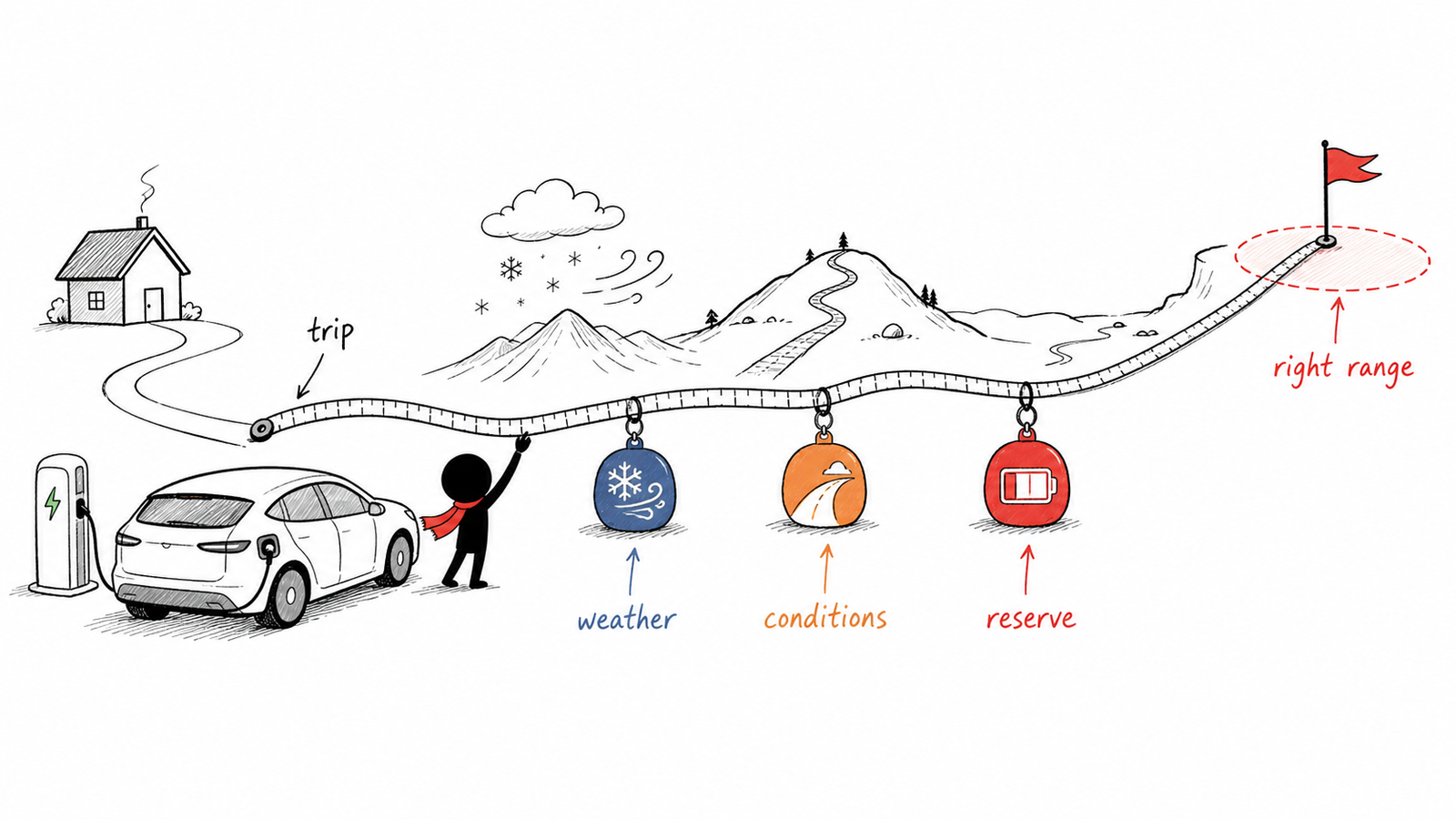
The number should come from your hardest recurring trip, not your average commute. Start with that trip, reduce the advertised range for the conditions you actually face, preserve an arrival reserve, and check whether a charging stop solves the problem more cheaply than a larger battery.
How Much EV Range Do You Need? Quick Answer
| Your Real Use | Practical EPA-Range Starting Point | Why |
|---|---|---|
| Local driving, under 50 miles most days, home charging | 200–250 miles | Daily energy use is small, and the car can recover overnight. |
| Mixed commuting and occasional highway travel | 250–300 miles | This is the strongest general-purpose range band when charging access is good. |
| Frequent long trips, cold winters or limited route options | 300–350+ miles | More rated range protects the trip from weather, speed and charger spacing. |
| No home charging | Range alone does not solve the problem | A larger battery reduces charging frequency but cannot make an unreliable charging routine dependable. |
| Regular towing or remote travel | Model- and route-specific | The required battery may become impractical; charging placement or another powertrain can matter more. |
These are editorial starting points, not guarantees. The U.S. Department of Energy says many EVs can travel 200 to 300 miles on a charge and advises buyers to account for hills, heavy loads, heating and air conditioning. Your answer changes when the same trip happens at 20°F, at sustained highway speed or with a trailer.
XCarspace verdict: Buy enough range for the worst trip you repeat, not the worst trip you can imagine. A once-a-year edge case is usually cheaper to solve with one charging stop, a rental or a second household vehicle than with years of unused battery capacity.
EPA Range Is a Comparison Number, Not a Personal Promise
The EPA label is the right place to begin because it gives buyers a standardized comparison. The agency’s current EV range-testing explanation says vehicles are evaluated across defined cycles and that adjusted city and highway results are weighted 55% and 45% to produce the combined label range.
That combined number does not describe every trip. The EPA calls its EV estimates general consumer guidelines, while the Department of Energy notes that EV efficiency and range vary substantially with conditions. Highway travel normally uses more energy than city driving because aerodynamic drag rises with speed, while city driving gives regenerative braking more opportunities to recover energy.
Read the window sticker as a consistent benchmark between vehicles. Do not treat it as a guarantee that a 300-mile EV will travel exactly 300 miles on an interstate in January with four people, cargo and cabin heat.
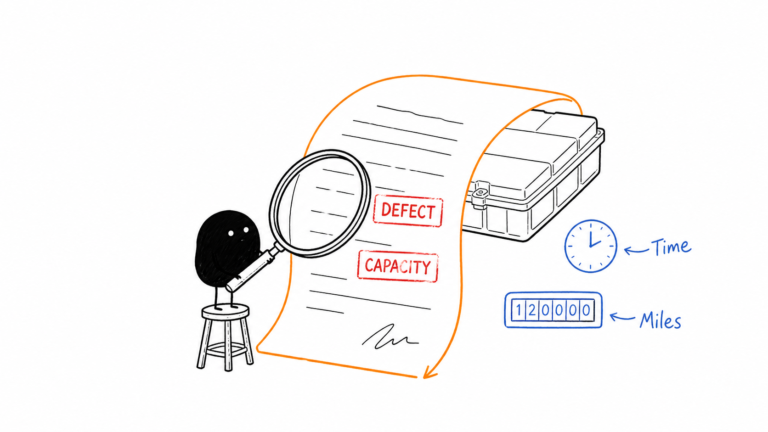
If you are shopping used, EPA range is only the original benchmark. The car’s present battery capability must be checked separately. Our used EV battery-health inspection guide combines model-specific diagnostics, usable-energy math, warranty verification and an underbody check.
The XCarspace Range-Budget Formula
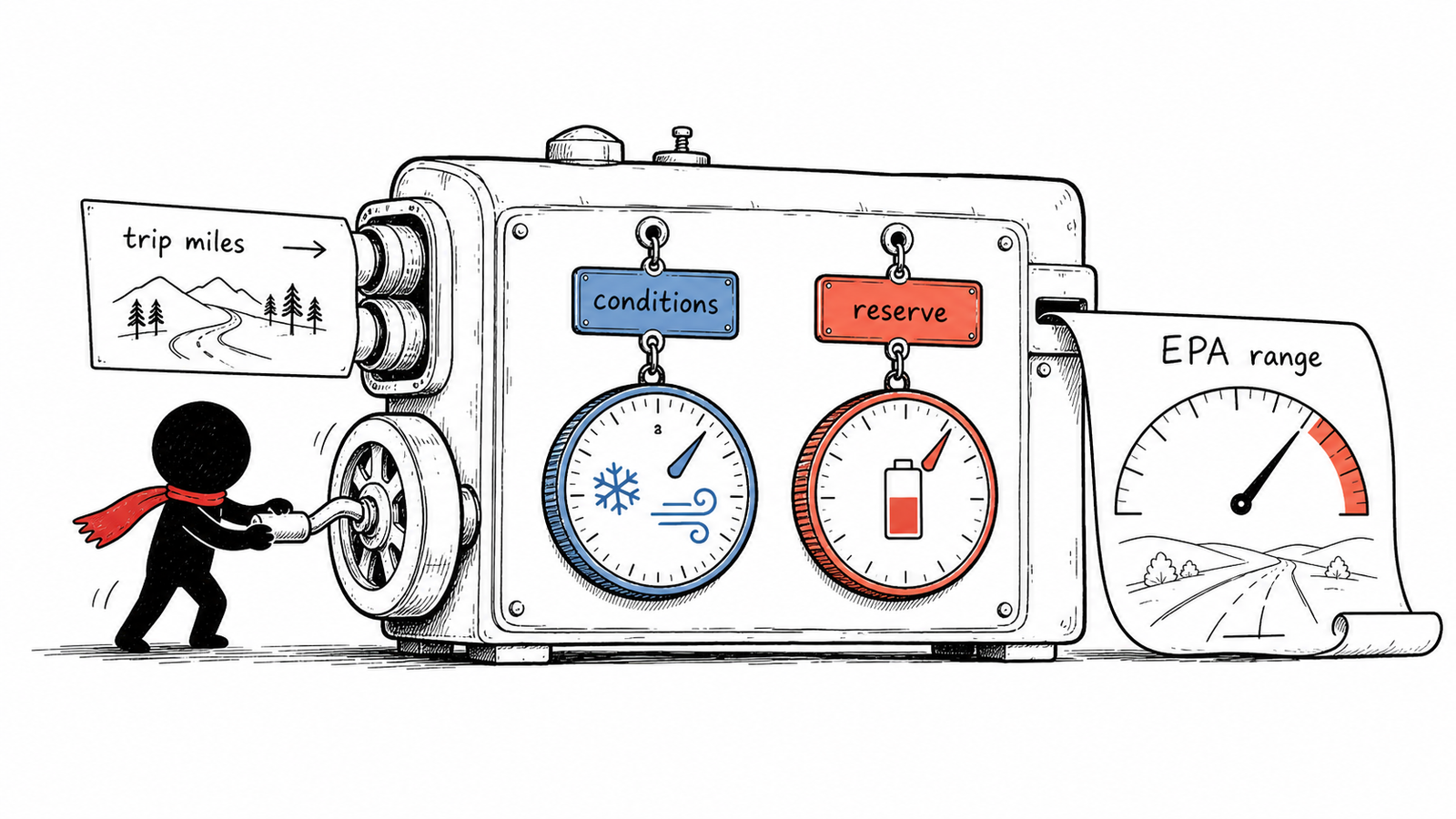
A useful buying estimate is:
Required EPA range = hardest recurring trip miles ÷ (condition factor × planned usable fraction)
The inputs mean:
- Hardest recurring trip miles: the longest trip you genuinely repeat without dependable destination charging.
- Condition factor: the share of EPA range you expect under that trip’s speed, temperature, elevation and load.
- Planned usable fraction: the share of the battery you intend to consume before reaching a charger. Departing at 100% and arriving at 15% equals 0.85.
The condition factor is not a universal government rating. It is a planning input that should come from model-specific testing, owner-manual guidance, route data and conservative judgment. The examples below are sensitivity scenarios, not national averages.
Example 1: A 120-Mile Mild-Weather Round Trip
- Trip: 120 miles
- Illustrative condition factor: 0.85
- Arrival reserve: 15%, so usable fraction is 0.85
120 ÷ (0.85 × 0.85) = 166 miles of required EPA range
A 220-mile EV would provide meaningful margin in this scenario. Buying 350 miles solely for a 120-mile recurring trip would be difficult to justify unless charging access, winter weather or future use changes the calculation.
Example 2: A 180-Mile Winter Family Trip
- Trip: 180 miles
- Illustrative winter condition factor: 0.70
- Arrival reserve: 15%, so usable fraction is 0.85
180 ÷ (0.70 × 0.85) = about 303 miles of required EPA range
This buyer has a credible reason to prefer roughly 300 miles or more. The daily commute may be only 35 miles, but the repeated winter trip sets the useful battery size.
Example 3: A 220-Mile Towing or Remote Route
- Trip: 220 miles
- Illustrative difficult-condition factor: 0.55
- Arrival reserve: 15%, so usable fraction is 0.85
220 ÷ (0.55 × 0.85) = about 471 miles of required EPA range
The correct conclusion is not automatically “buy a 471-mile EV.” It may be to schedule a charging stop, choose a route with dependable infrastructure, use another household vehicle or buy a hybrid. When the calculated requirement becomes extreme, change the trip plan before paying for a battery built around one edge case.
Cold Weather Can Rewrite the Range Budget
Cold weather is not a small footnote for buyers in northern states. In controlled testing summarized by Argonne National Laboratory, average battery-electric range fell 41% at 20°F and 54% at 0°F compared with 72°F while the cabin was maintained at 72°F. At 95°F, average range fell 14%.
Those results are a stress test across the vehicles and conditions studied, not a prediction for every current EV. Heat pumps, battery thermal management, preconditioning, trip length and cabin settings can change the result. The important buying lesson is that a cold-climate driver should not apply a warm-weather percentage to the hardest winter trip.
The Department of Energy recommends preconditioning while the vehicle is still plugged in when possible. That lets the grid help warm the cabin and battery instead of drawing all of that energy from the pack after departure. Covered parking and a heat pump can also improve the winter experience, though neither makes the temperature penalty disappear.
Hot weather deserves its own calculation. Our summer AC and EV range guide uses Argonne’s 95°F test result plus highway and city models to show why the same cooling load costs more range on a slow trip.
Highway Speed, Hills and Cargo Matter More Than Many Buyers Expect
The Department of Energy’s all-electric vehicle guide identifies several range reducers: extreme temperatures, sustained highway travel, rapid acceleration, heavy loads and significant inclines. The same EV can therefore feel generous in stop-and-go city driving and much tighter on a fast mountain route.
Do not build the range budget from one average efficiency number when the decisive trip is unusual. Use the efficiency the vehicle reports on that type of route, or look for reputable testing at comparable speed, temperature and load. For a future-model purchase, treat manufacturer range as an estimate until an EPA label is available.
Towing requires an even stricter approach. Trailer size, shape, weight, speed, wind and elevation all change energy use. A generic towing reduction percentage is not reliable enough for a purchase decision. Model the exact trailer and route, and verify that compatible chargers allow the vehicle and trailer to enter, park and leave safely.
Arrival Reserve Is Usable Range, Not Wasted Range
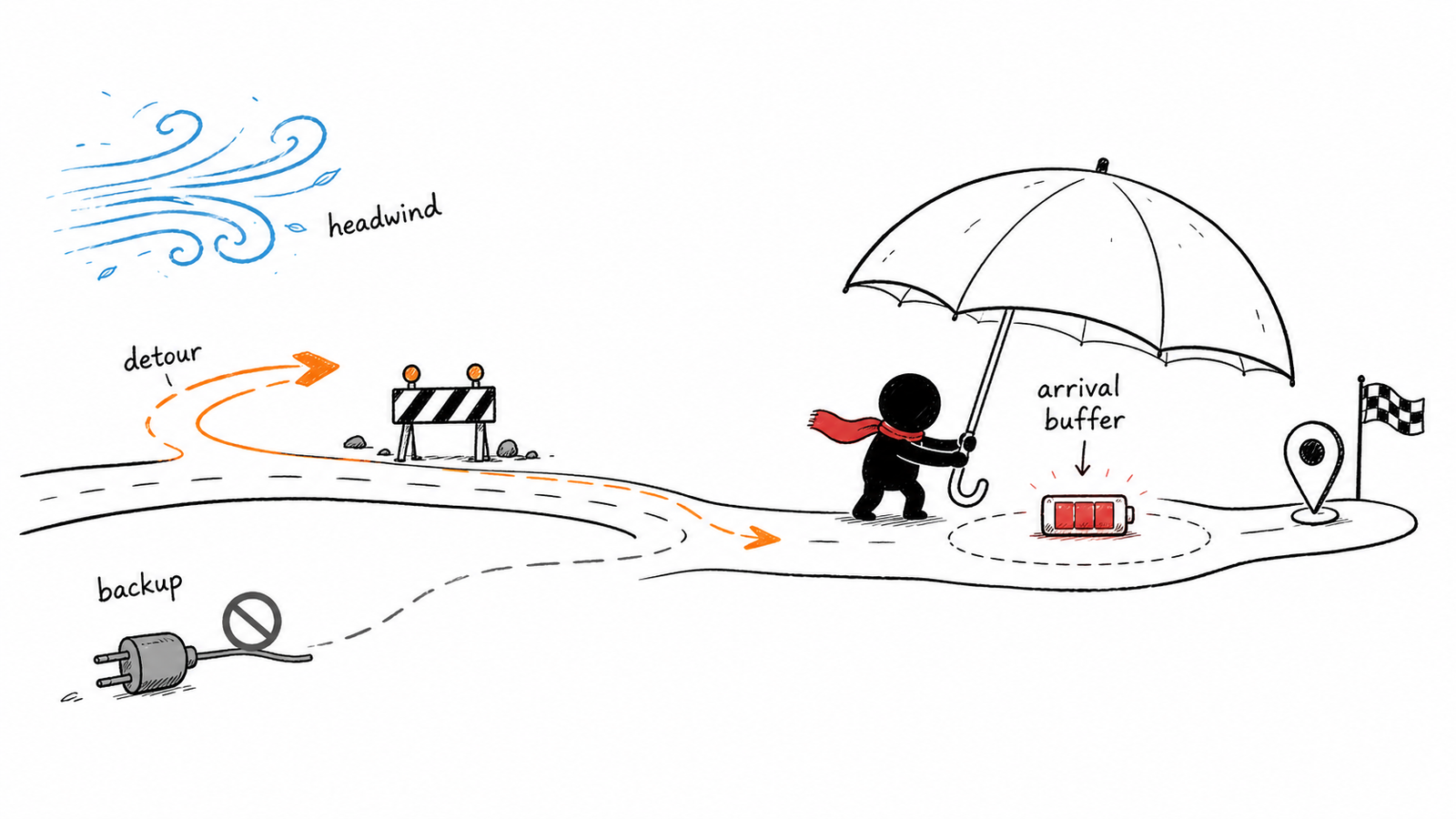
Planning to arrive at 0% makes every error expensive. A closed road, headwind, missed exit or unavailable charger can turn a mathematically possible trip into a stressful one.
The right reserve is personal and route-specific. A 10% arrival target may be comfortable on a familiar corridor with several working alternatives. A remote winter route may justify substantially more. The point is not to prescribe one percentage; it is to include a reserve explicitly instead of pretending every rated mile is available for the plan.
Reserve also changes the way two vehicles compare. A 250-mile EV with a strong, predictable route planner and dense compatible charging may be easier to travel in than a 300-mile EV with slow charging or poor route coverage. Range and charging speed solve different problems. XCarspace’s EV charging-time guide explains why peak charger power does not equal total stop time.
Charging Access Changes How Much Range Feels Necessary
Home charging reduces the value of an oversized battery for daily driving. A 40-mile commute does not require 300 miles of fresh range every morning; it requires enough overnight charging power to replace roughly 40 miles. The battery acts as a buffer for days that are longer than normal.
Without home charging, extra range can reduce the number of public sessions. That convenience has value, but it does not cure expensive, crowded or unreliable charging. Before buying more battery, read XCarspace’s 2027 guide to owning an EV without home charging and price the actual networks you would use.
Road-trip charging changes the answer again. A car that charges quickly across a useful state-of-charge window may cover a 500-mile day with shorter stops than a longer-range car that charges slowly. Compare the complete trip, not only the distance between plugs.
The 200-, 250-, 300- and 350-Mile Range Tiers
About 200 Miles: Enough for the Right Buyer
This tier can work well for local driving, home charging and households with another vehicle for rare long trips. It is less forgiving when winter conditions, public-charging dependence or frequent highway travel enter the picture.
About 250 Miles: The Practical Entry Point
For predictable use and good charging access, roughly 250 miles covers far more than the daily needs of many drivers. It also creates enough trip flexibility that one well-placed charging stop can handle journeys beyond the battery’s comfortable nonstop range.
About 300 Miles: The Best General-Purpose Default
Roughly 300 EPA miles is the strongest default for a one-car household that mixes commuting with road trips. It offers useful weather and detour margin without making maximum possible range the only buying priority.
About 350 Miles or More: Buy It for a Specific Reason
Long range is valuable for frequent interstate travel, cold climates, sparse charging corridors or drivers who cannot charge reliably every night. It may also increase purchase price, mass or charging time depending on the vehicle. Compare efficiency, usable battery capacity and charging curve rather than assuming the largest pack is automatically best.
Four Buyers, Four Different Answers
Suburban Commuter With a Garage
This driver travels 35 miles per day, has Level 2 charging and makes two long vacations a year. A 250-mile EV is likely enough if the vacation routes have dependable fast charging. Paying substantially more for 350 miles may solve a problem that occurs only twice a year.
Apartment Renter With Public Charging
This driver may value 300 miles because it reduces charging frequency, but the recommendation changes if public electricity is expensive or the reliable station is inconvenient. Charging access remains the first purchase criterion.
Cold-Climate One-Car Family
This household repeats a 170- to 200-mile winter trip and cannot substitute another vehicle. A 300- to 350-mile rating, efficient cabin heating, reliable battery preconditioning and strong fast charging all deserve priority. The winter trip, not the weekday commute, decides the car.
Remote Traveler or Regular Tower
This buyer should not shop by EPA range alone. Route-specific consumption, charger spacing, trailer access and backup plans are essential. If the trip repeatedly produces an extreme required-range calculation, a hybrid may be more rational. The broader choice is covered in XCarspace’s EV vs. hybrid buyer guide.
What Would Change Our Recommendation?
- Dependable destination charging: It can cut the required nonstop range nearly in half for a round trip.
- A second household vehicle: The EV no longer needs to handle every rare edge case.
- Frequent severe cold: More rated range and better thermal management become valuable.
- Fast, reliable route charging: A lower-range EV may complete long trips easily.
- No home or workplace charging: Extra range helps frequency but may not fix the ownership routine.
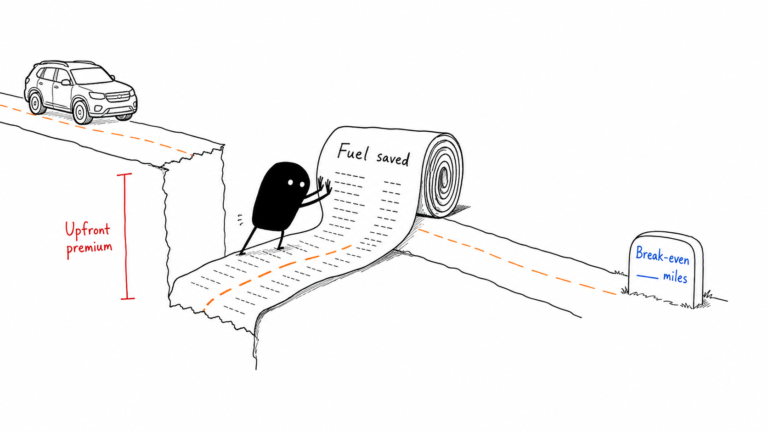
- A large price jump for the bigger battery: Occasional charging stops or rentals may be much cheaper.
- Regular towing: Generic range tiers become unreliable; model the exact duty cycle.
EV Range Questions to Answer Before You Buy
- What is the longest trip you repeat at least several times a year?
- How many of those miles are at highway speed?
- What is the coldest temperature in which that trip must work?
- Will the vehicle carry heavy cargo, climb mountains or tow?
- Is dependable charging available at the destination?
- What arrival reserve makes you comfortable on that route?
- How quickly does the vehicle charge across a defined percentage window?
- What does the larger battery option cost?
- Could one planned stop or occasional rental solve the same problem?
- Are the range figures EPA-rated, manufacturer-estimated or still unconfirmed?
Frequently Asked Questions
Is 250 miles of EV range enough?
It is enough for many buyers who charge at home, drive predictable daily distances and have reliable fast charging on longer routes. It becomes less comfortable for frequent cold-weather travel, sparse charging corridors or public-charging-only ownership.
Do I need a 300-mile EV?
No, but roughly 300 EPA miles is a strong general-purpose default for a one-car household. Use the range-budget formula on your hardest recurring trip before paying for more or accepting less.
How much EV range is lost in winter?
There is no single percentage for every EV. Argonne’s controlled multi-vehicle averages showed 41% lower range at 20°F and 54% lower at 0°F compared with 72°F while maintaining a 72°F cabin. Vehicle technology, trip length, speed, preconditioning and settings can produce different results.
Should I buy the biggest battery available?
Only when the extra range solves a real repeated problem. A larger battery can cost more and may add mass. Compare the price difference with the cost and inconvenience of occasional charging stops, rentals or another household vehicle.
Is highway range lower than EPA range?
It can be, especially at sustained high speed. The EPA label combines adjusted city and highway results, while actual range depends on speed, weather, elevation, load and accessory use. Look for model-specific highway testing that resembles your route.
Final Verdict: Buy Enough Range, Not Maximum Range
For most buyers with home charging, 250 to 300 miles of EPA range is the sensible place to begin. Choose less when daily use is predictable and long trips are rare. Choose more when a repeated winter or highway trip proves that you need it.
The calculation should be allowed to reject an EV. If a remote route, trailer or charging gap demands an unrealistic battery, the answer may be a charging stop, a different vehicle or a hybrid. Range anxiety is not solved by optimism, but it is also not solved by buying the largest number on the window sticker.
The right EV is the one that completes your difficult recurring trip with a reserve, then quietly handles everything easier.
Methodology: The XCarspace range-budget formula divides the hardest recurring trip by an illustrative condition factor and a planned usable-battery fraction. Condition factors in the worked examples are sensitivity inputs, not official averages or predictions for a specific vehicle. EPA-range testing, Department of Energy consumer guidance and Argonne extreme-weather research were checked July 29, 2026.