Tesla Optimus Gen 2
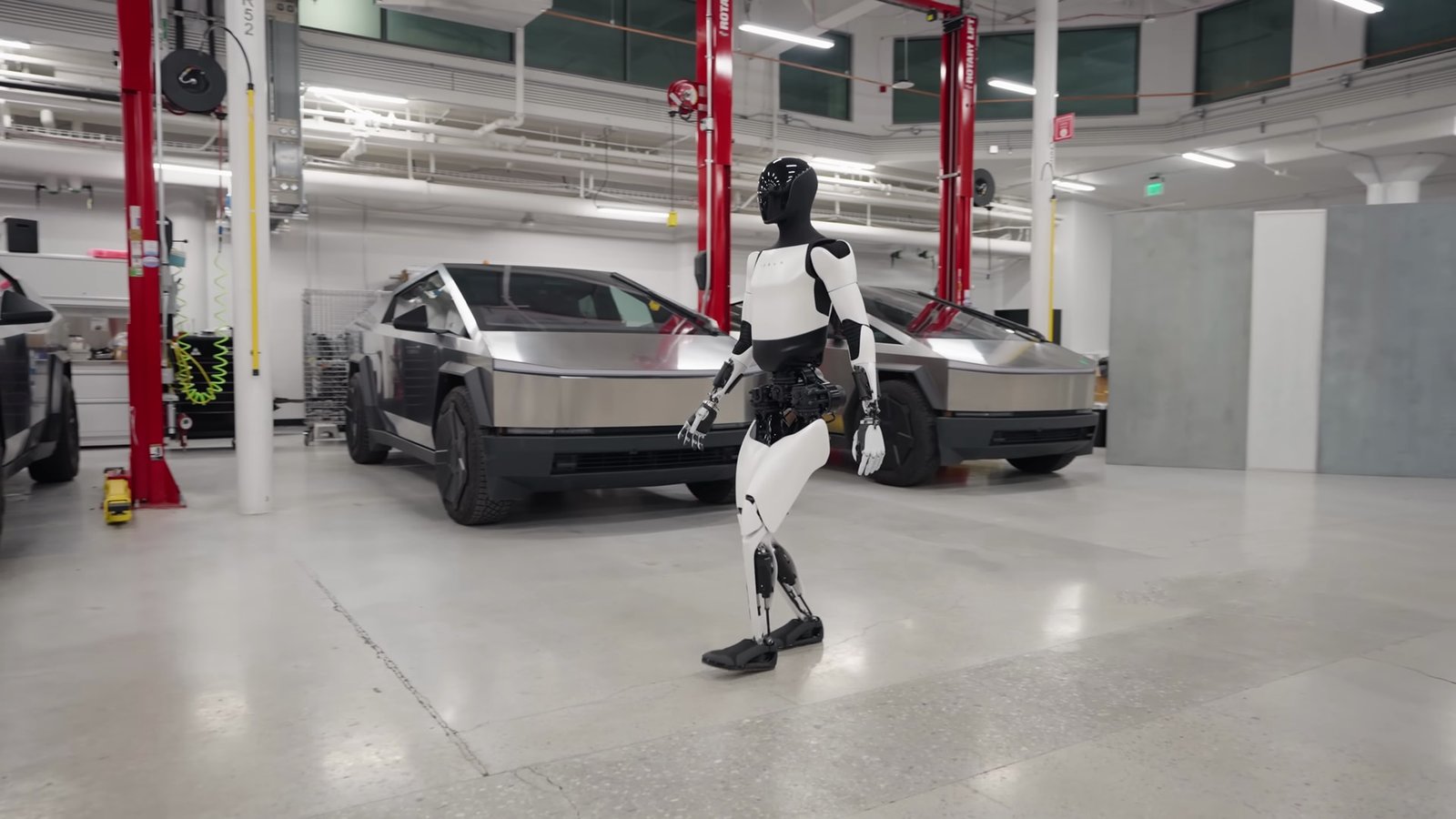
Tesla’s refined second-generation humanoid robot that delivered major gains in walking stability, balance, and hand dexterity, becoming the first version deployed for real factory work and critical fleet-learning data collection.
Core Highlights
| Feature | Description |
|---|---|
| Improved Mobility | 30% faster walking speed, significantly better balance and dynamic control |
| 11 DOF Dexterous Hands | 11 degrees of freedom per hand with tactile sensing on all fingers |
| Tesla-Designed Actuators | Custom actuators throughout the body for better efficiency and control |
| Vision-Based Autonomy | Pure vision system using Autopilot-grade cameras + FSD-derived neural networks |
| Factory Deployment | First version actively used inside Tesla factories for data collection and real tasks |
Release Info
- Prototype Reveal: December 2023 (viral video showing dancing, egg handling, squatting)
- Developer: Tesla, Inc.
- Country: United States
- Robot Type: General-purpose Humanoid Robot
- Internal Factory Use: Mid-2024 onward (Fremont & Giga Texas)
Overview
The Tesla Optimus Gen 2 represented a major leap forward from the Gen 1 prototype. Unveiled in December 2023, it featured a lighter 57 kg frame, dramatically improved walking speed and stability, better balance recovery, and significantly more capable hands with tactile feedback.
Standing 173 cm tall, Optimus Gen 2 used the same vision-first approach as Tesla’s Full Self-Driving system. It could learn tasks through human demonstration and simulation. Starting in mid-2024, dozens to hundreds of Gen 2 units began operating inside Tesla factories, performing battery cell sorting, parts handling, and simple repetitive tasks. This deployment was crucial — it generated the real-world data that powered the development of the much more advanced Gen 3 hands and AI systems.
Gen 2 proved that a humanoid robot could operate safely and usefully in a real factory environment, even if its capabilities were still limited compared to what would come next.
Key Specifications
| Specification | Details |
|---|---|
| Robot Name | Tesla Optimus Gen 2 (V2) |
| Developer | Tesla, Inc. |
| Country | United States |
| Robot Type | General-purpose Humanoid Robot |
| First Announced | Project: 2021; Gen 2 details: December 2023 |
| Prototype Reveal | December 2023 (dancing + delicate manipulation video) |
| Height | 173 cm (5’8″) |
| Weight | 57 kg (125 lbs) — 16 kg lighter than Gen 1 |
| Payload Capacity | ~20 kg practical carrying capacity |
| Walking Speed | Up to ~8 km/h (5 mph) — ~30% faster than Gen 1 |
| Power System | Battery-electric (2.3 kWh NMC pack in torso) |
| Hand Degrees of Freedom | 11 DOF per hand with tactile sensing |
| Locomotion | Bipedal walking with greatly improved dynamic balance |
| Battery Life | ~5–8 hours active use (light to moderate tasks) |
| AI System | Tesla FSD-derived custom inference chip + end-to-end neural networks |
| Primary Use | Internal Tesla factory tasks + data collection |
| Status | Internal factory deployment (hundreds of units) |

Design, Hardware and Engineering
Gen 2 introduced a much more production-friendly and human-compatible design.
Key Engineering Features
| Aspect | Description |
|---|---|
| Materials | Lighter aluminum-magnesium alloys + composites; significant weight reduction |
| Hand System | 11 DOF per hand with tactile sensors on all fingers; capable of delicate tasks (e.g. handling raw eggs) |
| Actuation | Tesla-designed custom actuators (major improvement over Gen 1) |
| Locomotion & Balance | Improved foot design with articulated toes, force/torque sensors, better IMU integration |
| Neck | 2-DoF actuated neck for better head movement and environmental awareness |
| Safety & Durability | Smoother exterior, reduced pinch points, suitable for shared human workspaces |
The biggest visible improvements were in walking fluidity, balance recovery, and the ability to perform precise, low-force manipulation tasks.

AI & Technology
Vision System
Pure vision-based perception using multiple high-resolution cameras (Autopilot heritage). Handles environment recognition, obstacle avoidance, object tracking, and basic manipulation without LiDAR.
AI Brain
| Aspect | Description |
|---|---|
| Hardware | Tesla custom inference chip based on FSD computer architecture |
| Software | End-to-end neural networks trained heavily in simulation + early real-world fleet data |
| Learning | Imitation learning from human demonstration and video; continuous improvement via simulation |
| Updates | OTA software updates (less frequent/mature than Gen 3) |
Motion Control
Whole-body torque control with improved proprioception and balance algorithms. Enabled squatting, dancing demos, and stable walking on factory floors.

Capabilities
| Timeframe | Capabilities |
|---|---|
| Current / Near-term | Battery cell sorting & handling, simple kitting, parts transport, delicate object manipulation (egg demo), basic walking on flat/uneven surfaces |
| Factory Use | Repetitive structured tasks inside Tesla facilities; data collection for training |
| Limitations | Still required significant human supervision for complex or long-horizon tasks; hand dexterity limited compared to Gen 3 |

Development Timeline
| Period | Milestone |
|---|---|
| 2021 | Optimus project publicly introduced at Tesla AI Day |
| 2022–2023 | Gen 1 prototypes – basic walking and very limited tasks |
| December 2023 | Gen 2 unveiled – major mobility and hand improvements demonstrated |
| 2024 | Internal factory deployment begins (Fremont & Giga Texas); real-world data collection starts |
| 2025 | Hundreds of units operating; continuous software and hardware refinements |
| Early 2026 | Gen 3 hands (22 DOF) revealed; Gen 2 continues as the main data-gathering platform |
Performance & Limitations
Performance Metrics
| Metric | Performance | Notes |
|---|---|---|
| Walking Speed | Up to 8 km/h | Much more natural and stable gait than Gen 1 |
| Payload Capacity | ~20 kg practical | Higher in controlled testing |
| Hand Dexterity | 11 DOF per hand | Good for basic grasping and delicate tasks; major step up from Gen 1 |
| Battery Life | 5–8 hours | Suitable for factory shifts with charging breaks |
| Balance & Recovery | Significantly improved | Could recover from moderate disturbances |
| Current Task Complexity | Structured repetitive factory tasks | Still early for complex unstructured work |
| Type | Key Points |
|---|---|
| Strengths | Excellent weight reduction and mobility improvements First version to prove useful factory deployment Strong data collection platform that enabled Gen 3 development Tesla-designed actuators showed clear progress |
| Limitations | Hand dexterity (11 DOF) still limited for complex tool use or fine manipulation AI compute and models not yet at Gen 3 level Required more human supervision than later versions Battery and runtime still constrained for true 24/7 operation |

Pros and Cons
| Aspect | Pros | Cons |
|---|---|---|
| Mobility | Big leap in walking speed and stability | Still not as fluid as some research platforms |
| Hands | 11 DOF + tactile sensing was a big step | Significantly less capable than Gen 3’s 22 DOF |
| Factory Readiness | First version actually deployed in Tesla factories | Mostly data collection role rather than high-value autonomous work |
| Data Advantage | Generated critical real-world training data | Compute and model limitations at the time |
| Manufacturing | Showed Tesla was serious about scaling | Not yet a true mass-production design (that came with Gen 3) |
Overall Verdict
Gen 2 was the most important stepping stone in the entire Optimus program. While its hands and AI were later surpassed, it proved that a humanoid could safely and usefully work alongside humans in a real factory. The data collected by Gen 2 units was instrumental in developing the much more advanced Gen 3 platform.
Competitor Comparison (as of early 2026)
| Robot | Hand Dexterity | Walking & Balance | Factory Deployment | AI Maturity | Notes |
|---|---|---|---|---|---|
| Tesla Optimus Gen 2 | 11 DOF | Very good | Hundreds of units | Good (FSD-based) | Critical data collector |
| Tesla Optimus Gen 3 | 22 DOF | Excellent | Low-volume starting | Excellent + Grok | Current production focus |
| Figure 02 | High | Good | Limited pilots | Very strong | Strong software partnerships |
| Boston Dynamics Atlas | Good | Excellent | Research/commercial | Advanced | Superior dynamic movement |
| Unitree G1/H1 | Moderate | Good | Commercially available | Developing | More affordable entry option |

Price & Availability
- Target Price (long-term): $20,000–$30,000 at high volume
- Gen 2 Status: Primarily internal Tesla use. Not sold externally in meaningful numbers.
- Availability: Internal factory deployment only (2024–2026). External sales began with Gen 3.
Real-World Applications
| Timeframe | Primary Applications |
|---|---|
| Factory (2024–2026) | Battery cell sorting, parts kitting, material transport, simple repetitive tasks |
| Data Collection | Generating training data for future generations |
| Demonstration | Public videos showing improved walking, balance, and delicate manipulation |
Future Outlook
Gen 2’s most important contribution was not its final capabilities, but the real-world operational data it collected. This data directly enabled the leap to Gen 3’s 22-DOF hands and more advanced AI.
By early 2026, Gen 2 had served its purpose as the bridge between impressive lab prototypes and serious production-intent machines.
FAQ
| Question | Answer |
|---|---|
| What is Tesla Optimus Gen 2? | The second-generation version of Tesla’s humanoid robot, unveiled in December 2023. It featured major improvements in walking speed, balance, weight reduction, and hand dexterity compared to Gen 1. |
| How is Gen 2 different from Gen 3? | Gen 2 had 11 DOF hands. Gen 3 upgraded to 22 DOF hands with tendon-driven actuators moved to the forearm. Gen 3 also uses the more powerful AI5 chip and has Grok integration. Gen 2 was mainly a data-gathering platform; Gen 3 is the first mass-production-focused design. |
| When was Gen 2 deployed in factories? | Internal deployment began in mid-2024 at Tesla’s Fremont and Giga Texas factories. |
| How capable were its hands? | 11 degrees of freedom per hand with tactile sensing — good enough for battery sorting and delicate tasks like handling eggs, but significantly less dexterous than Gen 3. |
| Will Gen 2 units be upgraded to Gen 3 hands? | Some hardware retrofits were explored, but most Gen 2 units continued operating in their original configuration while new Gen 3 units entered production. |
| What was Gen 2’s biggest contribution to the Optimus program? | It was the first version to operate in real Tesla factories, generating massive amounts of real-world interaction data that directly enabled the development of Gen 3’s advanced hands and AI. |
| How fast could Gen 2 walk? | Up to approximately 8 km/h (5 mph), about 30% faster than Gen 1, with much better balance and stability. |
| What tasks could Gen 2 actually perform in the factory? | Battery cell sorting, simple kitting, parts handling, and other repetitive structured tasks. It still required human supervision for more complex work. |
| Did Gen 2 have Grok integration? | No. Grok integration and natural language capabilities were introduced with Gen 3. Gen 2 relied on Tesla’s FSD-derived neural networks. |
| What is the current status of Gen 2 units (June 2026)? | Most Gen 2 units continue to operate internally at Tesla factories for ongoing tasks and data collection, while production focus has shifted to Gen 3. |

Xcar Comment (Verdict)
Tesla Optimus Gen 2 was the version that made the entire Optimus program believable.
While Gen 1 proved basic walking was possible, Gen 2 proved a humanoid robot could actually do useful work inside a real Tesla factory. The improvements in walking speed, balance recovery, and the addition of tactile hands were substantial. Most importantly, the hundreds of Gen 2 units deployed in 2024–2025 generated the massive amounts of real-world interaction data that made the dramatic Gen 3 hand upgrade possible.
Gen 2 still had clear limitations — especially in hand dexterity and long-horizon task reliability — but it was never meant to be the final product. It was the crucial data engine that allowed Tesla to move from impressive demos to a genuine production-intent platform.
In the history of Optimus, Gen 2 will be remembered as the robot that went from viral videos to actual factory floors, and in doing so, laid the foundation for everything that followed.