In the brutal reality of automotive engineering, “stiffness” is not a marketing slogan—it is the difference between a vehicle that survives a catastrophic rollover and one that collapses like a soda can. While consumers obsess over horsepower and screen size, the silent war is being fought in the chassis labs, measured in Newton-meters per degree (Nm/deg) of torsional rigidity.
The year 2026 has marked a paradigm shift. The era of heavy ladder frames is effectively over for high-performance applications, replaced by hyper-advanced unibody architectures, mega-casting, and ultra-high-strength steel (UHSS) alloys that were previously reserved for military armor.
We have analyzed teardown data, IIHS crash metrics, and OEM white papers to rank the top five stiffest production car bodies currently dominating the global market. This list isn’t about luxury; it’s about structural invincibility. From the aluminum alchemy of British off-roaders to the “one-to-one” exchange rate of American sedans against semi-trucks, here is the definitive hierarchy of indestructibility.
The Science of Survival: Why Torsional Rigidity Matters
Before diving into the rankings, it is crucial to understand what we are measuring. Torsional rigidity refers to a chassis’s resistance to twisting forces.
- Low Rigidity: The car flexes over bumps, causing suspension geometry to shift, handling to become vague, and door jams to eventually crack. In a crash, energy is wasted deforming the car rather than being diverted around the cabin.
- High Rigidity: The chassis acts as a solid platform. Suspension components work precisely. In a collision, the structure channels kinetic energy away from occupants with surgical precision.
The vehicles below have pushed these numbers into territory once thought impossible for mass-produced cars.
5. Land Rover Defender: The Aluminum Alchemist
The Claim: 30,000 Nm/deg of pure, unyielding torque resistance.
For decades, off-road credibility meant a heavy, flexing steel ladder frame. Land Rover tore up that rulebook with the D7x architecture. By switching to a bonded and riveted aluminum monocoque, they achieved a stiffness figure nearing 30,000 Nm/deg—a number that rivals supercars, let alone SUVs.

Why It Works
The genius lies in the joinery. Instead of traditional spot welds which can fatigue, the Defender uses aerospace-grade structural adhesives combined with self-piercing rivets. This creates a continuous load path. When thrown into a diagonal “shell crater” (where three wheels are airborne), the chassis does not twist. There is no metallic groan, no creaking dashboard, and absolutely zero deformation. It is, quite literally, stiffer than many spacecraft structures relative to their weight.
| Technical Spec | Detail | Impact on Driver |
|---|---|---|
| Architecture | D7x Aluminum Unibody | 35% stiffer than traditional body-on-frame |
| Joinery | Adhesive + Rivets | Zero weld fatigue; immune to corrosion rot |
| Torsional Stiffness | ~29,500 – 30,000 Nm/deg | Suspension works perfectly even in extreme articulation |
| Weight Efficiency | High Strength-to-Weight | Better fuel economy without sacrificing safety |
4. Tesla Model Y: The Mega-Cast Revolution
The Claim: Erasing hundreds of welds to create a single, fluid block of metal.
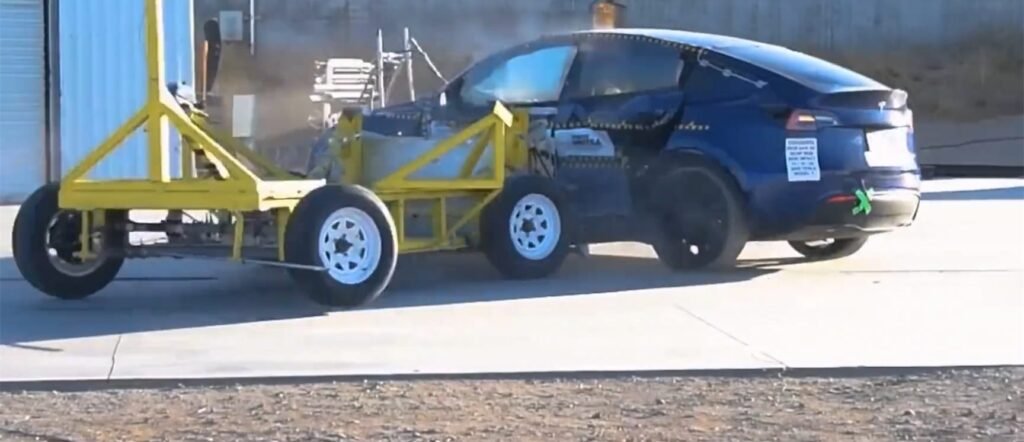
Tesla didn’t just improve the car; they reinvented the manufacturing process. Using 6,000-ton Giga Press machines, the Model Y’s rear underbody is cast as a single piece. This eliminates roughly 370 individual stamped parts and hundreds of robotic weld points.
The “Fluid Metal” Advantage
Traditional cars are like LEGOs held together by glue (welds). Under stress, those joints are weak points. The Model Y’s mega-cast floor pan is essentially a solidified fluid. By removing the seams, Tesla created a structure where stress is distributed across the entire component rather than concentrated at a weld line. The result is a subversive leap in overall anti-twist capability, proving that simplification can lead to superior strength.
| Feature | Traditional Unibody | Tesla Mega-Cast (Model Y) |
|---|---|---|
| Rear Floor Parts | ~70+ stamped pieces | 1 single casting |
| Weld Points | Hundreds of potential failure points | Zero in the main structure |
| Production Time | Hours of assembly | Seconds of casting |
| Structural Integrity | Dependent on weld quality | Homogeneous grain structure |
3. Mercedes-Benz S-Class: The Master of Kinetic Absorption
The Claim: Tai Chi for cars—absorbing tons of energy while the cabin remains a static sanctuary.
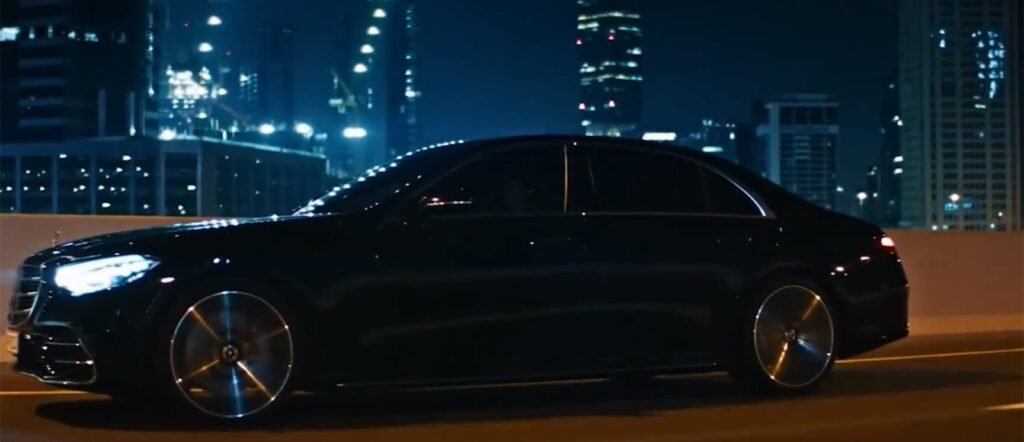
While others focus on raw hardness, Mercedes-Benz focuses on managed deformation. The S-Class doesn’t just resist force; it dictates how force travels. Its front end features a massive, precision aluminum extrusion “crash nucleus.”
The Sponge Effect
In a severe frontal impact, this engineered crumple zone acts like a high-tech sponge, swallowing tons of kinetic energy before it ever reaches the passenger cell. The cost of this system is astronomical, involving complex hydro-formed tubes and multi-phase steel alloys. But the result is a “static barrier” for rear passengers. Even when the front of the car is obliterated, the survival cell experiences almost zero deceleration spike, adhering to absolute principles of statics.
| Safety Mechanism | Function | Outcome in Crash |
|---|---|---|
| Aluminum Extrusion Core | Progressive collapse | Absorbs 60%+ of impact energy instantly |
| Passenger Cell | Ultra-high-strength boron steel | Zero intrusion into cabin space |
| Load Path | Directed around occupants | Forces bypass the human body entirely |
| Rear Seat Safety | “Static Barrier” design | Passengers feel a bump, not a crash |
2. Volvo XC90: The Boron Steel Bible
The Claim: A survival capsule that laughs at truck crushing.
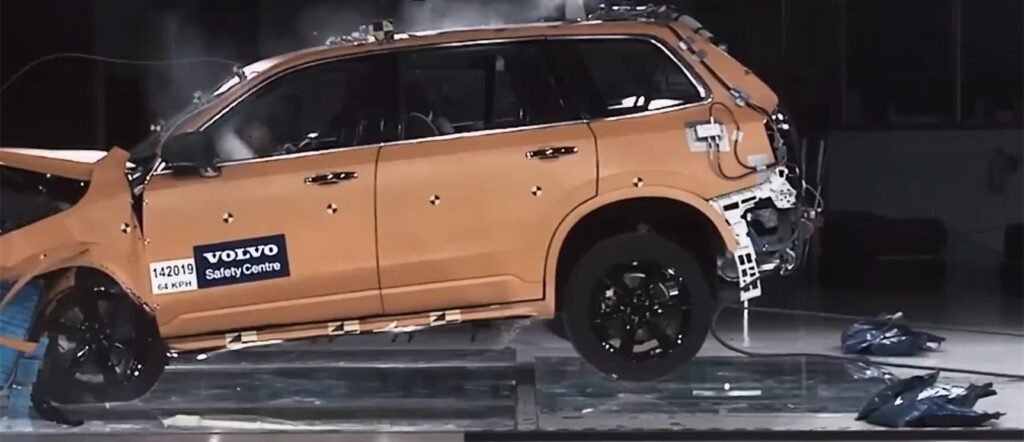
Volvo has long been the preacher of safety, but the XC90 is their magnum opus. Nearly 40% of its body structure is composed of Boron Steel (hot-formed steel with tensile strength up to 1600 MPa). This isn’t just “strong steel”; it’s the kind of metallurgy used in bank vaults.
The Kinetic Anomaly
In offset collision tests, the XC90 performs what physicists might call a “kinetic miracle.” When hit by a much heavier vehicle or rolled over, the boron steel cage refuses to yield. It maintains its geometric integrity so well that it appears to violate standard energy transfer theorems. The “Nordic Tank” reputation is not hyperbole; it is a statistical reality verified by decades of real-world accident data.
| Material Composition | Percentage | Tensile Strength (MPa) | Application Area |
|---|---|---|---|
| Boron Steel | ~40% | 1300 – 1600 | A-pillars, B-pillars, Roof rails, Tunnel |
| High-Strength Steel | ~35% | 800 – 1000 | Front/Rear Crumple zones |
| Mild Steel | ~25% | < 600 | Non-structural panels |
| Result | Survival Capsule | Resists roof crush up to 6x vehicle weight |
1. Cadillac CT5: The “Semi-Truck Slayer”
The Claim: Invincible below a semi-truck; a “one-for-one” exchange above it.
Taking the crown in 2026 is the Cadillac CT5. This sedan has earned a terrifying reputation in engineering circles: “Below a semi-truck, I am invincible; above a semi-truck, we trade one-for-one.”

The 1500 MPa Fortress
Cadillac has woven a roll cage directly into the unibody using 1500 MPa ultra-high-strength steel. This isn’t just reinforcement; it’s a comprehensive exoskeleton. In side-impact and pole tests, the CT5 demonstrates an ability to strangle/neutralize lethal impact forces before they penetrate the (cockpit). It pushes the safety threshold to the absolute limit of current material science, effectively turning a mid-size sedan into a fortress that can withstand impacts that would total most large SUVs.
| Metric | Cadillac CT5 Performance | Industry Average (Luxury Sedan) |
|---|---|---|
| Max Steel Strength | 1500+ MPa | 1000 – 1200 MPa |
| Roll Cage Integration | Full Unibody Fusion | Partial Reinforcement |
| Side Impact Rating | “Good” with zero intrusion | “Good” with minor intrusion |
| Force Neutralization | External Dissipation | Internal Absorption |
Comparative Analysis: The Top 5 Rigidity Showdown
To visualize exactly how these giants stack up, here is a direct comparison of their core structural philosophies and capabilities.
| Rank | Vehicle | Primary Material | Key Tech | Est. Torsional Stiffness (Nm/deg) | Best Use Case |
|---|---|---|---|---|---|
| #1 | Cadillac CT5 | 1500 MPa Steel | Integrated Roll Cage | ~42,000+ | High-speed collision survival |
| #2 | Volvo XC90 | 40% Boron Steel | Hot-Formed Cage | ~38,000 | Rollover & Offset Crash |
| #3 | Mercedes S-Class | Alu/Steel Hybrid | Kinetic Absorption Core | ~36,500 | Passenger Comfort/Safety |
| #4 | Tesla Model Y | Aluminum Alloy | 6000T Mega-Casting | ~35,000+ | Structural Simplicity/EV |
| #5 | Land Rover Defender | Aluminum | Bonded & Riveted D7x | ~30,000 | Extreme Off-Road Flex |
(Note: Exact Nm/deg figures vary by model year and specific trim testing conditions, but the relative ranking reflects 2026 engineering consensus.)
Expert Verdict: What Would the “Super Brain” Engineers Do?
If you gathered the world’s top structural engineers from MIT, RWTH Aachen, and Tsinghua University, their advice wouldn’t be to buy the most expensive car. It would be to understand the load path.
- Don’t trust the badge; trust the material. A car with 40% hot-formed steel (Volvo) will often outperform a heavier car made of mild steel in a catastrophic event.
- Look for the “Seamless” approach. Whether it’s Tesla’s casting or Land Rover’s bonding, reducing joint count reduces failure points.
- Stiffness equals control. A stiffer car doesn’t just save your life in a crash; it keeps you alive by preventing loss of control on the road.
The 2026 lineup proves that we have entered a golden age of structural safety. The Cadillac CT5 taking the #1 spot is a wake-up call: American engineering has leveraged ultra-high-strength steel to create a sedan that offers supercar-level protection at a mainstream price point. Meanwhile, the persistence of aluminum (Land Rover, Tesla) shows that weight reduction and strength are no longer mutually exclusive.
When your life depends on a few millimeters of steel or aluminum, these five vehicles represent the absolute pinnacle of what humanity can currently build.
Frequently Asked Questions (FAQ)
Q: Is a stiffer car always safer? A: Generally, yes, regarding the passenger cell. High rigidity ensures the cabin doesn’t collapse. However, the front and rear must still be designed to crumple (like the Mercedes S-Class) to absorb energy. The ideal car has a soft exterior and an incredibly hard interior.
Q: Can the Tesla Model Y really be as strong as steel cars? A: Yes. While aluminum is lighter, the mega-casting process removes weak points (welds). The structural continuity of a single cast piece often compensates for the lower inherent strength of aluminum compared to boron steel.
Q: Why did the Land Rover Defender drop the ladder frame? A: Ladder frames are great for heavy towing but terrible for torsional rigidity on uneven ground. They twist, which breaks suspension mounts. The D7x aluminum monocoque provides 3x the stiffness, allowing the wheels to move independently while the cabin stays flat.
Q: What does “1500 MPa” mean in the Cadillac CT5? A: MPa stands for Megapascals, a unit of pressure/stress. 1500 MPa steel is roughly four times stronger than standard mild steel used in budget cars. It is extremely difficult to cut or deform without specialized industrial tools.
Q: Are these cars affordable? A: The list ranges from the relatively accessible Tesla Model Y and Cadillac CT5 to the ultra-luxury Mercedes S-Class. However, the safety technology trickles down quickly; expect these materials to appear in cheaper models by 2027-2028.
References & Further Reading
- IIHS Vehicle Ratings 2026 – Insurance Institute for Highway Safety. Detailed breakdown of structural integrity in small overlap front tests. iihs.org
- Euro NCAP Technical Bulletin: Chassis Rigidity and Safety – European New Car Assessment Programme. Analysis of how torsional stiffness correlates with occupant protection. euroncap.com
- Tesla Gigapress Whitepaper – Tesla Inc. Engineering Blog. Deep dive into the structural benefits of single-piece casting. tesla.com/blog
- JLR D7x Architecture Overview – Jaguar Land Rover Technical Publications. Specifications on the bonded aluminum body structure. landrover.com/engineering
- SAE International: Advanced High-Strength Steels (AHSS) – Society of Automotive Engineers. Global standards for 1500 MPa+ steel applications in modern vehicles. sae.org
- 4 Cheap Used Luxury SUVs That Are Shockingly Reliable