For years, the conversation around electric vehicles has been split in two directions. Some brands talk about “the big three features”—premium interiors, giant screens, and endless entertainment. Tesla, in contrast, has built its reputation on an entirely different trio: the battery, the motor, and the control electronics. Most consumers agree that Tesla makes excellent EVs, but surprisingly few understand why.
To answer that question, we need to step behind the showroom and into the machinery, materials science, and software architecture that hold Tesla’s ecosystem together. These are the Eight Manufacturing Pillars that explain Tesla’s scale, efficiency, and technological lead—and how the company sold 1.78 million vehicles in a single year.
1. Battery Architecture: From 18650 to 4680—A Decade of Relentless Reinvention
Tesla’s battery strategy has always been unconventional: adopt early, scale aggressively, validate in mass production, and let the rest of the industry follow.
- 18650 cells proved that cylindrical cells could work in a mass-produced EV.
- 2170 cells pushed density, thermal control, and charging performance into mainstream acceptance.
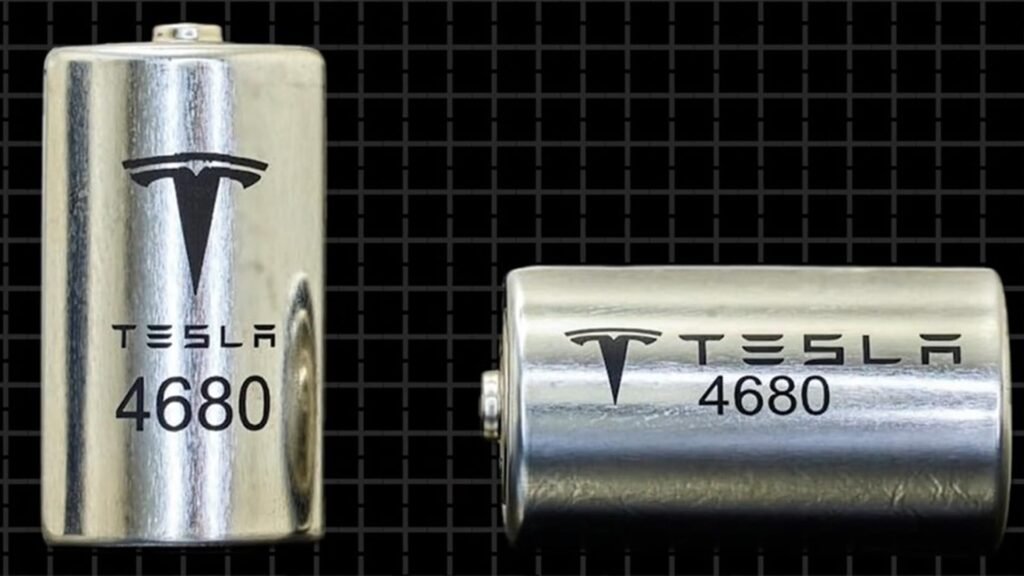
- 4680 cells, now scaling globally, integrate structural functions, fast heat shedding, and simplified manufacturing.
Tesla validates each generation with millions of kilometers of real-world data before competitors even begin adoption. That cycle speed—design, industrialization, iteration—is the core reason Tesla leads battery engineering.
2. High-Density Electric Motors: Carbon-Fiber Sleeves and Instant Torque Mastery
Tesla’s motor engineering is a rare blend of elegant theory and brutal manufacturing discipline. The company’s permanent-magnet synchronous motors use:
- Carbon-fiber rotor sleeves for higher rotational stability
- Concentrated-winding stators for thermal efficiency
- Power densities starting around 2.5 kW per kilogram
This is how a production Model S Plaid manages 0–100 km/h in barely over 2 seconds, a metric once reserved for million-dollar hypercars.
Tesla’s motor supply chain includes Taiwan’s Futian Motor Technology and China’s Zhongke Sanhuan, but the assembly integration, cooling strategy, and electromagnetic design remain Tesla’s proprietary strengths.
3. Power Electronics: Tesla’s Most Guarded Advantage
The battery and motor supply chains can be traced.
The power electronics cannot.
Tesla’s inverters and drive modules remain the least publicized part of its architecture—for good reason. They determine:
- Charging efficiency
- Motor torque behavior
- Real-world range
- Battery lifespan
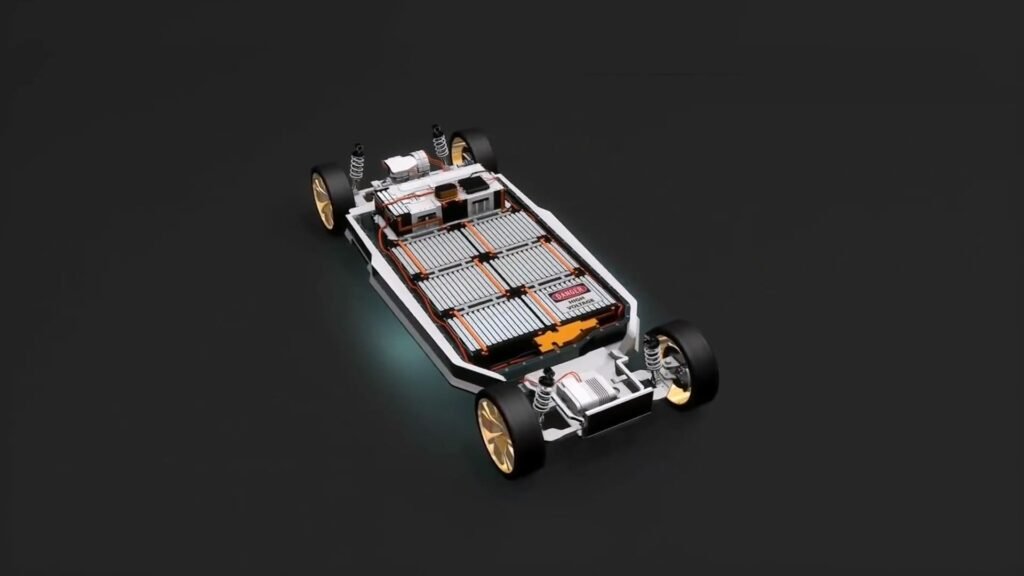
Tesla uses Infineon SiC MOSFETs, but the performance comes from Tesla’s own drive-unit design, which consolidates inverter, motor, and reduction gearbox into a single compact module. This three-in-one architecture enables:
- Shorter signal paths
- Faster thermal dissipation
- Higher switching efficiency
The result: even with the same battery pack, a Tesla typically delivers longer range and slower degradation than rival EVs using equivalent chemistry.
4. Tesla’s AI Stack: FSD as an Industrial Capability, Not a Feature
If the first decade of EVs was a hardware race, the second decade is a software war.
Tesla entered early—and aggressively.
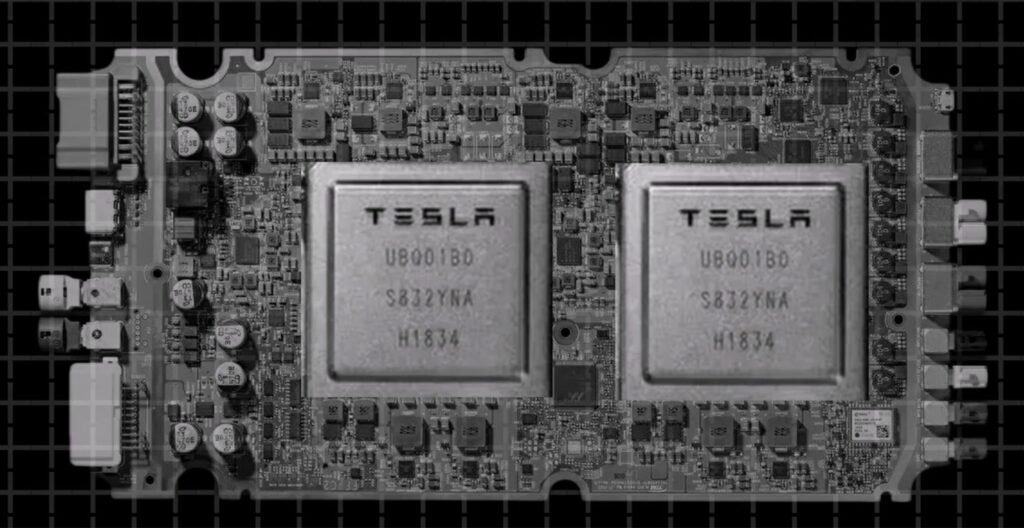
Its vision-based FSD system relies on neural networks trained on billions of real-world miles, rather than high-precision maps. The company’s vector-space planning engine interprets the environment in real time, then translates that into incredibly accurate throttle, brake, and steering control through its proprietary drive electronics.
Tesla’s autonomous hardware has now reached HW4.0, powered by the second generation of Tesla’s FSD computing chips, built on TSMC’s 4-nanometer process.
This is not just an ADAS feature—it is a vertically integrated AI infrastructure.
5. Sentry Mode: Real-Time Sensor Fusion at Consumer Scale
Sentry Mode feels simple on the surface: eight cameras, ultrasonic sensors, onboard storage, and live monitoring. But the enabling technology is anything but simple:
- Multi-camera synchronization
- Millisecond-level decision processing
- Dedicated compute channels to avoid interfering with drive functions
- Power-management firmware to prevent battery drain
It’s a feature only possible because Tesla controls the entire software stack—from the kernel to the AI inference engine. In practice, Sentry Mode is a showcase of Tesla’s sensor integration and distributed computing capabilities.

6. Gigacasting: The Industrial Revolution Hidden in One Press
A Tesla body is stiff not only because of high-strength steel and hot-formed components, but also because of a manufacturing technique few automakers dared to attempt: gigacasting.
Traditional rear underbodies use more than 250 stamped and welded parts.
Tesla compresses that into three massive castings.
This breakthrough was enabled by Idra Group, the Italian machinery company now under China’s LK Group, which built:
- 6,000-ton Gigapress machines for Model Y
- 9,000-ton units for the Cybertruck using ultra-hard 30X cold-rolled stainless steel
Gigacasting reduces:
- Manufacturing steps
- Tolerance stacking
- Part failures
- Assembly cost
- Structural inconsistency
It is arguably the most disruptive change to automotive body construction in half a century.
7. Supercharging: The World’s Largest High-Power Charging Network
Tesla’s charging strategy reflects an important truth: an EV is only as usable as its charging infrastructure. Tesla now operates 70,000+ V3 chargers worldwide, each capable of:
- 250 kW peak power
- ~250 km of range in about 15 minutes
Unlike competing networks, Tesla designs the hardware, the software, the payment layer, and the grid interface. The charging ecosystem is not an accessory—it is an extension of the vehicle’s electrical architecture.
8. The Gigafactory: Tesla’s Final Advantage and Its Hardest to Copy
Many automakers speak of “gigafactories,” but few operate true high-integration EV factories at scale.
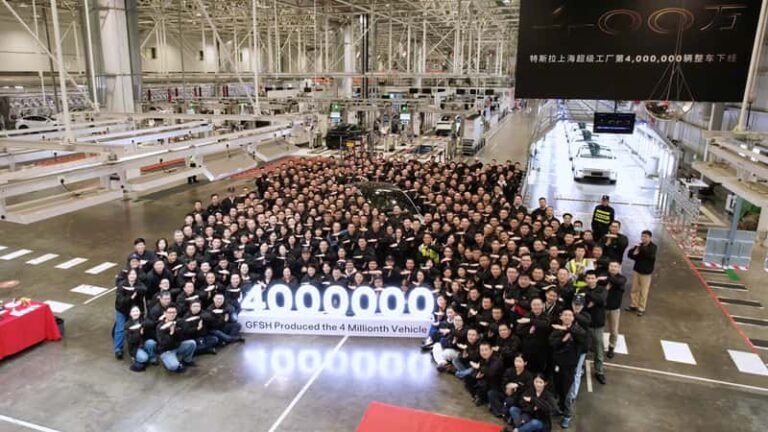
Tesla runs seven, including the benchmark Shanghai facility.
A Gigafactory is not merely a large plant—it is:
- A closed-loop materials system
- Highly automated manufacturing (Shanghai reaches 95%)
- MFS (Modular Flow System) logistics
- Massive robotics investment from KUKA, FANUC, and ABB
- Integrated battery, motor, and electronics production lines
- Real-time data analytics for yield control
The Shanghai Gigafactory alone cost approximately 7.1 billion dollars, but it simultaneously became the world’s most efficient electric-vehicle plant. Tesla’s ability to produce at this scale is not a side effect of growth—it is a manufacturing philosophy.
Tesla Manufactures Differently
Tesla’s advantage isn’t a single technology. It is the interlocking nature of all eight pillars:
- A battery architecture built for continuous evolution
- Motors with aerospace-grade engineering discipline
- Power electronics tuned at the firmware level
- AI systems trained at planetary scale
- Real-time sensor fusion that runs on car-grade hardware
- Structural gigacastings that rewrite the rules of auto body engineering
- The world’s most complete fast-charging network
- Factories that function as software-driven machines
While other brands compete on features, Tesla competes on manufacturing intelligence.
This is why its vehicles have longer range, lighter powertrains, lower complexity, and higher production throughput. And it is why Tesla continues to define the EV benchmark, year after year.
Reference: