Is a hybrid car actually better than a gas or electric vehicle? An experienced automotive reviewer breaks down costs, performance, reliability, and real-world ownership to help you decide honestly.
The Honest Answer First:
A hybrid is better for most people — not all people.
- Better than gas for daily efficiency and comfort
- Easier than electric for real-world ownership
- Less risky than new EV platforms
- More refined than traditional engines
But if:
- You drive mostly highways → gas may be fine
- You can charge daily and drive short distances → EV may be better
- You change cars every 2 years → cost recovery may not matter
The Honest Question
“Is a hybrid car better?”
Not cleaner.
Not trendier.
Not politically correct.
Better — for real life.
After reviewing hundreds of vehicles, driving hybrids across cities, highways, winters, and long road trips, the answer is not a simple yes or no.
It depends on how you drive, where you live, and what you expect from a car.
So let’s be honest — no marketing language, no ideology, no hype.
What “Better” Actually Means in 2026
When most buyers ask if a hybrid is better, they’re really asking four things:
- Will it save me money?
- Is it reliable long-term?
- Does it drive better or worse?
- Is it less hassle than gas or electric?
Let’s evaluate hybrids against those exact standards.
Hybrid vs Gas vs Electric — Real-World Comparison
| Category | Hybrid | Gas | Electric |
|---|---|---|---|
| Fuel Cost | ⭐⭐⭐⭐☆ | ⭐⭐ | ⭐⭐⭐⭐⭐ |
| Maintenance | ⭐⭐⭐⭐☆ | ⭐⭐ | ⭐⭐⭐⭐ |
| Driving Ease | ⭐⭐⭐⭐☆ | ⭐⭐⭐ | ⭐⭐⭐⭐⭐ |
| Range Anxiety | None | None | Present |
| Cold Weather Reliability | ⭐⭐⭐⭐☆ | ⭐⭐⭐⭐⭐ | ⭐⭐ |
| Long-Term Proven Tech | ⭐⭐⭐⭐⭐ | ⭐⭐⭐⭐⭐ | ⭐⭐⭐ |
| Charging Required | No (PHEV optional) | No | Yes |
Key takeaway:
A hybrid is not the best at everything — but it is the least compromised choice.
The Real Advantages of a Hybrid (No Sales Talk)
| Benefits of Hybrids | Details |
|---|---|
| Fuel Savings That Actually Show Up | In city and mixed driving, hybrids consistently reduce fuel consumption by 25–45% compared to similar gas vehicles. That’s not theoretical — that’s everyday traffic. |
| Smoother, Calmer Driving | Electric motors handle low-speed movement better than engines, resulting in: • No jerky starts • Less engine noise • Less stress in traffic Once you live with it, it’s hard to go back. |
| Proven Reliability (Yes, Really) | Modern hybrid systems — especially from Japanese and Korean manufacturers — have fewer wear components: • Less brake wear (regenerative braking) • Less engine stress • Fewer transmission issues High-mileage hybrids are common. |
| No Lifestyle Change Required | Unlike EVs: • No charging planning • No infrastructure dependency • No range anxiety A hybrid behaves like a normal car — just smarter. |
The Honest Downsides of Hybrids
A fair review must include what hybrids don’t do well.
| Downsides of Hybrids | Details |
|---|---|
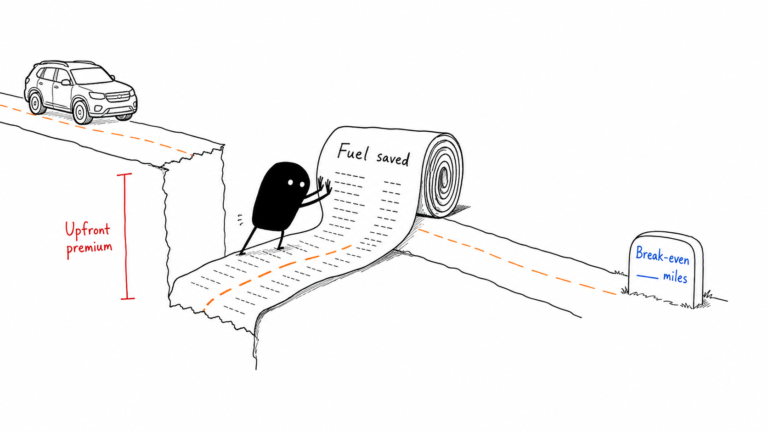
| Higher Purchase Price | A hybrid typically costs $1,500–$4,000 more than its gas equivalent. You recover this over time — but not instantly. |
| Smaller Highway Advantage | At steady highway speeds, hybrids lose much of their efficiency edge. If you drive 90% highway, the benefit shrinks. |
| Not “Future-Proof” Like EVs | Hybrids are a bridge technology, not a long-term replacement for fully electric vehicles. |
Hybrid Types Matter (This Changes the Answer)
| Type | What It Means | Who It’s For |
|---|---|---|
| HEV (Full Hybrid) | Self-charging | Most drivers |
| PHEV (Plug-in Hybrid) | Short electric range | Home chargers |
| MHEV (Mild Hybrid) | Engine assist only | Don’t count it |
Important: Mild hybrids are not true hybrids.
They save a little fuel — nothing more.
Ownership Cost Comparison (5-Year Average)
| Vehicle Type | Fuel | Maintenance | Total Cost |
|---|---|---|---|
| Gas | High | Medium | $$$$ |
| Hybrid | Medium | Low | $$$ |
| Electric | Very Low | Very Low | $$ (if charging is easy) |
Hybrid ownership is predictable.
EV ownership can be cheaper — if conditions are right.
Best Hybrid Cars — Real-World Scores
| Model | Type | MPG / MPGe | Reliability | Overall Score |
|---|---|---|---|---|
| Toyota RAV4 Hybrid | HEV | ~40 MPG | Excellent | 9.4 |
| Honda CR-V Hybrid | HEV | ~38 MPG | Excellent | 9.2 |
| Lexus RX Hybrid | HEV/PHEV | ~30 MPG | Excellent | 9.0 |
| Hyundai Tucson Hybrid | HEV | ~38 MPG | Very Good | 8.9 |
| Volvo XC90 Recharge | PHEV | ~58 MPGe | Good | 8.6 |
Final Verdict — No Marketing, Just Reality
A hybrid car is not exciting technology.
It’s not revolutionary.
It doesn’t demand attention.
And that’s exactly why it works.
Hybrid cars are the smartest compromise the industry has produced so far.
If your goal is lower stress, lower fuel bills, and fewer lifestyle changes, a hybrid isn’t just better — it’s the most sensible choice available today.
Reference: