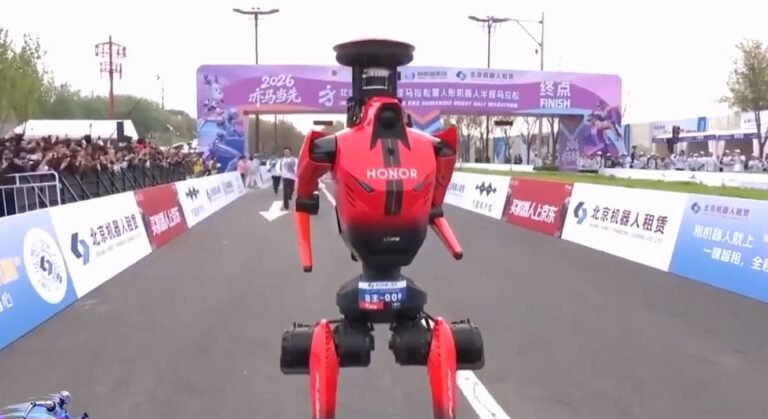
Quick take: Robotics is no longer niche engineering; it is the connective tissue linking semiconductors, energy, critical minerals, advanced manufacturing, logistics and artificial intelligence into a single strategic ecosystem. The combination of surging deployments, policy prioritization, and AI-driven capability advances means robotics will be a primary driver of U.S. competitiveness, supply-chain resilience, and productivity over the next decade. This article explains why, synthesizes the latest evidence, and gives practical guidance for corporate leaders, investors, and policymakers.
Robotics Industry 2026–2030: Why Robotics Will Be America’s Strategic Industry — Market Growth, Policy Shifts, and Actionable Steps for Business & Government
- Global factory robot deployments have more than doubled over the last decade and installations topped 500,000 units in 2024 — a trend that is accelerating.
- U.S. policy is explicitly treating robotics and embodied AI as a national-competitiveness priority, linking industrial policy to supply-chain security and reshoring.
- McKinsey and other analysts estimate trillions in economic value if organizations redesign workflows to pair humans, agents and robots; failure to adapt creates large strategic risk.
- Recommendation snapshot: (1) Treat robotics as strategic CapEx + R&D priority; (2) invest in human-robot workflow redesign and upskilling; (3) de-risk supply chains for key components; (4) engage with federal programs to access funding and standards.

1. The evidence: market momentum and capability convergence
Two concrete datapoints anchor the case. First, industrial robot installations have surged — the International Federation of Robotics reports 542,000 units installed worldwide in 2024 (more than double ten years prior) and sustained annual installations above 500k. That scale shift is structurally changing manufacturing footprints.
Second, advances in AI — especially generative models, perception stacks, and integrated edge/cloud orchestration — have materially increased the usefulness of robots beyond repetitive, fixed tasks into adaptable, semi-autonomous roles (collaborative robots, mobile manipulators, logistics bots). When AI is embedded into physical systems (“embodied AI”), the result is a multiplication of value: robots can perceive complex environments, make decisions locally, and coordinate at scale. This convergence is precisely why policy makers now treat robotics as strategic infrastructure.
2. Why this matters for U.S. strategy (manufacturing, defense, and supply chains)
Robotics is not only a productivity play; it is a national-security and economic-resilience instrument. The U.S. “AI Action Plan” and related executive priorities explicitly link robotics, drones, and semiconductor supply-chains to national economic security and reshoring initiatives. Those documents fund convening, supply-chain mapping, and manufacturing incentives to onshore critical nodes — and they place robotics at the center of that effort. For firms and regions, robotics becomes the lever for attracting on-shoring investment and shortening fragile supply chains.
3. Business implications: winners and losers
- Winners will be organizations that treat robotics as a systems problem, not an equipment purchase. That means redesigning work around human-robot teams, investing in tooling, controls, and software, and reshaping talent pipelines. McKinsey projects that redesigning workflows around agents, robots and people could unlock trillions in U.S. economic value by 2030 — but realizing it requires organizational change, not bolt-on automation.
- Losers will be companies that underinvest in embodied AI or that outsource critical subsystems to geopolitically risky suppliers without mitigation. The IFR data show Asia dominating deployment; U.S. competitiveness will depend on a combination of domestic manufacturing, favorable policy, and supply-chain diversification.
4. Technology trends to watch (2026–2030)
- Embodied AI becomes commodity — perception + decision stacks packaged with mobility and manipulation. This shifts procurement from mechanical selection to software/subscription models.
- Cobot and mobile-manipulator proliferation — collaborative robots will expand beyond assembly to warehousing, last-mile handling, and light construction tasks.
- Edge-cloud orchestration — latency-sensitive control loops shift to hybrid edge architectures; energy and data center capacity become bottlenecks. (Investor coverage already highlights AI energy demand as a near-term market constraint.)
- Standards, safety, and human-machine teaming — regulatory and interoperability frameworks will determine speed of adoption in safety-critical industries.
5. Practical roadmap for corporate leaders (operations, manufacturing, logistics)
Phase A — Strategic alignment (0–12 months)
- Appoint a robotics/automation strategy lead reporting to the COO or CTO.
- Map business processes to identify 12–18 month pilots with clear KPIs (throughput, OEE, safety incidents, labor savings).
- Audit supply-chain risk for actuators, sensors, semiconductors, and power modules; categorize items by criticality and substitute risk.
Phase B — Pilot & workforce redesign (12–24 months)
- Start pilots focused on human-robot workflows; measure task redesign benefits, not just headcount reduction.
- Build a reskilling plan: technicians, integrators, and “robotic workflow designers.” Trade schools and community colleges should be partners.
Phase C — Scale & supply resilience (24–60 months)
- Move from point automation to platform investments (control stacks, fleet management, OTA updates).
- Lock supply with multi-sourcing, domestic partners, and engagement in federal programs to finance capacity.
6. Investment and policy considerations
For investors, robotics is a platform bet: choose companies with strong software-first strategies, recurring service revenue, and control of critical components (perception stacks, fleet software, ASIC or GPU partnerships). For policymakers, the priority is coordinated incentives that fund manufacturing capacity, workforce training, and standardization while avoiding narrow protectionism that stifles ecosystems.
The U.S. policy agenda already reflects that synthesis: federal plans focus on supply-chain mapping, standards, and funding mechanisms to lower adoption friction for both commercial and defense use cases. Engaging with these programs is not optional — it is a competitive necessity.

7. Risks and realistic timelines
- Hype vs. reality: Humanoid generalists remain a long-term prospect; near-term value will come from domain-specific embodied systems. Industry signals (summits, venture rounds) show excitement, but deployment realities — integration, safety certs, and ROI proofs — will pace adoption.
- Labor market friction: Rapid automation without workforce transition policies creates social and operational disruption; successful adopters combine automation with robust retraining.
8. Ten concrete actions (checklist for executives & policymakers)
- Publish a 3-year robotics adoption roadmap aligned with business KPIs.
- Create a capital envelope for pilots + platform investments.
- Partner with community colleges for technician pipelines.
- Map component supply chains; identify single-source risks.
- Prioritize software and systems vendors with update/service revenue models.
- Pilot human-robot teaming in low-risk facilities (logistics, kitting).
- Engage with federal robotics consortia to access funding and standards.
- Measure outcomes in workflow-level KPIs, not just headcount.
- Prepare energy plans for increased compute and charging loads.
- Communicate transparently with employees and communities about transition plans.

Conclusion — the strategic choice
Robotics will not merely reshape factories; it will rewrite the geography of manufacturing, the architecture of supply chains, and the boundaries of what companies can do profitably in the U.S. The technology is already at scale globally; policy and capital are aligning to make the United States a place where the embodied-AI economy can be built and defended. For leaders, the choice is simple: treat robotics as strategic infrastructure now, or watch competitors capture the long-term productivity, security, and market advantages that come with it.