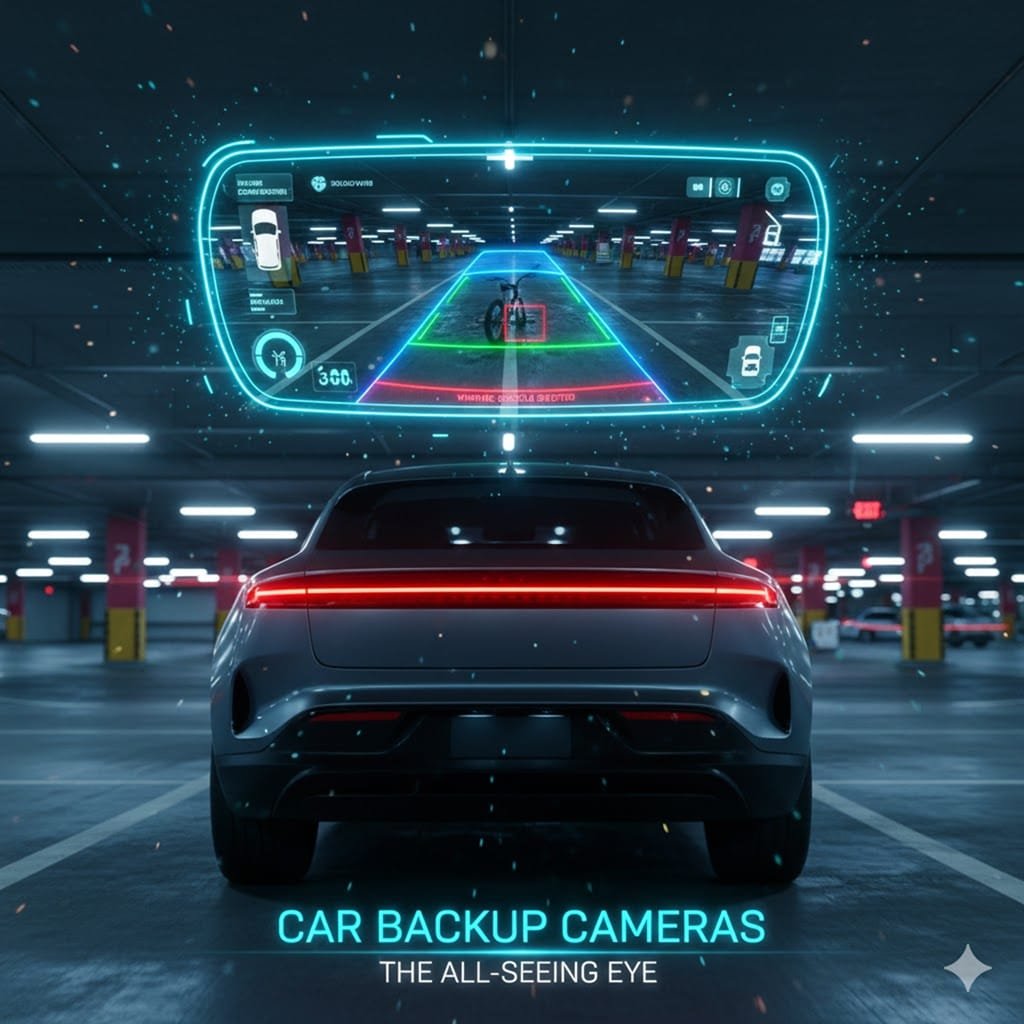
Since May 2018, every new car sold in the United States has been required by law to feature a rearview monitoring system. On paper, the mandate was a victory for safety, designed to eliminate the “blind zone” behind a vehicle. Yet, insurance data and accident reports tell a more complicated story: backup accidents haven’t disappeared—they’ve evolved.
While car backup cameras are an invaluable tool, relying on them as a primary safety net is a dangerous gamble. Here is a deep dive into the technical, psychological, and environmental reasons why that little screen on your dash isn’t a fail-safe.
1. The “Monitor Blindness” Phenomenon
The most significant hurdle to safety isn’t the technology; it’s human psychology. Safety experts call it “Cognitive Tunneling.”
When a driver stares at the backup camera screen, their peripheral vision effectively shuts down. They become so hyper-focused on the 7-to-10-inch display that they fail to notice cross-traffic, cyclists approaching from the side, or even the front-end swing of their own vehicle.
- The Front-Swing Risk: In a tight turn while reversing, the front of your car swings outward. If your eyes are glued to the camera, you won’t see your front bumper scraping a parked car or a garage pillar.
2. Lens Distortion and “The Fish-Eye Effect”
To provide a wide field of view, backup cameras use wide-angle (fish-eye) lenses. While this captures more area, it severely distorts depth perception.
Objects in the camera often appear further away than they actually are. By the time a stationary object looks “close” on the screen, your rear bumper may already be inches from impact. This distortion is particularly dangerous when estimating the speed of an approaching pedestrian or a car driving through a parking lot.
3. The “Blind Zone” vs. The “Blind Spot”
A backup camera eliminates the area directly behind the rear bumper, but it creates new vulnerabilities. Most cameras are mounted low (near the license plate). This positioning means:
- High-Level Obstacles: Overhanging items like a low-hanging tree branch or a truck’s open liftgate may be completely invisible to a camera angled toward the ground.
- The “A-Pillar” Shadow: As you turn while backing up, the pillars of your car still create massive blind spots that the camera cannot see.
Technical Limitations: Why Hardware Fails
Even the best hardware has a “breaking point.” Depending on the weather or the time of day, your camera’s effectiveness can drop by over 50%.
Environmental Factors Comparison
| Condition | Impact on Camera Performance | Driver Risk Level |
| Heavy Rain/Snow | Water droplets on the lens create a “blurred” or “streaked” image. | High |
| Direct Sunlight | “Sun Flare” can wash out the sensor, rendering the screen white. | Medium |
| Low Light/Night | Budget sensors produce “grainy” video with poor contrast. | Very High |
| Mud/Road Salt | Can completely coat the lens, requiring manual cleaning. | High |
4. The False Sense of Security (Risk Compensation)
There is a concept in behavioral economics called Risk Compensation. As cars get safer, drivers tend to take more risks. Before cameras, drivers performed a “360-degree walk-around” or at least turned their heads to check all mirrors and windows.
Today, many drivers shift into reverse and move immediately, trusting the camera to alert them. This “passive” driving style ignores the fact that a child or a pet can dart into the path of a moving vehicle faster than a human can react to a digital screen.
5. System Latency and “Freeze” Bugs
Modern infotainment systems are essentially computers. Like any computer, they can lag. A half-second delay (latency) between the actual movement and the image appearing on the screen might not seem like much, but at 5 mph, your car travels several feet in that window. In rare cases, the software may even freeze on a “still” image, leading the driver to believe the path is clear when it isn’t.
How to Actually Stay Safe: The “Hybrid” Approach
To prevent being a statistic, you must treat the backup camera as a secondary tool, not a primary one.
- The 360-Degree Sweep: Before entering the car, walk around the rear. Check for toys, pets, or low-lying debris.
- The “Look-Back” Method: Physically turn your head and use your mirrors. Use the camera only to check the final 2-3 feet of clearance behind the bumper.
- Clean the Lens: Make it a habit to wipe the camera lens with a microfiber cloth once a week, especially during winter months.
- Listen to the Beeps: If your car has ultrasonic parking sensors (the “beeping” alerts), trust your ears over your eyes. Those sensors use sound waves and are often more reliable than a rain-blurred camera.
Is Your Current Vehicle Truly Protected?
While backup cameras are standard, many older vehicles lack Rear Cross-Traffic Alert (RCTA) and Automatic Emergency Braking (Reverse). These are the “active” versions of the technology that can actually stop the car for you.
Useful Links: