For years, the automotive world was divided into two camps: the raw, mechanical soul of Internal Combustion Engines (ICE) and the silent, torque-heavy promise of Electric Vehicles (EV). But the real revolution didn’t happen at either extreme. It happened in the middle.
Hybrid technology, once mocked as a niche experiment for the eco-conscious, has evolved into a sophisticated mechanical symphony. But how do these systems—ranging from mild-hybrids to plug-in powerhouses—actually manage the handoff between gas and electrons?
Let’s pull back the curtain on the complex architecture of modern hybrid powertrains.
The Core Philosophy: Harmonizing Two Worlds
At its simplest, a hybrid vehicle is an exercise in efficiency optimization. An internal combustion engine is notoriously inefficient in stop-and-go traffic, while electric motors struggle with the energy density required for long-distance, high-speed cruising.
A hybrid engine works by intelligently toggling between these two power sources (or using them in tandem) to ensure the engine always operates in its “sweet spot.”
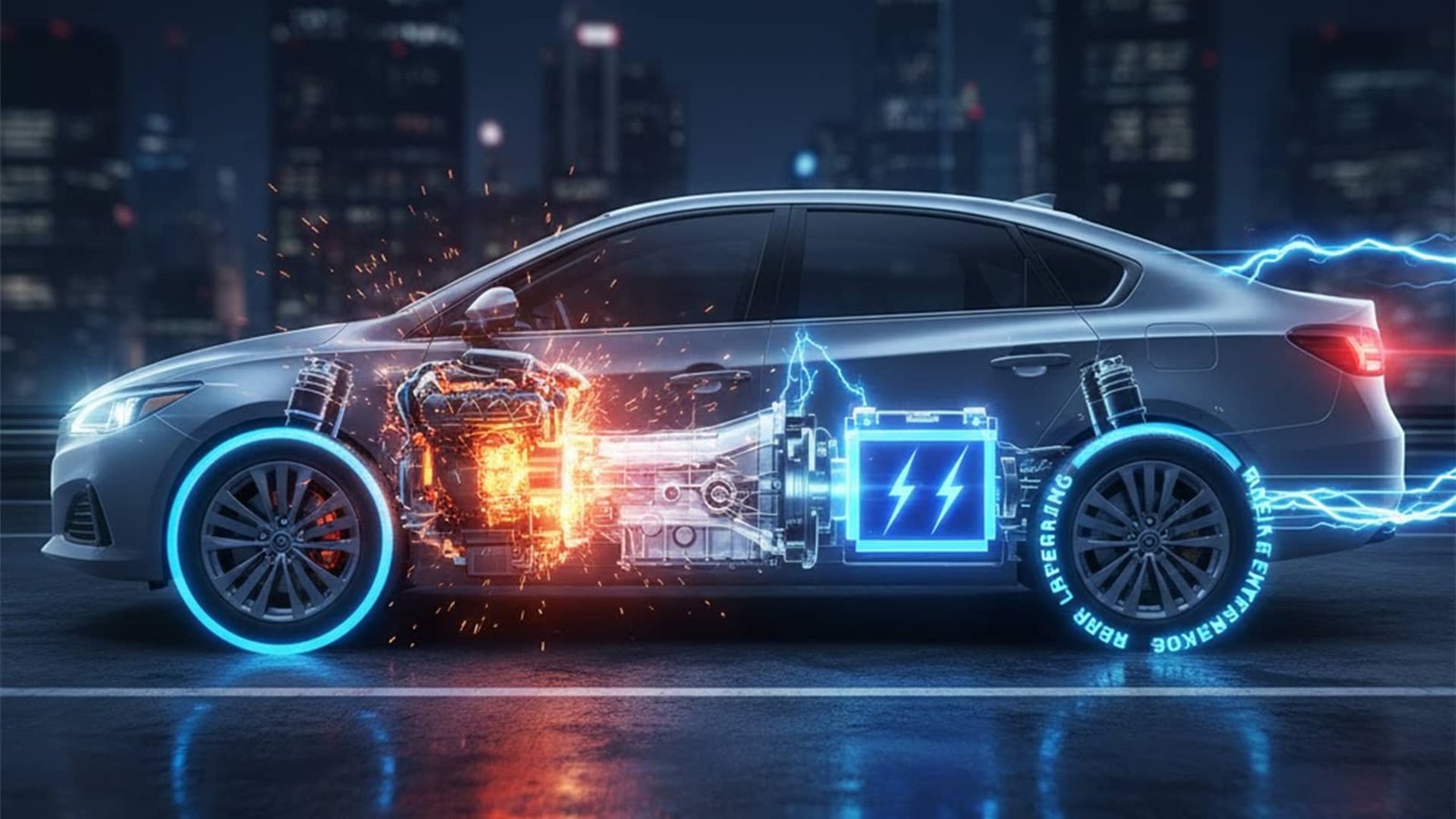
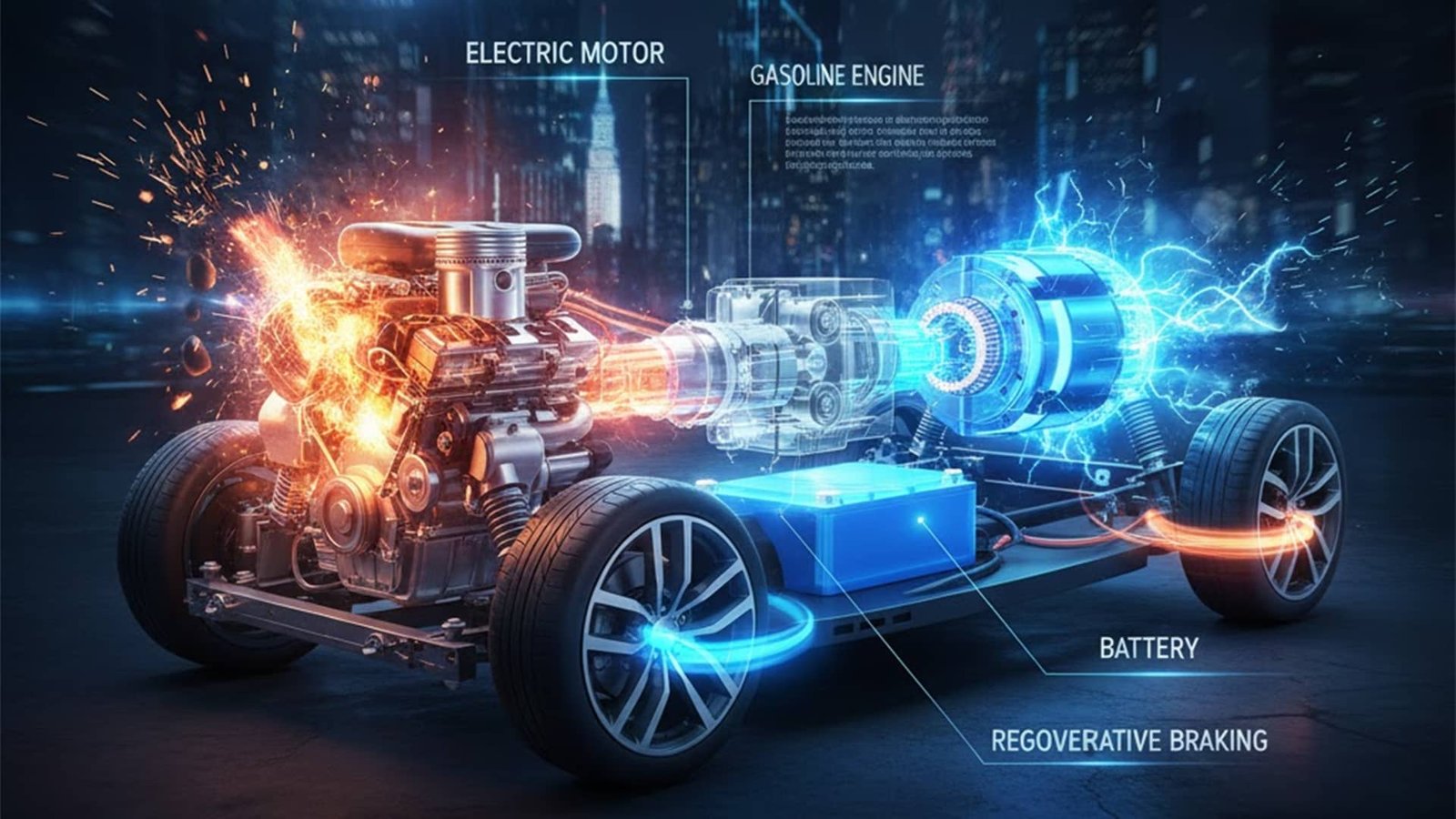
1. The Regenerative Braking Loop
In a traditional car, braking converts kinetic energy into wasted heat through friction. In a hybrid, the electric motor runs in reverse during deceleration. It acts as a generator, capturing that kinetic energy and trickling it back into the high-voltage battery. This is “free” energy that would otherwise be lost to the atmosphere.
2. The Power Split Device (The “Brain”)
The magic happens in the transmission—often a Planetary Gear Set or a Power Split Device. Unlike a standard gearbox, this system manages the torque flow from the engine and the motor simultaneously. It decides whether to send power to the wheels, to the generator to charge the battery, or both.
The Three Pillars of Hybrid Architecture
Not all hybrids are created equal. Depending on the mechanical layout, the driving experience and efficiency gains vary wildly.
Parallel Hybrids
In this setup, both the engine and the electric motor are connected to a common transmission. They can power the car individually or together. This is the “muscle” approach, often found in performance hybrids where the electric motor provides a “torque fill” to eliminate turbo lag.
Series Hybrids
Here, the engine never actually drives the wheels. It acts solely as an onboard generator to charge the battery, which then powers the electric motor. It feels exactly like an EV, but you fill it with gas.
Series-Parallel (Power-Split) Hybrids
This is the gold standard (popularized by brands like Toyota and Hyundai). The system can operate in series mode, parallel mode, or all-electric mode. It is the most complex to engineer but offers the highest thermal efficiency.
Technical Comparison: Hybrid Types at a Glance
| Feature | Mild Hybrid (MHEV) | Full Hybrid (HEV) | Plug-in Hybrid (PHEV) |
| Primary Power Source | Gas Engine | Gas + Electric | Electric + Gas |
| EV-Only Range | None (Assist only) | Short (1–2 miles) | Long (20–50 miles) |
| Charging Method | Regenerative Only | Regenerative Only | Plug + Regenerative |
| Battery Size | Very Small (48V) | Medium | Large |
| Best For | Fuel savings on a budget | City commuting | Short commutes with zero gas |
Why Modern Hybrids Feel Different: NVH and Torque
If you’ve driven a modern hybrid like the Hyundai IONIQ or a Lexus HW, you’ve noticed the transition between the engine and motor is nearly invisible. This is achieved through Active Control Transmission (ACT) technology.
Engineers use the electric motor to “revolution-match” the engine’s crankshaft speed before the clutch engages. This eliminates the “jerk” traditionally associated with shifting gears or starting an engine. Furthermore, because electric motors provide 100% of their torque at 0 RPM, hybrids offer a “punchy” off-the-line acceleration that traditional 4-cylinder engines simply can’t match.
The Verdict: Is a Hybrid Right for You?
The decision to go hybrid isn’t just about saving the planet; it’s about mechanical logic.
- Choose a Full Hybrid (HEV) if you live in an apartment without charging access and spend most of your time in urban traffic.
- Choose a Plug-in Hybrid (PHEV) if you have a home charger and a commute under 30 miles. You will effectively own an EV for daily use and a long-range cruiser for road trips.
The hybrid engine is no longer a compromise—it is the peak of internal combustion refinement. By bridging the gap between fossil fuels and pure electricity, it offers a level of redundancy and efficiency that represents the smartest engineering in the automotive world today.
Useful Links: