
The luxury electric vehicle market has reached an inflection point. While Tesla dominates headlines with acceleration figures and Lucid chases range records, Cadillac just unveiled something fundamentally different at The Quail during Monterey Car Week 2025. The Elevated Velocity concept isn’t competing on traditional metrics—it’s redefining what a luxury electric vehicle should deliver.
This 2+2 electric crossover blends V-Series performance DNA with spa-level wellness technology, self-cleaning bodywork, and design language that feels pulled from 2035 rather than 2025. The question isn’t whether this concept will reach production unchanged—it won’t. The real question is which features will trickle down to future Cadillacs, and whether competitors should be worried.
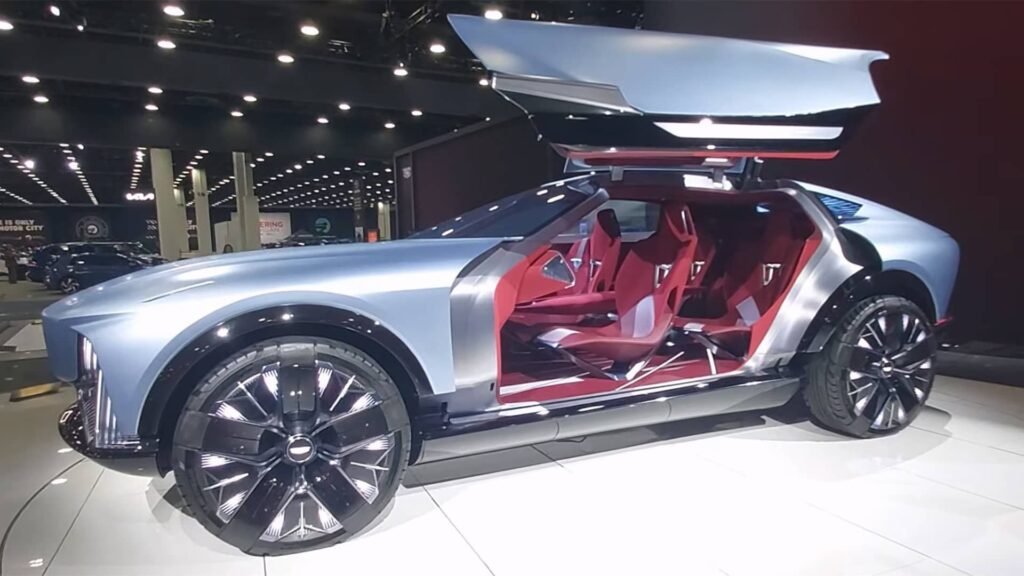
Why the Elevated Velocity Matters Beyond Concept Car Theater
Concept cars typically serve as rolling mood boards—visual exercises that never touch public roads. The Elevated Velocity breaks this pattern. Cadillac has made explicit statements about which technologies are production-intent versus purely conceptual.
| Feature Category | Production Intent | Timeline Expectation |
|---|---|---|
| Self-Cleaning Body Technology | High | 2027-2028 models |
| Sand Vision Thermal Imaging | Medium | 2026 Escalade IQ refresh |
| Wellness Mode (Light Therapy) | Medium | 2027 Celestiq variants |
| 24-Inch Wheel Design | Low | Scaled to 22-inch production |
| Gull-Wing Door Mechanism | Low | Traditional doors retained |
| Retractable Steering Wheel | Medium | Level 4 autonomy readiness |
| Three-Mode Interior System | High | 2026-2027 V-Series EVs |
This distinction matters. When Cadillac showcases technology at The Quail—a venue reserved for the world’s most significant automotive debuts—they’re signaling intent to investors, competitors, and potential buyers.
Design Language: When Off-Road Capability Meets Evening Wear
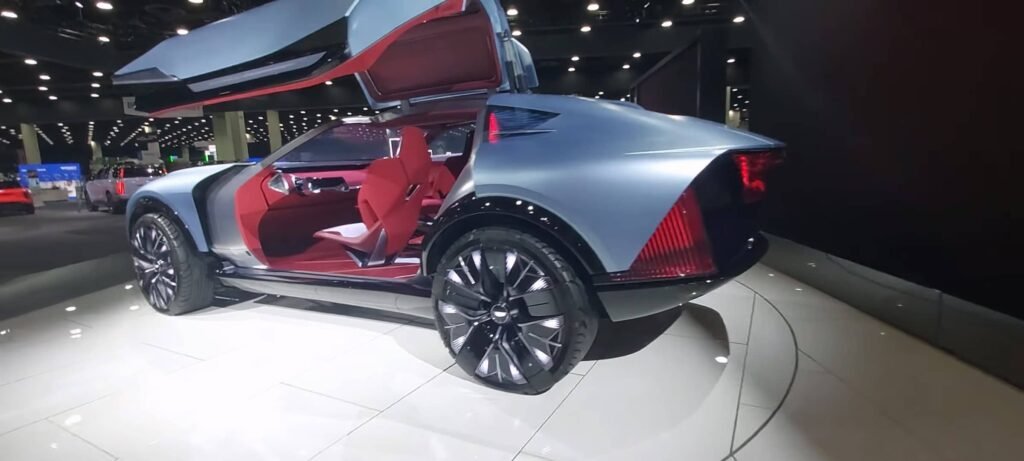
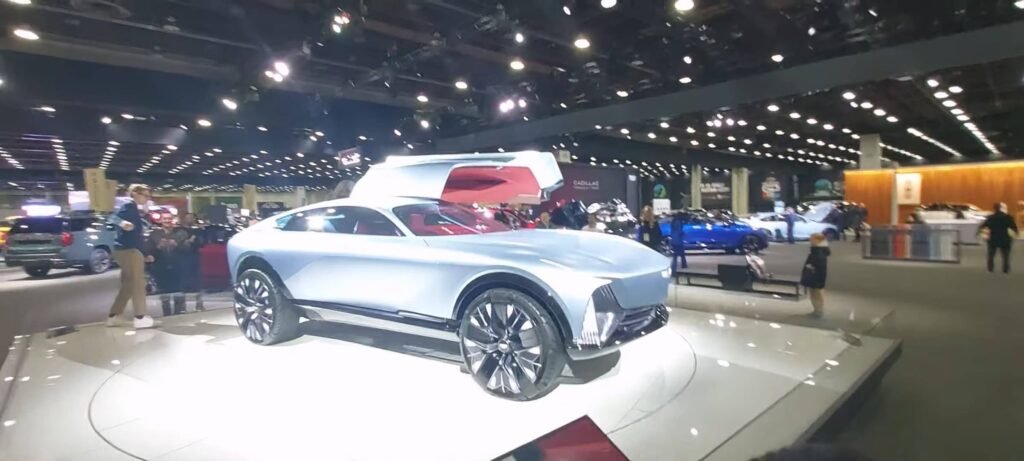
The Elevated Velocity’s exterior creates visual tension that shouldn’t work but does. It sits higher than a traditional GT coupe while maintaining proportions that suggest performance rather than utility. The stance communicates capability without sacrificing elegance.
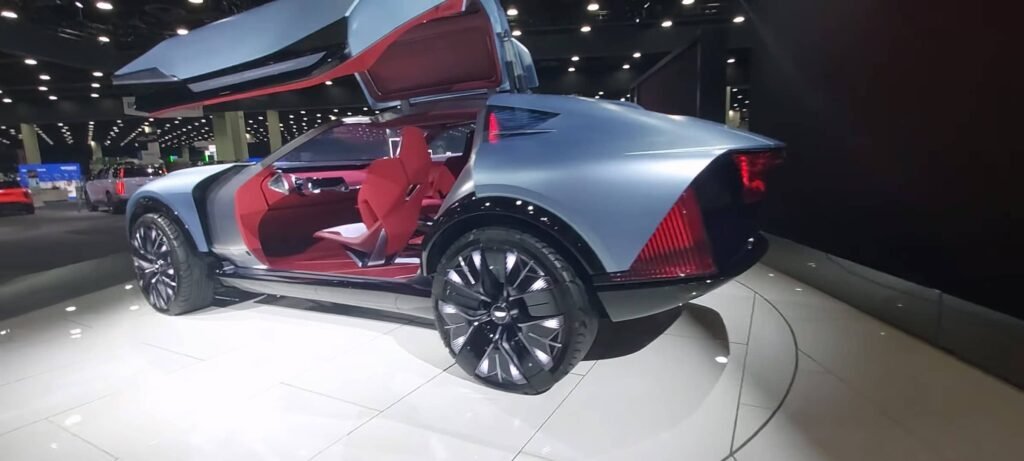
Exterior Specifications
| Dimension | Measurement | Comparison Benchmark |
|---|---|---|
| Wheel Size | 24 inches | Largest ever on Cadillac |
| Wheel Material | Flax fiber composite | 40% lighter than aluminum |
| Wheel Finish | Black crystal acrylic | Custom formulation |
| Paint Color | Vapor Blue | Glacier-inspired color-shift |
| Door Type | Gull-wing | Theatrical entry experience |
| B-Pillar | Hidden | Clean side profile |
| Ground Clearance | Variable (air suspension) | Off-road capable |
The Vapor Blue paint deserves specific attention. This isn’t standard metallic finish—it’s a multi-layer application that shifts from icy blue to flinty gray depending on sunlight angle. The effect echoes Cadillac’s Celestiq customization program, where buyers can commission bespoke paint formulations.
Twenty-four-inch wheels represent the largest ever offered on a Cadillac. The flax fiber construction reduces unsprung mass while maintaining structural integrity. Black crystal acrylic inserts catch light differently than traditional polished surfaces, creating visual depth that photographs struggle to capture.
Lighting Signature
Cadillac’s lighting design has become a brand identifier. The Elevated Velocity extends this philosophy:
- Front: Translucent fluted lamps with vertical emphasis
- Rear: Light tunnel effect with radial internal structure
- Logo Illumination: Every badge backlit like jewelry
- Entry Sequence: Choreographed light show during door operation
This isn’t decorative. The lighting system communicates vehicle status, welcomes occupants, and reinforces brand identity in low-light conditions.
Interior: Where Wellness Technology Meets Automotive Design
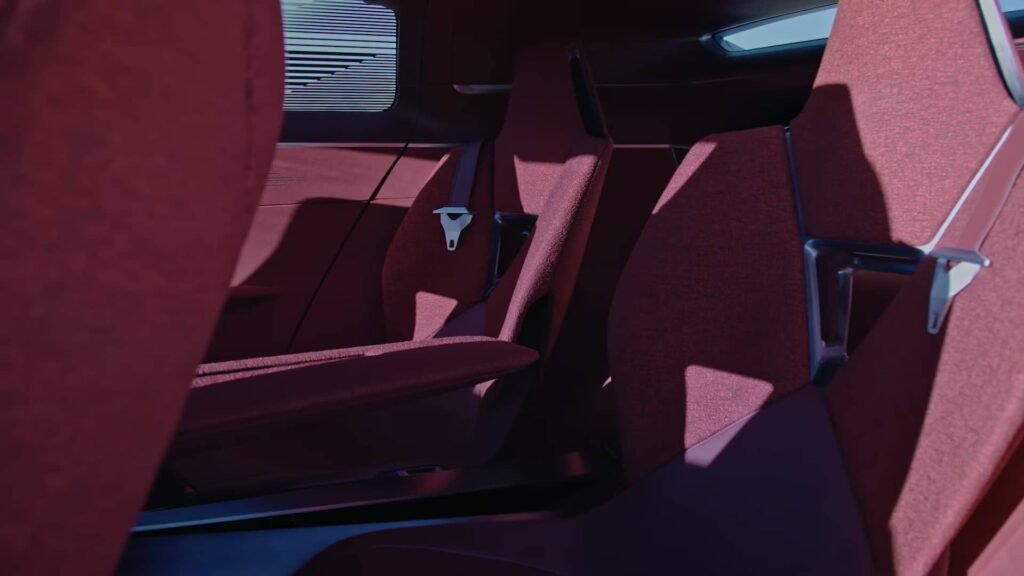
Step inside the Elevated Velocity, and the automotive metaphor dissolves. This cabin functions as a transformation chamber first, driving environment second. The material palette rejects minimalism in favor of textured richness.
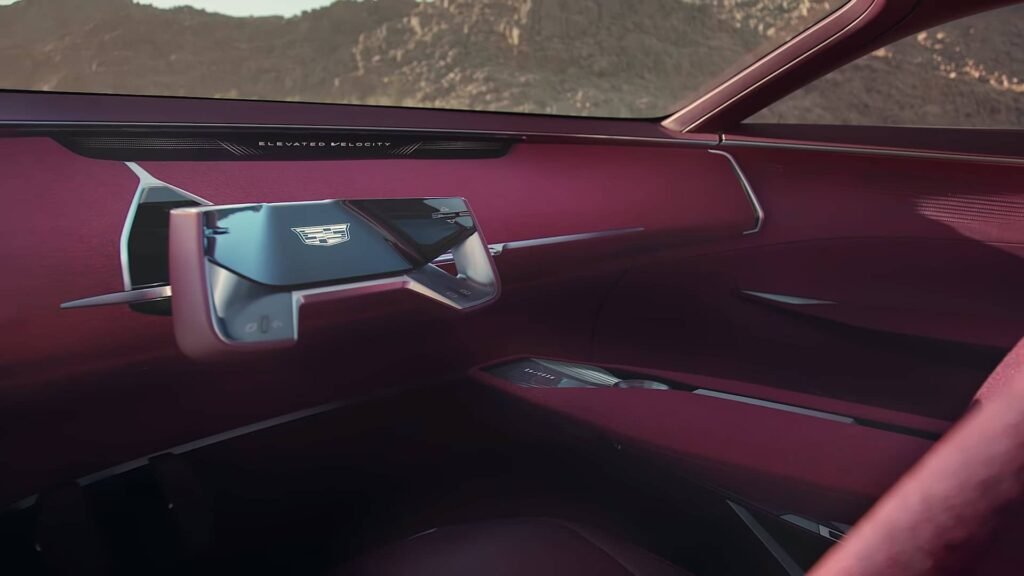
Material Breakdown
| Material | Application | Sensory Characteristic |
|---|---|---|
| Morello Red Nappa Leather | Primary seating surfaces | Soft, warm touch |
| Cerise Fabric | Seat inserts, door panels | Textured contrast |
| Garnet Bouclé | Accent surfaces | Woven depth |
| Crystal Elements | Control interfaces | Light refraction |
| Brushed Aluminum | Structural trim | Cool temperature |
The T-shaped dashboard layout maintains driver focus while concealing technology until needed. Screens disappear into surfaces rather than dominating the visual field. This approach contrasts sharply with Tesla’s screen-centric philosophy and Mercedes’ hyperscreen implementation.
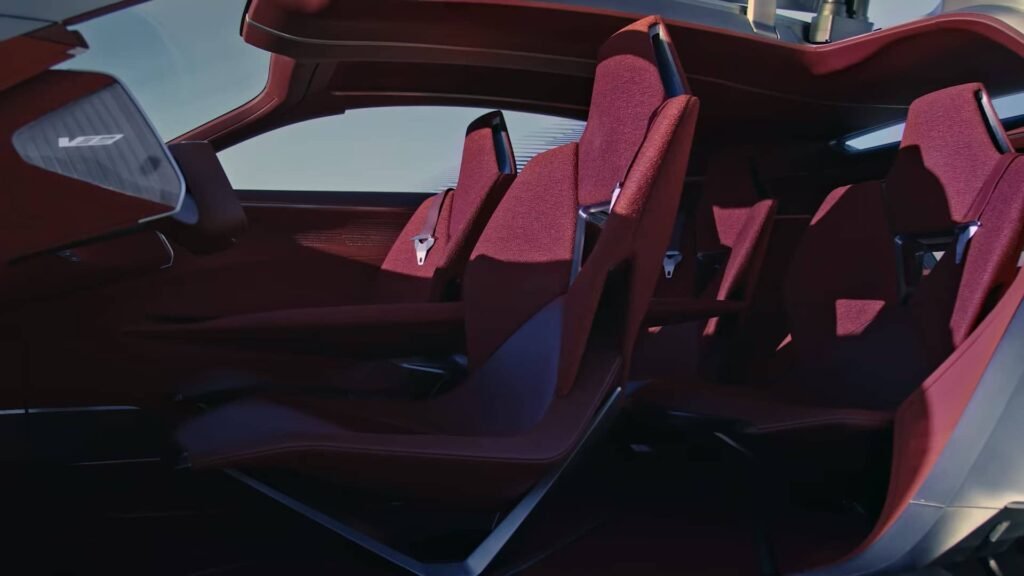
Three-Mode Interior System
The Elevated Velocity’s interior transforms based on selected mode. This isn’t ambient lighting color changes—it’s comprehensive reconfiguration of the cabin environment.
| Mode | Steering Wheel | Pedals | Lighting | Primary Function |
|---|---|---|---|---|
| Welcome | Extended | Visible | Flowing amber | Greeting sequence |
| Elevate | Retracted | Hidden | Red therapy | Wellness experience |
| Velocity | Extended | Visible | Crisp white | Performance driving |
Welcome Mode activates upon approach. Doors rise, ambient lighting flows across surfaces, and the cabin prepares for occupancy. This sequence creates emotional connection before the driver touches any controls.
Elevate Mode represents Cadillac’s wellness thesis. The steering wheel retracts into the dashboard. Pedals disappear. Red light therapy activates alongside guided breathwork programs, fragrance diffusion, and air purification. This isn’t massage seats—this is a mobile recovery environment designed for post-stress decompression.
Velocity Mode returns the cabin to driver-focused configuration. Lighting shifts to neutral white. The AR head-up display prioritizes performance metrics over navigation. Throttle response sharpens. Suspension firms. This is the V-Series heritage manifest in electric form.
Performance Technology: V-Series DNA in Electric Form
Cadillac hasn’t released final powertrain specifications for the Elevated Velocity concept. However, they’ve confirmed V-Series engineering principles guide development. This matters because V-Series represents Cadillac’s performance sub-brand—the division responsible for the CT5-V Blackwing and previous ATS-V models.
Drive Mode Architecture
| Mode | Purpose | Suspension | Throttle | Steering | Target Use |
|---|---|---|---|---|---|
| E-Velocity | Performance | Firmest | Sharpest | Heaviest | Track/canyon |
| Terra | Off-Road | Raised | Smoothed | Lightened | Rocky trails |
| Sand Vision | Desert | Adaptive | Progressive | Balanced | Sand/dunes |
| Elements Defy | Self-Clean | Standard | Standard | Standard | Debris removal |
E-Velocity Mode translates traditional V-Series characteristics to electric powertrain. Throttle mapping becomes aggressive. Regenerative braking intensifies. Suspension damping firms for cornering precision. This mode exists for drivers who want engagement rather than isolation.
Terra Mode raises the air suspension for obstacle clearance. Throttle response smooths for technical terrain. Traction management adapts to loose surfaces. This capability positions the Elevated Velocity against Porsche Macan EV rather than Tesla Model X.
Sand Vision represents genuine innovation. This thermal imaging system penetrates dust and sandstorms that would blind conventional cameras. The technology evolved from Cadillac’s existing night vision systems but targets specific environmental challenges. For buyers in Middle Eastern markets or desert regions, this feature provides capability no competitor offers.
Elements Defy sounds gimmicky until you understand the engineering. Piezoelectric actuators embedded in body panels generate micro-vibrations that dislodge dust, mud, and debris. The system activates automatically when sensors detect contamination or manually via driver command. This isn’t pressure washing—it’s continuous maintenance that reduces cleaning frequency.
Competitive Landscape: Where Elevated Velocity Positions Itself
The luxury electric crossover segment has become crowded. Tesla Model X Plaid dominates acceleration conversations. Porsche Macan EV claims driving purity. Lucid Air leads range discussions. The Elevated Velocity doesn’t challenge these competitors on their terms—it creates a new category.
Specification Comparison
| Vehicle | 0-60 mph | Range (EPA est.) | Starting Price | Unique Feature |
|---|---|---|---|---|
| Cadillac Elevated Velocity | TBD (concept) | TBD (concept) | ~$200K (estimated) | Wellness mode, self-clean |
| Tesla Model X Plaid | 2.5 seconds | 352 miles | $108,490 | Falcon wing doors |
| Porsche Macan Turbo EV | 3.3 seconds | 276 miles | $105,800 | PSM sport mode |
| Lucid Air Sapphire | 1.89 seconds | 427 miles | $249,000 | Tri-motor AWD |
| Mercedes EQS SUV | 3.4 seconds | 305 miles | $125,950 | Hyperscreen |
| BMW iX M60 | 3.6 seconds | 288 miles | $111,300 | Executive lounge |
The price estimation matters. If Cadillac prices the production variant near $200,000, it positions above Model X Plaid but below Lucid Air Sapphire. This pricing strategy targets buyers who want exclusivity without hypercar territory.
Feature Differentiation
| Feature | Elevated Velocity | Model X Plaid | Macan EV | Lucid Air |
|---|---|---|---|---|
| Wellness/Spa Mode | Yes | No | No | No |
| Self-Cleaning Body | Yes | No | No | No |
| Sand/Dust Vision | Yes | No | No | No |
| Gull-Wing Doors | Yes | Falcon wing | No | No |
| Retractable Controls | Yes | No | No | No |
| Red Light Therapy | Yes | No | No | No |
| Off-Road Capability | Yes | Limited | Moderate | No |
This comparison reveals Cadillac’s strategy. They’re not competing on acceleration or range—those metrics favor specialists. Instead, they’re competing on experience differentiation. The buyer who chooses Elevated Velocity isn’t buying the fastest EV. They’re buying the most transformative cabin environment.
Production Reality: What Actually Reaches Showrooms
Concept cars exaggerate. The Elevated Velocity will not reach production with gull-wing doors, fully retractable steering wheels, and 24-inch wheels. However, Cadillac’s recent track record suggests significant concept DNA reaches production vehicles.
Technology Transfer Timeline
| Concept Feature | Expected Production Vehicle | Expected Year | Confidence Level |
|---|---|---|---|
| Self-Cleaning Vibrations | Escalade IQ refresh | 2027 | High |
| Sand Vision Imaging | XT7/XT8 SUV | 2026 | Medium |
| Wellness Mode Lighting | Celestiq variants | 2026 | High |
| Three-Mode Interior | V-Series EV sedan | 2027 | Medium |
| Flax Fiber Wheels | Limited edition models | 2028 | Low |
| Gull-Wing Mechanism | None planned | N/A | Very Low |
| AR HUD Enhancement | Full lineup | 2026 | High |
The Celestiq provides a reference point. Cadillac’s ultra-luxury flagship incorporated significant concept car technology when it reached production. Custom paint formulations, bespoke interior materials, and advanced driver assistance all transitioned from concept to showroom.
Ownership Considerations for Early Adopters
Buyers considering Elevated Velocity-derived production vehicles should understand the implications of cutting-edge technology adoption.
Potential Advantages
| Benefit | Impact | Likelihood |
|---|---|---|
| Exclusivity | High social recognition | Certain |
| Technology Leadership | First-to-market features | High |
| Resale Premium | Collector interest | Medium |
| Brand Positioning | Cadillac flagship status | High |
| Customization Options | Bespoke programs available | High |
Potential Concerns
| Concern | Impact | Mitigation |
|---|---|---|
| Reliability Unknown | Early adoption risk | Extended warranty |
| Service Network | Limited specialist technicians | Dealer training |
| Software Updates | Feature evolution over time | OTA capability |
| Resale Uncertainty | Depreciation unpredictable | Lease options |
| Charging Infrastructure | EV adoption dependent | Home charging |
The wellness technology raises specific questions. Red light therapy, fragrance systems, and guided breathwork programs represent new categories for automotive regulation. Long-term durability of these systems remains unproven. Cadillac will need to demonstrate reliability before mainstream luxury buyers embrace these features.
The Strategic Context: Cadillac’s Electric Transformation
The Elevated Velocity doesn’t exist in isolation. It represents a chapter in Cadillac’s broader electrification strategy. The brand has committed to full electrification by 2030, with the Celestiq, Lyriq, and Optiq establishing the foundation.
Cadillac Electric Lineup Timeline
| Vehicle | Launch Year | Segment | Price Range |
|---|---|---|---|
| Lyriq | 2023 | Mid-size SUV | $63,000-$67,000 |
| Celestiq | 2024 | Ultra-luxury sedan | $340,000+ |
| Optiq | 2024 | Compact SUV | $55,000-$60,000 |
| Escalade IQ | 2024 | Full-size SUV | $130,000-$150,000 |
| V-Series EV Sedan | 2026 (est.) | Performance sedan | $100,000+ |
| Elevated Velocity Production | 2027 (est.) | Performance crossover | $180,000-$220,000 |
This roadmap shows Cadillac’s ambition. They’re not merely electrifying existing models—they’re creating new segments. The Elevated Velocity production variant would slot between Escalade IQ and Celestiq, targeting buyers who want performance without sacrificing utility.
The Bottom Line: Concept or Preview?
The Cadillac Elevated Velocity succeeds as both concept car and technology preview. As theater, it generates conversation and media coverage. As engineering statement, it signals which features will define Cadillac’s electric future.
Who Should Pay Attention:
- Luxury EV shoppers seeking differentiation beyond acceleration
- Cadillac loyalists considering brand transition to electric
- Technology early adopters interested in wellness integration
- Buyers in desert/sand-prone regions (Sand Vision capability)
- Collectors tracking concept-to-production technology transfer
Who Should Wait:
- Range-anxious buyers (specifications TBD)
- Price-sensitive luxury shoppers (estimated $200K+)
- Traditional driving purists (wellness features may feel gimmicky)
- Buyers needing immediate availability (2027+ production)
The Elevated Velocity represents Cadillac’s answer to a fundamental question: What does luxury mean when acceleration and range become commoditized? Their answer centers on transformation—of environment, of mood, of experience. Whether this resonates with buyers remains to be seen. But one thing is certain: Tesla, Porsche, and Lucid are now watching.
Quick Reference Specifications
| Category | Detail |
|---|---|
| Vehicle Type | Electric Performance Crossover Concept |
| Seating | 2+2 configuration |
| Platform | GM Ultium (expected) |
| Debut Venue | The Quail, Monterey Car Week 2025 |
| Design Lead | Cadillac Global Design Studio |
| Production Intent | Select features, 2026-2028 |
| Estimated Price | $180,000-$220,000 (production variant) |
| Key Competitors | Model X Plaid, Macan EV, Lucid Air |
| Unique Features | Self-cleaning body, Sand Vision, Wellness mode |
| Brand Positioning | V-Series electric flagship |
The Elevated Velocity isn’t just a concept car. It’s a declaration that Cadillac intends to define luxury electric mobility on its own terms. The old metrics—acceleration, range, charging speed—matter less than the experience they enable. Whether the market agrees will determine whether this concept becomes a catalyst or a curiosity.