
By early 2026, the American driveway has undergone a fundamental shift. The initial “EV or bust” frenzy has matured into a more pragmatic reality: the Hybrid SUV is the undisputed champion of the family garage. For the modern household, the math simply works. You get the near-silent, torque-rich urban cruising of an electric motor without the “range anxiety” of a mid-winter road trip to the mountains.
But “hybrid” is no longer a monolith. As we look at the 2026 model year, families are choosing between self-charging hybrids (HEVs) and the increasingly dominant plug-in hybrids (PHEVs). Drawing on real-world reliability data, updated federal tax credit eligibility, and long-term cabin durability scores, we’ve identified the absolute best hybrid SUVs for families hitting the road this year.
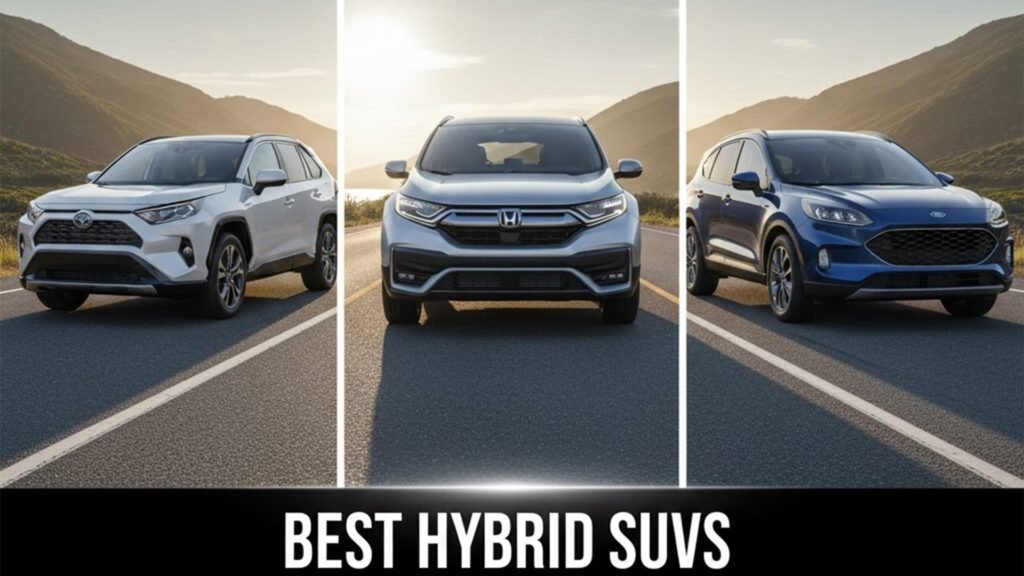
2026 Family Hybrid Comparison: At a Glance
| Model | Hybrid Type | Combined MPG (Est.) | Max Cargo Space (Cu. Ft.) | Notable Tech |
| Toyota Highlander | HEV (Self-Charging) | 36 MPG | 84.3 | TSS 4.0 / Digital Key |
| Hyundai Santa Fe | HEV / PHEV | 34 MPG (HEV) | 79.6 | Dual Wireless Charging / HDA2 |
| Mazda CX-90 | PHEV (Plug-in) | 56 MPGe / 25 MPG | 75.2 | Kinematic Posture Control |
| Honda CR-V Hybrid | HEV (Self-Charging) | 40 MPG | 76.5 | Mechanical AWD / Simple UI |
| Kia Sorento PHEV | PHEV (Plug-in) | 79 MPGe / 34 MPG | 75.5 | Blind-Spot View Monitor |
1. The Benchmark: 2026 Toyota Highlander Hybrid
If there were a hall of fame for family haulers, the Highlander Hybrid would be in the first wing. For 2026, Toyota has further refined its fifth-generation hybrid system, focusing on “refinement over revs.”
- Why It Wins: It remains the gold standard for Total Cost of Ownership (TCO). Its ability to achieve a real-world 35+ MPG in a vehicle that seats seven is a feat of engineering that competitors still struggle to match.
- The 2026 Edge: Updated infotainment and enhanced “Toyota Safety Sense 4.0” make it arguably the safest cabin in its class. It’s the “boring” choice in the best way possible—it simply never breaks.
- Best For: Families who plan to keep their vehicle for 10+ years and 200,000 miles.
2. The Tech Sophisticate: 2026 Hyundai Santa Fe Hybrid
The Santa Fe’s radical, boxy redesign has aged remarkably well, and by 2026, Hyundai has ironed out the first-year software glitches. It offers a “Terrace-concept” interior that feels more like a high-end lounge than a commuter car.
- Why It Wins: Space efficiency. The vertical tailgate and wide opening allow for cargo configurations that rounder SUVs can’t handle. The hybrid powertrain is punchy, thanks to a turbocharged 1.6L engine paired with a potent electric motor.
- The 2026 Edge: Hyundai’s HDA2 (Highway Driving Assist 2) is now standard on most hybrid trims, offering some of the most fluid lane-centering and adaptive cruise control on the market.
- Best For: The “Aesthetic Family” who wants Land Rover-inspired design with a 10-year powertrain warranty.
3. The PHEV Powerhouse: 2026 Mazda CX-90 PHEV
Mazda has successfully moved upmarket, and the CX-90 PHEV is their flagship proof-of-concept. It is a driver-centric SUV that happens to have a massive battery and three rows.
- Why It Wins: Dynamics. Most hybrids feel like appliances; the CX-90 feels like a sports sedan. With roughly 26 miles of pure electric range, most families can do the school run and grocery trips without burning a drop of gasoline.
- The 2026 Edge: Mazda has significantly improved the “transition” smoothness between the electric motor and the 2.5L gas engine for 2026, addressing the jerky shifts noted in earlier versions.
- Best For: The parent who isn’t ready to give up the “joy of driving” but needs to fit three car seats in the back.
4. The Value Champion: 2026 Honda CR-V Hybrid
While technically a “compact” SUV, the 2026 CR-V Hybrid’s interior packaging is so efficient that many families find it more usable than larger mid-size rivals.
- Why It Wins: Simplicity and resale value. Honda’s dual-motor hybrid system is mechanically elegant—it lacks a traditional transmission, which reduces long-term failure points. It’s the “Swiss Army Knife” of SUVs.
- The 2026 Edge: Improved sound deadening for 2026 has finally addressed the CR-V’s historical weakness: highway road noise.
- Best For: Small families or those living in urban environments where parking a “land yacht” isn’t feasible.
5. The Luxurious Alternative: 2026 Lexus RX 450h+ (PHEV)
For those willing to stretch the budget, the Lexus RX 450h+ offers a level of serenity that rivals German luxury brands but with Toyota-backed reliability.
- Why It Wins: 35+ miles of EV-only range and a cabin that uses “Takumi” craftsmanship. The materials don’t just look good; they are built to withstand the “Cheeto-finger” assault of a toddler without staining or cracking.
- Best For: Families wanting a premium experience with the lowest possible “stress-per-mile.”
Critical Advice for 2026 Buyers: HEV or PHEV?
The decision between a standard hybrid (HEV) and a plug-in (PHEV) should be based on your parking situation, not just your environmental goals.
- Choose an HEV (Highlander, CR-V) if you live in an apartment or don’t want to deal with chargers. You’ll still save 30-40% on fuel compared to a gas-only SUV without any change in behavior.
- Choose a PHEV (CX-90, Sorento, Lexus) if you have a garage with an outlet. If your daily commute is under 25 miles, you might only visit a gas station once every three months.
Final Thoughts
In 2026, the “best” hybrid isn’t the one with the most horsepower; it’s the one that integrates seamlessly into your family’s chaotic schedule. Toyota still owns the reliability crown, but Hyundai and Mazda are offering compelling reasons to look elsewhere for tech and driving dynamics.
Useful Links: