The pickup truck landscape is experiencing its most significant disruption since the F-150 went aluminum. While American manufacturers continue debating electrification roadmaps and charging infrastructure timelines, BYD has quietly launched a plug-in hybrid pickup that delivers premium capabilities at a price point that seems almost impossible.
The BYD Shark 6 represents more than a new model—it signals a fundamental shift in global automotive power dynamics. This vehicle combines electric efficiency with gasoline flexibility, luxury interior appointments with genuine utility, and technology typically reserved for six-figure vehicles at roughly half the cost.
For buyers monitoring this segment, the Shark 6 forces uncomfortable questions about value propositions, brand loyalty, and whether legacy manufacturers have been charging premiums for features that no longer justify the price gap.
Design Philosophy: Breaking the Pickup Mold
Exterior Dimensions and Market Positioning
| Specification | BYD Shark 6 | Ford Ranger | Toyota Tacoma | Rivian R1T |
|---|---|---|---|---|
| Length | 5,457mm | 5,370mm | 5,380mm | 5,514mm |
| Width | 1,971mm | 1,860mm | 1,910mm | 2,015mm |
| Height | 1,925mm | 1,848mm | 1,895mm | 1,880mm |
| Wheelbase | 3,260mm | 3,270mm | 3,260mm | 3,550mm |
| Ground Clearance | 230mm | 226mm | 244mm | 226mm |
| Curb Weight | ~2,400kg | ~2,100kg | ~2,050kg | ~3,000kg |
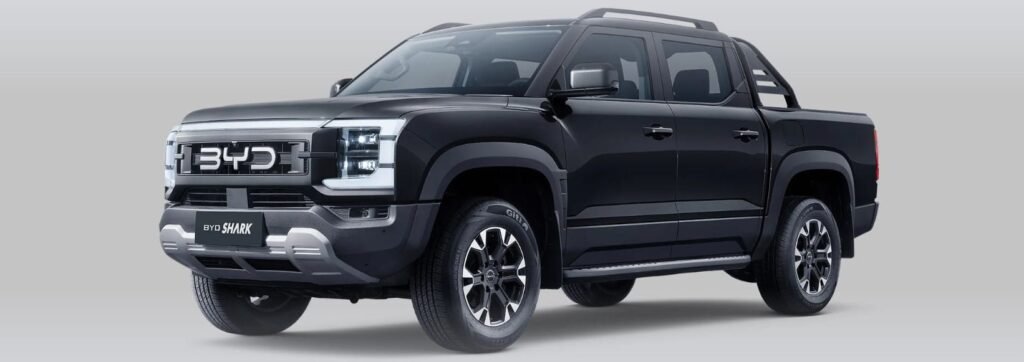
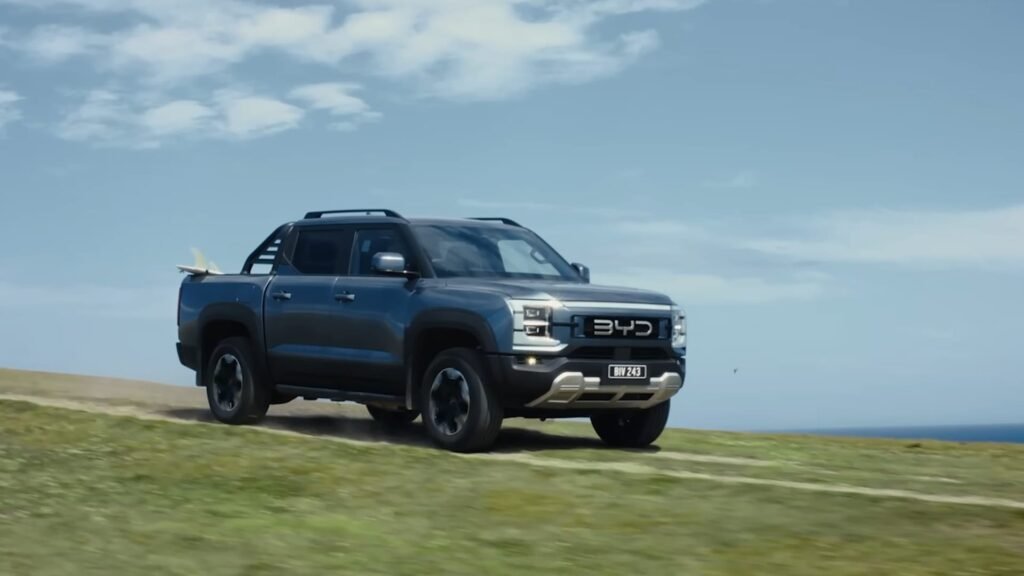
The Shark 6’s exterior design diverges sharply from traditional pickup aesthetics. There’s no pretend grille suggesting a large internal combustion engine beneath. Instead, the front fascia features a sculpted, closed-off design with aggressive LED headlamps that create a predator-like stance. This isn’t evolutionary styling—it signals a clear break from ICE heritage.
The profile balances utility with sophistication. Strong character lines run along the doors, wheel arches feature protective cladding, and the roofline slopes gently toward the rear without compromising bed functionality. Higher trims offer 20 to 22-inch alloy wheels that fill the arches proportionally, avoiding the undersized wheel problem plaguing many budget trucks.
At the rear, a full-width LED light bar spans the tailgate with wraparound elements that emphasize width. The bed itself receives serious attention—tie-down points, rail attachments, and under-body protection aren’t afterthoughts but integrated design elements. This matters for buyers who actually use their trucks for work rather than weekend aesthetics.
Design Assessment by Buyer Priority
| Priority | Best Choice | Reasoning |
|---|---|---|
| Traditional truck appearance | Ford Ranger | Familiar, proven design language |
| Modern/futuristic styling | BYD Shark 6 | EV-influenced design, premium feel |
| Off-road capability appearance | Toyota Tacoma | Aggressive stance, proven heritage |
| Luxury presence | BYD Shark 6 | Premium materials, attention to detail |
| Brand recognition | Ford Ranger/Tacoma | Established market presence |
| Head-turning uniqueness | BYD Shark 6 | Distinctive in any parking lot |
Interior: Where the Price Point Becomes Confusing
Cabin Technology and Features
| Feature | BYD Shark 6 | Ford Ranger Lariat | Toyota Tacoma Limited | Rivian R1T |
|---|---|---|---|---|
| Center Display | 15.6″ Rotating | 12″ Fixed | 14″ Fixed | 15.6″ Fixed |
| Digital Cluster | 10.25″ Full Digital | 8″ Digital | 7″ Digital | 12.3″ Digital |
| Head-Up Display | Available | Available | Not Available | Not Available |
| Wireless CarPlay | Standard | Standard | Standard | Wireless Only |
| Wireless Charging | Front + Rear | Front Only | Front Only | Front Only |
| V2L (Vehicle to Load) | Standard | Not Available | Not Available | Standard |
| Ambient Lighting | Multi-Zone | Available | Limited | Available |
| Seat Ventilation | Front Standard | Available | Available | Standard |
| Seat Massage | Available (Top Trim) | Not Available | Not Available | Available |
| Premium Audio | 12-Speaker | 10-Speaker B&O | 9-Speaker JBL | 18-Speaker Rivian |
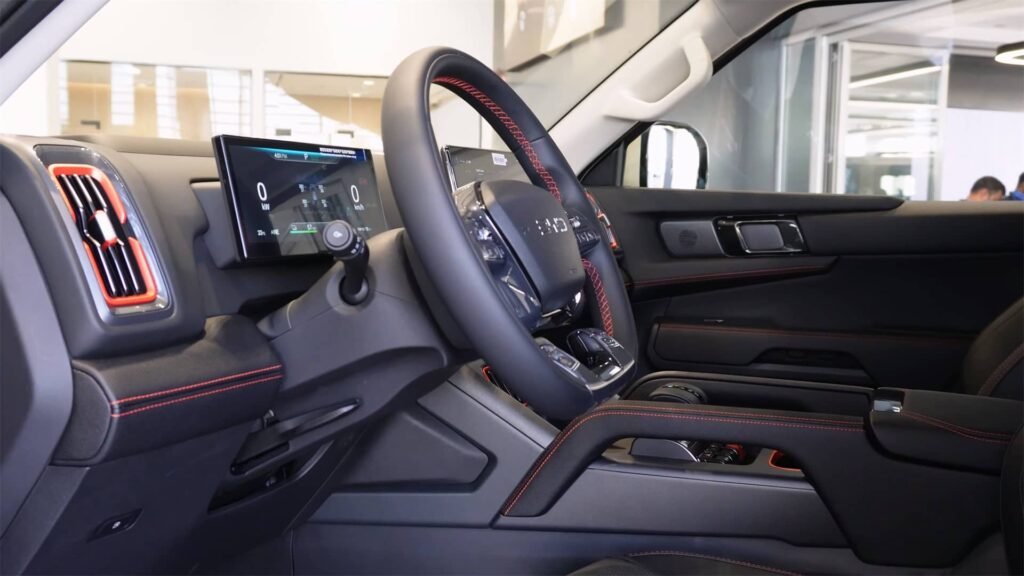
Opening the Shark 6’s door creates immediate cognitive dissonance. The expected truck interior—hard plastics, utilitarian surfaces, minimal comfort—doesn’t materialize. Instead, soft-touch materials cover contact surfaces, contrast stitching appears throughout, and ambient lighting creates atmosphere typically associated with luxury sedans.
The rotating 15.6-inch touchscreen isn’t gimmicky. It physically angles toward the driver upon entry, creating a welcoming interaction that feels intentional rather than theatrical. The interface runs BYD’s latest smart system with voice commands, OTA updates, and comprehensive vehicle settings. Energy flow visualization shows real-time power distribution between electric motors and gasoline engine—a feature that helps owners optimize efficiency.
Vehicle-to-Load functionality deserves specific attention. The Shark 6 can power external devices, tools, camping equipment, and even household appliances directly from its battery. This isn’t marketed as a novelty but as genuine utility for tradespeople, overlanders, and emergency preparedness scenarios. A 29.5 kWh battery provides meaningful external power capacity without compromising driving range.
Comfort and Practicality Assessment
| Metric | BYD Shark 6 | Ford Ranger | Toyota Tacoma | Assessment |
|---|---|---|---|---|
| Seating Capacity | 5 passengers | 5 passengers | 5 passengers | Tie |
| Rear Legroom | Generous | Adequate | Adequate | Shark 6 |
| Rear Door Opening | Wide | Standard | Standard | Shark 6 |
| Floor Configuration | Flat (EV-influenced) | Transmission tunnel | Transmission tunnel | Shark 6 |
| Cargo Bed Length | Standard midsize | Standard midsize | Standard midsize | Tie |
| Payload Capacity | 790kg | 750kg | 735kg | Shark 6 |
| Towing Capacity | 2,500kg | 2,500kg | 2,950kg | Tacoma |
| In-Cabin Storage | Extensive | Good | Good | Shark 6 |
Rear passengers aren’t treated as afterthoughts. The flat floor (enabled by hybrid architecture rather than traditional drivetrain) creates genuine three-across seating capability. Rear climate vents, USB-C ports, and adjustable seatbacks demonstrate consideration for occupants who aren’t driving. For families using this as a primary vehicle, this matters significantly.
Powertrain: The Hybrid Advantage Nobody Expected
Performance Specifications
| Specification | BYD Shark 6 | Ford Ranger Hybrid | Toyota Tacoma Hybrid | Rivian R1T |
|---|---|---|---|---|
| Powertrain | PHEV (1.5T + Dual Motor) | Hybrid | Hybrid | Full Electric |
| Combined Power | 430 hp | 325 hp | 326 hp | 533-835 hp |
| Combined Torque | 650 Nm | 542 Nm | 542 Nm | 1,100+ Nm |
| 0-100 km/h | 5.7 seconds | 7.2 seconds | 6.9 seconds | 3.0-4.5 seconds |
| EV-Only Range | 100km (CLTC) | ~50km | ~55km | 320-640km |
| Total Range | 800km (combined) | 700km | 750km | 400-650km |
| Battery Capacity | 29.5 kWh | 18.1 kWh | 18.7 kWh | 105-149 kWh |
| DC Fast Charging | 55kW (30-40 min) | Not Available | Not Available | 160kW+ |
| Fuel Economy (Hybrid) | ~2.5L/100km | ~8.5L/100km | ~8.0L/100km | N/A (Electric) |
Note: CLTC range typically exceeds real-world by 15-20%. EPA equivalents would be lower.
The Shark 6’s plug-in hybrid architecture solves the primary limitation facing full electric trucks: range anxiety without infrastructure dependency. The 100km EV-only range covers typical daily commuting for most owners without consuming gasoline. When battery depletes or additional power is needed, the 1.5-liter turbocharged engine engages seamlessly.
This isn’t a mild hybrid system—it’s a genuine PHEV with meaningful electric capability. Dual electric motors provide all-wheel drive without mechanical linkages, enabling precise torque vectoring. The combined 430 horsepower and 650 Nm torque deliver acceleration that embarrasses traditional midsize trucks while maintaining efficiency that full ICE trucks can’t match.
Drive Mode Capabilities
| Mode | Function | Best Use Case |
|---|---|---|
| Pure EV | Electric-only propulsion | Daily commuting, urban driving |
| Hybrid | Optimized power distribution | Mixed driving, efficiency focus |
| Petrol-Only | Engine primary, battery reserve | Highway cruising, battery preservation |
| Sport | Maximum power output | Performance driving, passing |
| Off-Road | Enhanced traction control | Unpaved surfaces, light trails |
| Snow | Reduced torque, stability focus | Winter conditions, slippery surfaces |
| Tow/Haul | Enhanced low-end torque | Towing, heavy payloads |
Real-world driving reveals the system’s sophistication. Electric mode provides silent, vibration-free operation ideal for residential areas and early morning departures. The transition to hybrid mode occurs without noticeable interruption—no jarring engine engagement that plagues earlier hybrid trucks. For buyers in regions with limited charging infrastructure, the gasoline backup eliminates range anxiety without sacrificing daily electric benefits.
Safety and Technology: Legacy vs. Innovation
ADAS Feature Comparison
| Safety Feature | BYD Shark 6 | Ford Ranger | Toyota Tacoma | Assessment |
|---|---|---|---|---|
| Automatic Emergency Braking | Standard | Standard | Standard | Tie |
| Adaptive Cruise Control | Standard | Available | Available | Shark 6 |
| Lane Keeping Assist | Standard | Available | Standard | Tie |
| Blind Spot Monitoring | Standard | Available | Available | Shark 6 |
| 360-Degree Camera | Standard | Available | Available | Shark 6 |
| Parking Assist | Available | Available | Limited | Shark 6 |
| Driver Fatigue Detection | Available | Limited | Limited | Shark 6 |
| Rear Cross-Traffic Alert | Standard | Available | Available | Shark 6 |
| Airbag Count | 6-8 (varies by trim) | 7 | 8 | Tie |
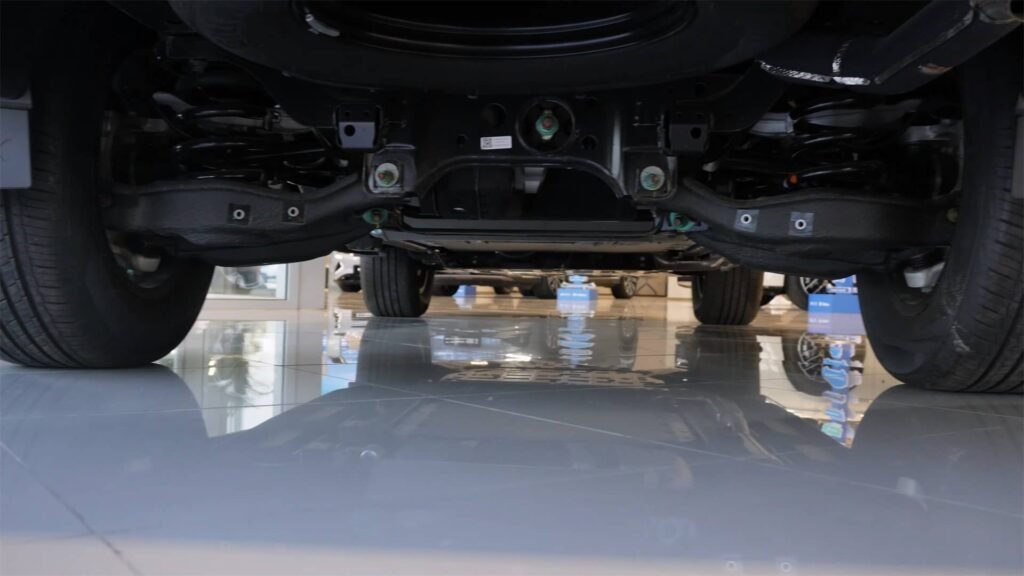
| Structural Materials | High-strength steel + aluminum | High-strength steel | High-strength steel | Shark 6 |
BYD’s safety approach combines traditional structural engineering with predictive technology. High-strength steel and aluminum reinforcements create crash-absorbing zones while maintaining cabin integrity. Multiple airbag systems protect occupants from various impact angles. This foundation matches legacy manufacturers’ approaches.
Where the Shark 6 differentiates is in sensor deployment and software intelligence. Radar, ultrasonic sensors, and multiple cameras create comprehensive environmental awareness. Some markets receive LiDAR integration for enhanced object detection. The software processes this data continuously, enabling features like predictive collision warnings that activate before hazards become immediately apparent.
OTA update capability means safety algorithms improve over time rather than remaining static from purchase date. This matters for long-term ownership—a 2026 Shark 6 could theoretically have better safety features in 2029 than when it left the factory. Legacy manufacturers are adopting this approach slowly; BYD implemented it as standard.
Pricing: The Number That Changes Everything
Global Pricing Analysis
| Market | BYD Shark 6 | Ford Ranger | Toyota Tacoma | Rivian R1T |
|---|---|---|---|---|
| China | ¥260,000-320,000 | ¥250,000-350,000 | ¥280,000-380,000 | Not Available |
| USD Equivalent | $36,000-44,000 | $35,000-48,000 | $39,000-53,000 | $73,000-95,000 |
| Australia | AUD $60,000-70,000 | AUD $55,000-75,000 | AUD $60,000-80,000 | AUD $120,000+ |
| Europe | €45,000-55,000 | €45,000-60,000 | Not Available | €80,000+ |
| United States | Not Available | $35,000-60,000 | $40,000-65,000 | $73,000-95,000 |
Exchange rates: 1 USD ≈ 7.2 CNY, February 2026. Import tariffs and compliance costs not included.
The pricing strategy creates genuine market disruption. A fully-loaded Shark 6 with premium interior, advanced safety features, and maximum battery capacity costs less than base-model competitors in many markets. This isn’t achieved through quality compromise—material inspections, feature verification, and independent testing confirm the specifications are legitimate.
Several factors enable this pricing:
- Vertical integration: BYD manufactures batteries, motors, and electronics in-house, reducing supplier margins
- Manufacturing scale: Chinese production volumes create cost advantages impossible for lower-volume competitors
- Government incentives: Domestic EV/PHEV subsidies reduce effective pricing in home market
- Margin strategy: BYD prioritizes market share over per-unit profit in expansion markets
- Technology amortization: R&D costs spread across multiple vehicle platforms
For buyers in accessible markets, the value proposition becomes difficult to ignore. The question shifts from “Can I afford this?” to “Can I afford not to consider this?”
Total Cost of Ownership (5-Year Projection)
| Cost Category | BYD Shark 6 | Ford Ranger | Toyota Tacoma | Rivian R1T |
|---|---|---|---|---|
| Purchase Price | $40,000 | $45,000 | $48,000 | $80,000 |
| Fuel/Electricity (5 years) | $4,500 | $12,000 | $11,500 | $6,000 |
| Maintenance (5 years) | $3,500 | $5,500 | $5,000 | $4,500 |
| Insurance (5 years) | $6,000 | $7,000 | $7,000 | $12,000 |
| Depreciation (5 years) | $18,000 | $22,000 | $20,000 | $40,000 |
| Total 5-Year Cost | $72,000 | $91,500 | $91,500 | $142,500 |
Assumptions: 20,000 km/year, mixed driving, market-average insurance and fuel costs
The five-year ownership cost advantage exceeds $20,000 compared to traditional competitors. Lower fuel costs (from electric daily driving), reduced maintenance (fewer ICE components), and competitive insurance rates create cumulative savings that compound the initial purchase price advantage.
The Reality Check: Risks Buyers Must Consider
Market Availability and Support
| Concern | Risk Level | Mitigation | Impact on Decision |
|---|---|---|---|
| US Market Availability | High | Not available due to tariffs/regulations | Cannot purchase in US currently |
| Service Network (Outside China) | Medium | Expanding but limited in some regions | Consider proximity to service centers |
| Long-Term Reliability Data | Medium | New model, limited long-term data | Wait for 2-3 year ownership reviews |
| Parts Availability | Medium | Improving but varies by market | Verify parts supply in your region |
| Resale Value Uncertainty | Medium | New brand in many markets | Expect higher depreciation initially |
| Software Updates | Low | OTA capability established | Regular improvements expected |
| Battery Longevity | Low-Medium | BYD Blade Battery has strong track record | 8-year/160,000km warranty typical |
Honest assessment requires acknowledging limitations. The Shark 6 isn’t available in the United States due to tariff structures, safety certification requirements, and political considerations around Chinese-manufactured vehicles. This isn’t changing in the near term—buyers in North America must consider alternatives.
Service network density varies significantly by market. China and Australia have established support infrastructure. Europe is expanding rapidly. Emerging markets may have limited coverage, creating potential challenges for rural owners or those far from urban centers.
Long-term reliability data doesn’t exist yet. BYD’s broader vehicle lineup has demonstrated improving quality, but the Shark 6’s specific hybrid system, suspension tuning under load, and electronic components lack decade-long validation. Legacy manufacturers benefit from field data accumulated over millions of vehicle-years. New entrants don’t have this advantage.
Battery degradation remains a consideration for all electrified vehicles. BYD’s Blade Battery technology has shown strong longevity in passenger vehicles, but pickup truck duty cycles differ significantly. Heavy towing, frequent fast charging, and extreme temperature exposure could accelerate degradation compared to sedan usage patterns.
Who Should Buy the BYD Shark 6?
Buyer Profile Recommendations
| Buyer Type | Recommendation | Key Reasoning |
|---|---|---|
| Urban commuter with weekend utility needs | Strong Buy | EV daily driving + truck capability |
| Tradesperson needing V2L capability | Strong Buy | External power for tools and equipment |
| Family primary vehicle | Buy | Space, safety, running cost advantages |
| Off-road enthusiast | Consider | Capable but not purpose-built like Tacoma |
| Heavy towing regular user | Consider | 2,500kg adequate but not class-leading |
| US-based buyer | Cannot Purchase | Not available due to regulatory barriers |
| Technology early adopter | Strong Buy | Advanced features at accessible price |
| Brand-loyal traditional truck buyer | Consider | Requires openness to new manufacturers |
| Fleet/commercial buyer | Strong Buy | TCO advantages significant at scale |
| Resale-value prioritizer | Wait | Let market establish depreciation patterns |
Market-Specific Guidance
| Region | Availability | Recommendation | Notes |
|---|---|---|---|
| China | Available Now | Strong Buy | Full support, best pricing |
| Australia | Available Now | Buy | Expanding dealer network |
| Europe | Limited Markets | Consider | Check local availability |
| Southeast Asia | Expanding | Buy | Strong regional support |
| United States | Not Available | Cannot Purchase | Tariff and regulatory barriers |
| South America | Limited | Consider | Verify service network |
| Middle East | Expanding | Consider | Climate suitability verified |
A Segment Redefined
Category Winners Summary
| Category | Winner | Margin |
|---|---|---|
| Purchase Price | BYD Shark 6 | Decisive |
| Technology Features | BYD Shark 6 | Significant |
| Fuel Efficiency | BYD Shark 6 | Significant |
| Towing Capacity | Toyota Tacoma | Moderate |
| Brand Recognition | Ford/Toyota | Significant |
| Service Network (Global) | Ford/Toyota | Significant |
| Interior Quality | BYD Shark 6 | Moderate |
| Safety Technology | BYD Shark 6 | Moderate |
| Long-Term Reliability Data | Ford/Toyota | Significant |
| Total Cost of Ownership | BYD Shark 6 | Significant |
The BYD Shark 6 accomplishes something rare: it forces legitimate competitors to reconsider their value propositions. This isn’t about being slightly better in specific categories—it’s about delivering 80-90% of what premium trucks offer at 50-60% of the price.
For buyers in accessible markets, the Shark 6 represents the most compelling value in the midsize pickup segment. The combination of electric daily driving, gasoline flexibility for longer trips, genuine utility capability, and luxury interior appointments creates a package that traditional manufacturers struggle to match without sacrificing margins.
For buyers in restricted markets like the United States, the Shark 6 serves as a warning shot. It proves that price gaps between legacy and emerging manufacturers aren’t justified by capability differences. When regulatory barriers eventually ease, competitive pressure will intensify significantly.
The question isn’t whether the Shark 6 is good—it clearly is. The question is whether buyers prioritize brand heritage and proven long-term reliability over immediate value and technology advantages. Both positions are defensible. But the conversation itself represents a shift in automotive purchasing dynamics that legacy manufacturers can no longer ignore.
Specifications sourced from manufacturer data, automotive databases, and regional pricing information, February 2026. Availability, pricing, and specifications vary by market. Verify local dealer information before purchase decisions.
The midsize pickup segment continues rapid evolution with new electrified models from multiple manufacturers. Buyers should verify current specifications, availability, and incentive programs before committing to purchase. Test drives and comparison shopping remain essential for informed decisions.