If you live in the American “Rust Belt,” the Upper Midwest, or the Northeast, you’ve likely heard the horror stories: Electric Vehicles (EVs) losing half their range the moment the mercury dips below freezing. While some of the internet hyperbole is just that—hyperbole—the “Winter Tax” on electric propulsion is a documented, scientific reality.
Unlike internal combustion engine (ICE) vehicles, which generate massive amounts of waste heat that can be repurposed to warm the cabin, an EV is a marvel of efficiency. Ironically, that efficiency is its Achilles’ heel in January. Every British Thermal Unit (BTU) used to keep your toes warm is a BTU that isn’t pushing the wheels forward.
As we navigate the 2025-2026 winter season, it’s time for a professional, BS-free look at the physics of cold-weather EV ownership and how savvy drivers can mitigate the loss.

1. The Chemistry of the Cold: Why Batteries Struggle
To understand range loss, you have to look at the molecular level. Most modern EVs use Lithium-ion battery chemistry. These batteries rely on liquid electrolytes to move ions between the anode and the cathode.
- Increased Internal Resistance: As temperatures drop, the electrolyte fluid becomes more viscous (thicker). This slows down the chemical reactions and increases internal resistance. The battery has to work harder just to move energy out of the cells, resulting in less usable power.
- Reduced Regenerative Braking: Cold batteries cannot accept a high rate of charge quickly. Consequently, your car may disable or significantly limit “one-pedal driving” or regenerative braking until the battery pack warms up. This removes a key efficiency tool just when you need it most.
2. The HVAC Drain: Heating the Human vs. Heating the Machine
For a gas car, about 60-70% of the energy in fuel is wasted as heat. In the winter, we simply vent that “waste” into the cabin. In an EV, the motor is roughly 90% efficient, meaning there is almost no waste heat to harvest.
- Resistive Heating vs. Heat Pumps: Older or cheaper EVs use resistive heating (essentially a giant hair dryer). This is an enormous energy hog. Newer, premium EVs (like the Tesla Model Y, Hyundai IONIQ 5, or Kia EV6) utilize Heat Pumps. These act like a refrigerator in reverse, scavenging heat from the outside air—even in sub-freezing temps—to warm the cabin. A heat pump can improve winter efficiency by as much as 20-30%.
- Battery Thermal Management: A significant portion of your energy is spent on “Active Thermal Management.” The car will actually use its own battery power to heat the battery pack to an optimal operating temperature (usually around 60-70°F) to prevent permanent cell damage.
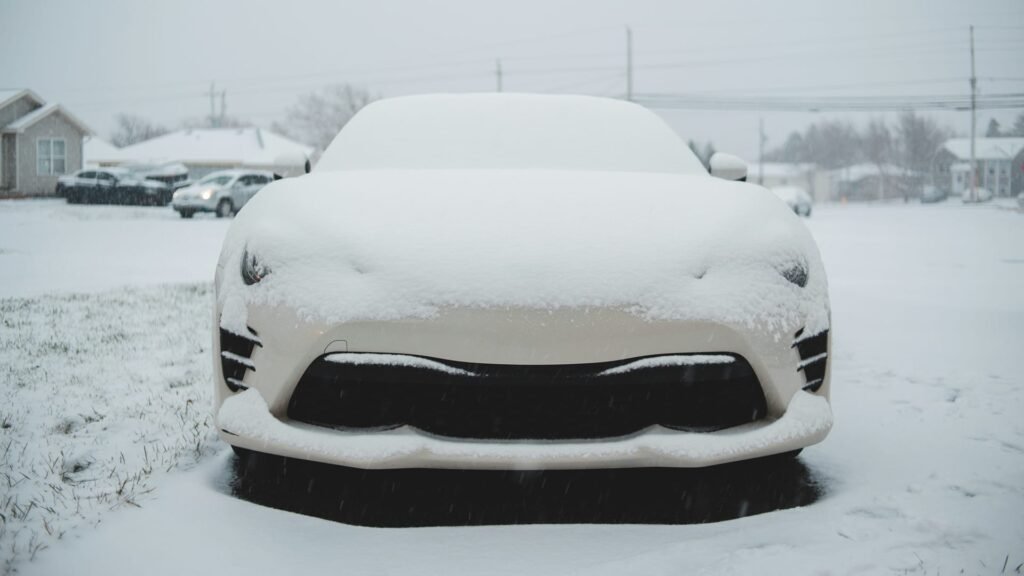
Winter Range Loss: Real-World Expectations by Model
Not all EVs are created equal when the snow falls. Below is a breakdown of observed range degradation at temperatures between 20°F and 32°F (-6°C to 0°C).
| EV Model | EPA Rated Range (Miles) | Est. Winter Range (Miles) | % Range Loss | Heating Tech |
| Tesla Model 3 / Y | 310 – 330 | 230 – 250 | ~24% | High-Efficiency Heat Pump |
| Ford F-150 Lightning | 320 (Extended) | 210 – 225 | ~32% | Resistive / Battery Loop |
| Hyundai IONIQ 5 | 303 | 225 – 240 | ~22% | Heat Pump (Select Trims) |
| Volkswagen ID.4 | 275 | 180 – 195 | ~30% | Resistive (US Models) |
| Nissan LEAF | 212 | 130 – 145 | ~35% | Resistive / Passive Air |
3. Charging Friction: Expect Longer Wait Times
If you rely on public DC Fast Charging, winter will test your patience. Because a cold battery is fragile, the car’s Battery Management System (BMS) will artificially throttle the charging speed to protect the cells from “lithium plating.”
A charger capable of 350kW might only deliver 40kW or 50kW if the battery is “cold-soaked.” This can turn a 20-minute charging stop into a 60-minute ordeal.
- Pro Tip: Always use your car’s built-in navigation to route to a charger. Most modern EVs will “pre-condition” (warm) the battery en route so that it’s ready to accept high-speed juice the moment you plug in.

4. Professional Strategies to Defeat the “Winter Tax”
If you’ve already committed to an EV, or are planning to, these four tactics are the difference between a stress-free commute and “range anxiety.”
A. The “Shore Power” Pre-Condition
Never leave your house in a cold car. Use your app to start the climate control while the car is still plugged into your home charger. This uses electricity from the grid to warm the cabin and the battery, leaving your 100% charge dedicated solely to driving.
B. Prioritize “Surface” Heat
Heating the air in a cabin is inefficient. Heating the driver directly is not. Using heated seats and a heated steering wheel allows you to keep the cabin temperature lower (say 64°F instead of 72°F), which significantly reduces the load on the main HVAC system.
C. Watch Your Speed
Cold air is denser than warm air, meaning your car has to push through “thicker” atmosphere. Combined with winter tires (which have higher rolling resistance), driving at 75 mph in the winter is exponentially more draining than 65 mph. If you’re low on range, drop your speed by 5-10 mph; it makes a bigger difference than you think.
D. Check Your Tire Pressure
For every 10-degree drop in temperature, tires lose about 1 PSI. Under-inflated tires increase rolling resistance and kill efficiency. Keep them at the manufacturer’s recommended spec.
The Expert Verdict: Is an EV Practical in the Cold?
Yes, but with caveats. If your daily commute is 50-80 miles, you won’t even notice the winter range loss if you charge at home. However, if you frequently take 200-mile road trips through rural, cold-weather states, you must plan for a 30% buffer.
For the professional driver, winter isn’t a reason to avoid EVs—it’s just a reason to buy one with a Heat Pump and a Pre-conditioning feature.
Useful Links: