
For nearly a century, the question of what powered your car was a non-starter. It was internal combustion or nothing. But in today’s market, American drivers are standing at a confusing crossroads. Between fluctuating gas prices, evolving federal tax credits, and a charging infrastructure that feels like a work in progress, the “best” choice is no longer universal.
Deciding between Internal Combustion (ICE), Hybrid (HEV/PHEV), and Battery Electric (BEV) isn’t just about being “green.” It’s a cold, hard calculation of geography, driving habits, and total cost of ownership (TCO). This guide cuts through the marketing noise to determine which powertrain truly deserves your driveway in 2025.
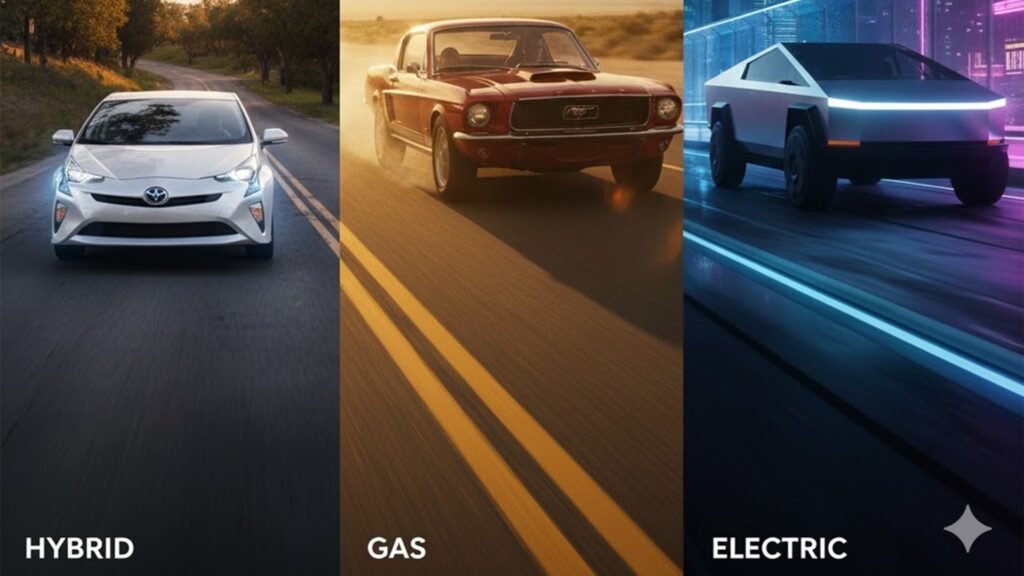
1. The Internal Combustion Engine (ICE): The Legacy Powerhouse
Despite the headlines, the traditional gas engine isn’t dead. For a significant portion of the U.S. population, it remains the most pragmatic choice.
- The Geography Factor: If you live in the “Dakota-style” rural stretches where the nearest neighbor is five miles away and the nearest fast-charger is two counties over, gas is still king.
- The “Apartment Dilemma”: If you don’t have a dedicated garage or a way to charge at home, the convenience of a 5-minute fuel stop outweighs the efficiency of an EV.
- Lower Entry Price: Generally, ICE vehicles have the lowest MSRP. For a buyer looking to minimize their monthly car payment rather than their long-term fuel bill, gas remains the most accessible entry point.
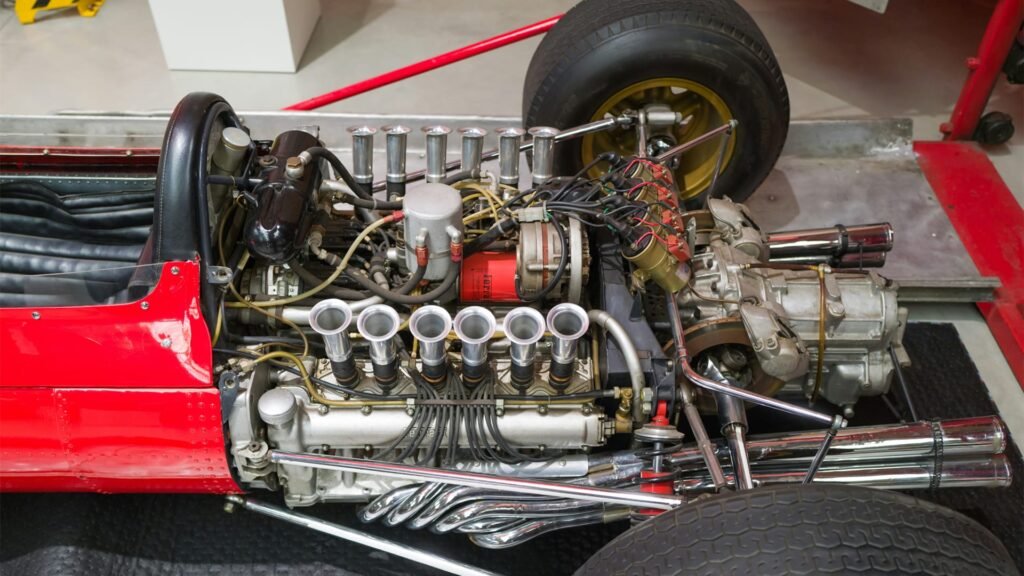
2. The Hybrid (HEV & PHEV): The “Goldilocks” Solution
Hybrids have surged in popularity recently, and for good reason. They offer the best “bridge” between the old world and the new.
- Standard Hybrids (HEV): These require zero change in behavior. You pump gas, but you get 40–50 MPG in the city. For the average suburban American, this is the most painless way to slash fuel costs.
- Plug-in Hybrids (PHEV): The ultimate “best of both worlds.” Models like the Toyota RAV4 Prime or Prius Prime offer 30–40 miles of pure electric range—enough for the average American commute—while retaining a gas engine for the 500-mile road trip to Grandma’s house.
- The Complexity Caveat: You are essentially carrying two powertrains. While reliable brands (Toyota, Honda, Hyundai) have mastered this, you do have more components (batteries and spark plugs) to eventually service.
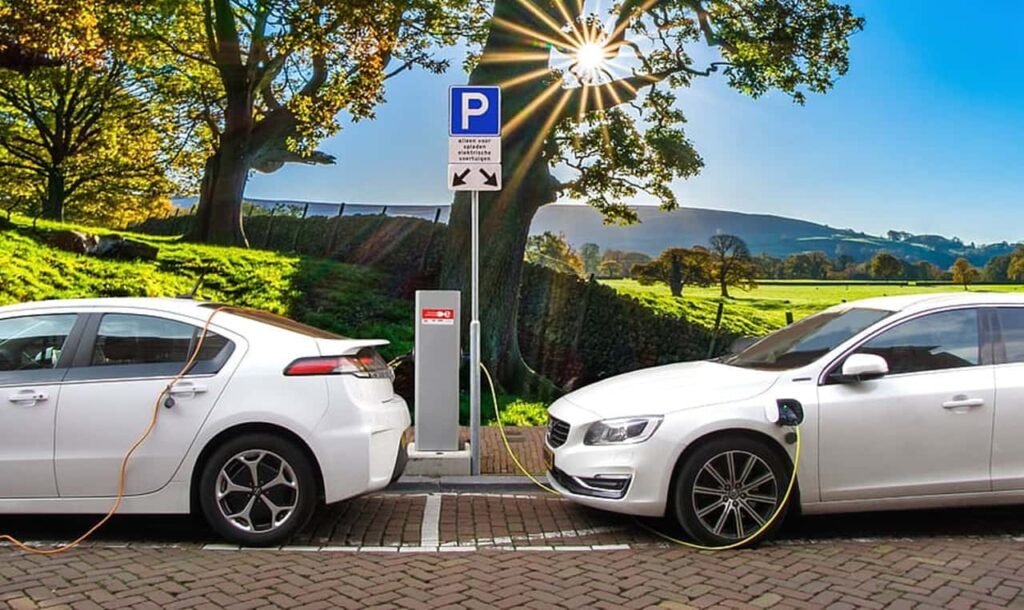
3. Battery Electric (BEV): The Performance and Cost-Per-Mile Champion
EVs are no longer just for early adopters. With the arrival of the Ford F-150 Lightning and the Tesla Model Y’s dominance, they have hit the mainstream.
- The Home-Charging Win: If you can charge at home (Level 2), the “fuel” cost of an EV is equivalent to paying roughly $1.00 to $1.50 per gallon of gas. The savings are massive over 100,000 miles.
- Maintenance Nirvana: No oil changes, no spark plugs, no timing belts, and significantly less brake wear due to regenerative braking.
- The Infrastructure Gap: If your life involves frequent long-distance towing or winter driving in the “Rust Belt” (where range can drop by 30%), the BEV still requires careful planning and a tolerance for “range anxiety.”

The Comparison Matrix: Which Fits Your Lifestyle?
| Feature | Gas (ICE) | Hybrid (HEV/PHEV) | Electric (BEV) |
| Best For… | Rural drivers & Apartment dwellers | Suburban families & Long commuters | Homeowners with short/mid commutes |
| Fueling/Charging | 5 mins (Anywhere) | 5 mins (Gas) / 2-6 hrs (Plug-in) | 20-40 mins (Fast) / 8 hrs (Home) |
| Maintenance Cost | Highest (Oil, Plugs, Belts) | Moderate | Lowest (Tires, Cabin Filter) |
| Driving Experience | Familiar, louder | Seamless, quiet | Instant torque, silent |
| Upfront Cost | Lowest | Moderate | Highest (Offset by credits) |
| Max Range | 400 – 500+ miles | 500 – 600+ miles | 250 – 350 miles |
Critical Considerations for the American Driver
The “Cold Weather” Penalty
If you live in Minnesota or Maine, the choice changes. Batteries are chemical devices that hate the cold. An EV that gets 300 miles in June might only get 200 in January. Hybrids and ICE vehicles handle cabin heating much more efficiently by using “waste heat” from the engine.
Resale Value and Depreciation
Currently, the used EV market is volatile due to rapid technology leaps and aggressive price cuts from manufacturers. If you plan to trade your car in every 3 years, a Hybrid or a high-demand ICE (like a Tacoma or Wrangler) will likely hold its value better than a 3-year-old EV.
The “True” Cost of Ownership
Don’t just look at the MSRP. An EV might be $10,000 more expensive upfront, but between the $7,500 Federal Tax Credit (if you qualify) and saving $1,500 a year on gas, the “break-even” point often arrives in less than 4 years.
The Final Verdict: How to Choose
- Choose Gas (ICE) if you have a limited upfront budget, no home charging, or your life involves frequent 400+ mile trips through areas with poor infrastructure.
- Choose Hybrid (HEV) if you want the highest possible MPG without thinking about charging. It is the “no-regrets” choice for 80% of American drivers.
- Choose Plug-in Hybrid (PHEV) if you have a garage and a commute under 30 miles, but still want to take the occasional cross-country road trip.
- Choose Electric (BEV) if you can charge at home, love high-tech performance, and want to permanently opt out of the gas-price rollercoaster.
The “best” car isn’t about what’s trending on social media—it’s about what fits your specific zip code and your daily routine. Do the math on your daily mileage before you sign the paperwork.
Useful Links: