Every era of automotive design has a moment where the industry collectively pauses—stunned by what the future could look like. The Mercedes-Benz Vision AVTR is that moment for our generation. More than just a design study, the AVTR represents a philosophical shift: a machine engineered not merely to move through the world, but to interact with it, sense it, and visually express its reactions in real time.
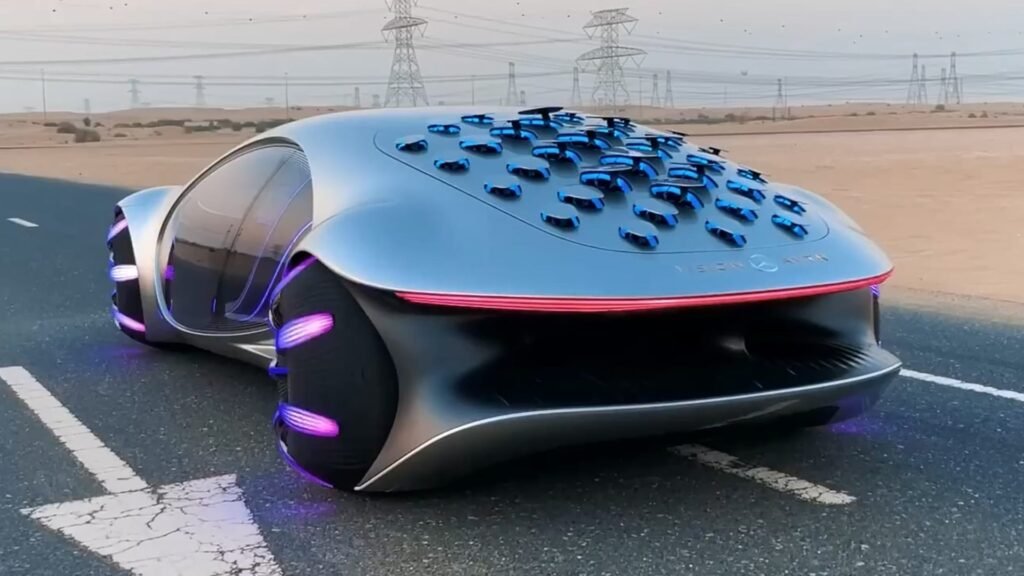
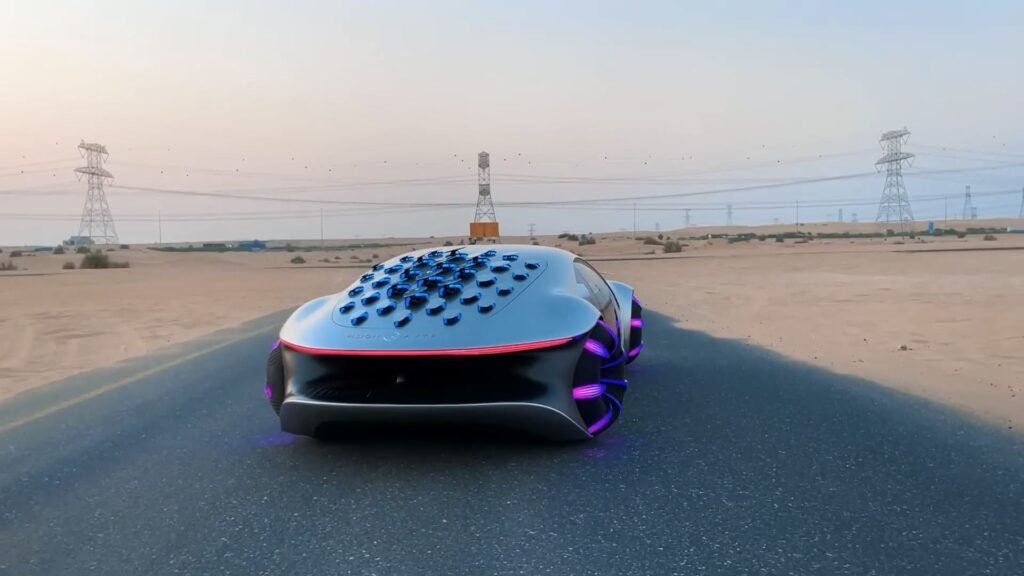
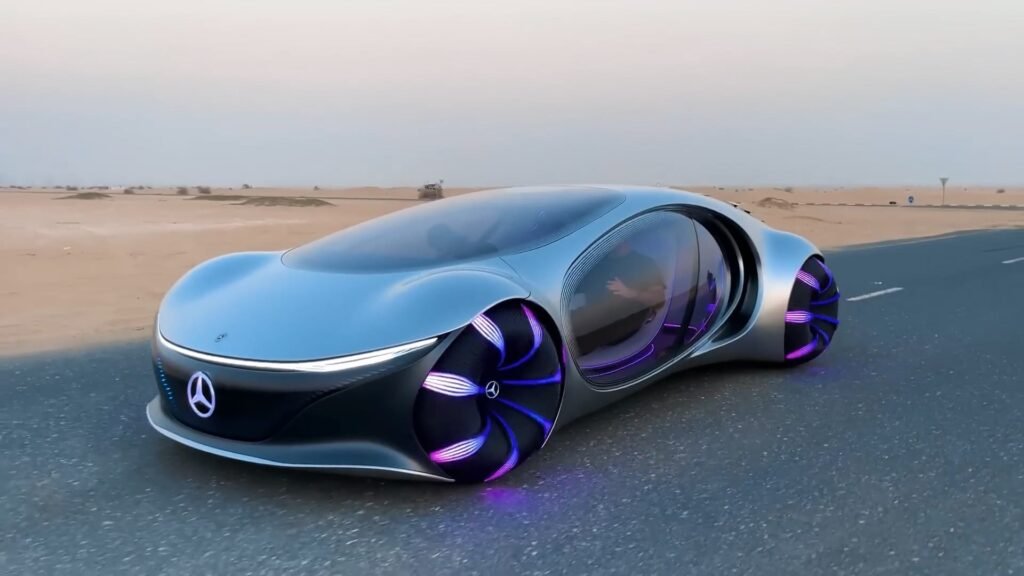
Presented originally as a collaboration between Mercedes-Benz and the creators of Avatar, the Vision AVTR was designed to explore the intersection of sustainability, biomimicry, experiential driving, and radical vehicle interface design. Seeing it in motion—especially across an open desert as shown in the image—feels like watching a living organism glide across the landscape rather than a human-made vehicle.
This is a comprehensive, expert-level analysis of what makes the Vision AVTR one of the most advanced concept cars ever produced.
A Design Language Inspired by Nature, Not Machinery
Exterior Overview
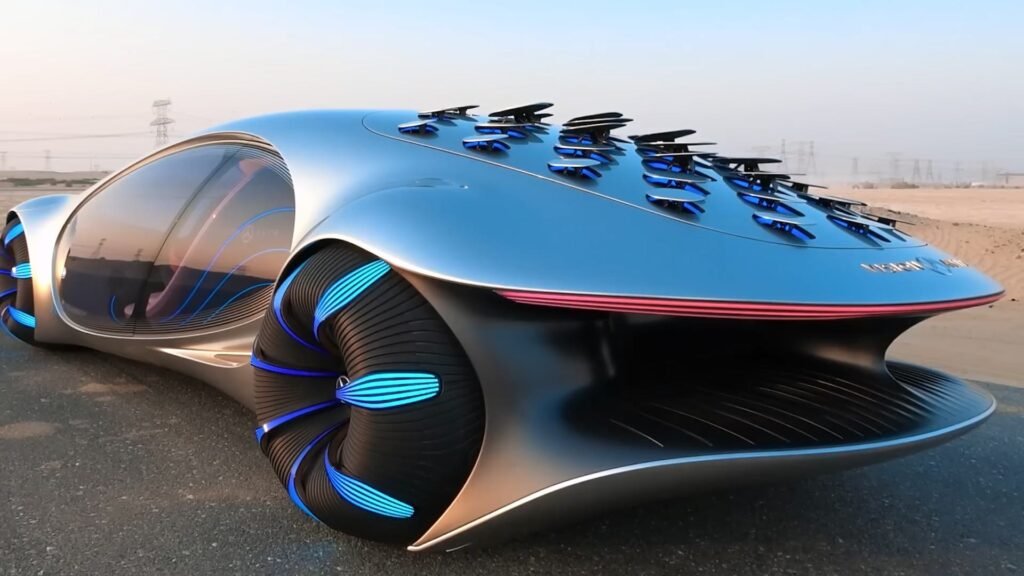
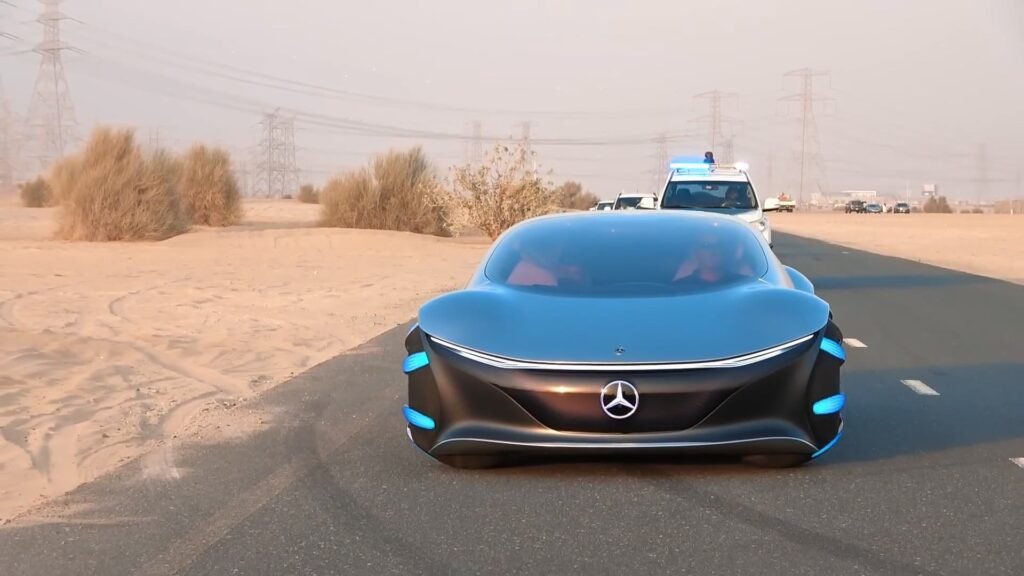
The first impression of the Vision AVTR is simple: it does not resemble a car. Its form is fluid and uninterrupted, blending oversized glass surfaces with a continuous metallic body shell. The proportions ignore traditional references—there is no hood as we know it, no grille, and no mechanical complexity visible externally.
Key Design Elements
- Ultra-smooth body structure with no sharp creases
- Full-glass cabin with “wing-style” transparent doors
- Continuous LED light bands front and rear
- Biomimetic “bionic flaps” on the tail section
- Spherical omnidirectional wheels
The image you provided captures the rear of the car—where the most visually arresting component sits: 33 active bionic flaps, designed to mimic the movement of organic scales or “seeds of the Tree of Souls” from Avatar. These flaps articulate independently, creating a living-creature effect and showing directional intent, braking signals, and expressive, reactive movement.
Mercedes intentionally wanted the vehicle to feel “alive,” and those flaps deliver that effect in a way no other vehicle has attempted.
The Spherical Wheels: A Radical Rethinking of Mobility
Traditional wheels limit movement. The AVTR’s spherical wheels break that barrier entirely.
Omnidirectional Wheel Technology
Each wheel is:
- A completely independent sphere
- Able to rotate 30° in multiple axes
- Electrically driven and controlled individually
This allows the AVTR to:
- Drive sideways (crab walk)
- Move diagonally
- Rotate tightly in place
- Maintain directional stability regardless of body orientation
Experiencing a full sideways motion at speed—as the video transcript describes—is one of the most surreal sensations a driver can have. Instead of steering with a wheel, you manipulate a central control pod that translates subtle movements into multi-directional wheel instructions.
This system represents one of the most advanced demonstrations of future vehicle mobility ever tested in a functioning concept.
Lighting That Feels Alive, Not Decorative
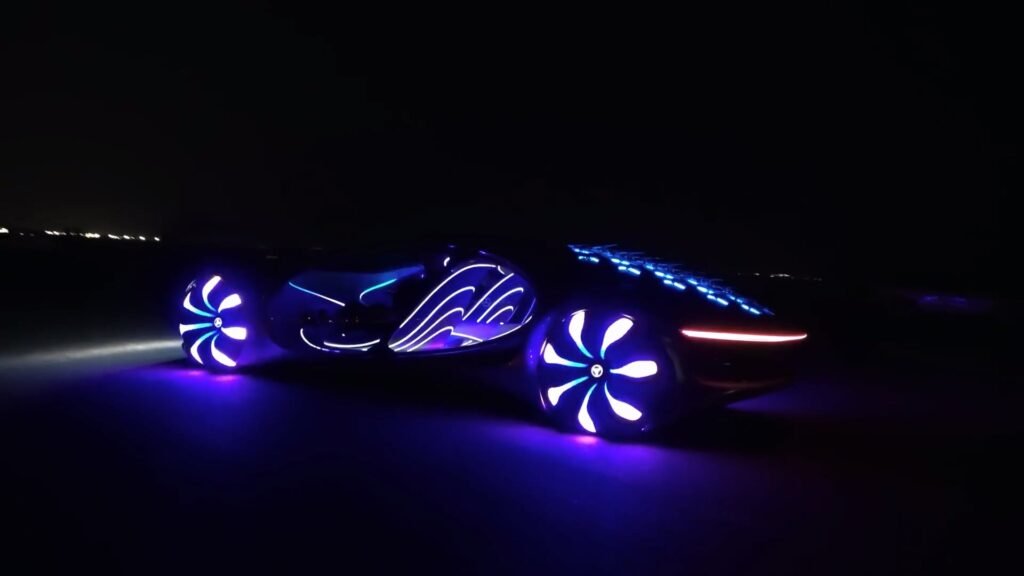
Lighting on the Vision AVTR isn’t ornamental; it is communicative.
Exterior Light Functions
- Full-vehicle LED “neural pathways”
- Charging animations that pulse inward
- Turn signals integrated into wheel pods
- Rear light bar with progressive motion
- Bionic flaps that change from blue when accelerating to red under braking
Mercedes’ intent here wasn’t merely futuristic aesthetics—it was to create an emotional interface. The vehicle uses light to “breathe,” “react,” and “signal” in ways comparable to a living organism.
This approach is part of the brand’s exploration of “emotionally intelligent vehicles,” which could eventually communicate intent to pedestrians, passengers, and other cars in an autonomous future.
The Interior: A Spacecraft Without a Steering Wheel
The cabin is where the AVTR breaks every rule of conventional car design.
A Zero-Wheel Cockpit
The vehicle has no steering wheel or pedals.
Instead, control is achieved through a central multifunctional biometric pod on the console.
The Control Pod Functions
- Tilt forward = accelerate
- Tilt backward = brake
- Rotate = turn
- Twist = omnidirectional crab movement
It allows either front passenger to drive, turning the cabin into a symmetrical, shared experience.
Biometric Interaction
The vehicle recognizes the driver through:
- Palm recognition
- Heart-rate sensing
- Breathing-pattern analysis
When the driver places a hand on the pod, the interior comes alive—lights pulse, seats adjust, and a full-width projection screen activates, showing navigation and environment-based holographic graphics.
The vehicle feels more like an intelligent companion than a machine awaiting input.
Sustainable Materials, Real Engineering Intent
Every surface inside the Vision AVTR has been engineered to align with sustainable principles.
Key Sustainability Features
- Vegan leather seats made from plant-based materials
- Karuun® wood panels, harvested from fast-growing rattan
- Recyclable battery concept using organic cell chemistry (no rare-earth metals)
- Transparent doors minimizing physical material use
Mercedes wanted the car to reflect a future where sustainability is not optional but intrinsic to luxury mobility.
Driving the AVTR: What It Actually Feels Like
Based on the test-drive footage and technical explanations, driving the Vision AVTR is unlike anything else on the road.
Driving Characteristics
- Extremely smooth, silent low-speed operation
- Immediate wheel response to pod input
- Crabbing ability that feels “unreal” to the driver
- Full awareness of driver bio-data, adapting interior and handling feel
- Light animation that reacts dynamically to motion
Even at low speeds—around 20 km/h, as described—drivers report that the experience is transformative. The ability to glide sideways while the wheels remain visually stationary to the body is something current production cars simply cannot replicate.
Technical Summary and Key Specifications
| Feature | Mercedes-Benz Vision AVTR |
|---|---|
| Vehicle Type | Fully electric, concept mobility platform |
| Drive System | Independent electric motors for each wheel |
| Wheel Design | Spherical omnidirectional wheels |
| Rear Aerodynamics | 33 active bionic flaps |
| Interior Controls | Central biometric joystick pod |
| Material Strategy | Vegan leather, sustainable wood, recyclable batteries |
| Doors | Transparent “insect-wing” style glass |
| Driving Capabilities | Sideways, diagonal, rotational, forward/backward |
| Human-Machine Interface | Heart-rate detection, projection dashboard |
A Concept Car With Genuine Engineering Depth
Some concept cars are static sculptures meant only for show. The Vision AVTR is the opposite:
it is a fully operational prototype, engineered to physically demonstrate technologies that could influence the next decade of vehicle development.
Technologies Likely to Influence Future Production Cars
- Advanced lighting communication for autonomous mobility
- Biometric vehicle identification
- Multi-directional low-speed maneuvering
- High-efficiency electric wheel modules
- Sustainable luxury material choices
While the AVTR will never enter production exactly as shown, many of its underlying technologies—particularly its HMI (human-machine interface) and sustainability strategy—are already influencing future Mercedes EQ models.
Why the AVTR Matters to the Automotive Industry
The AVTR serves as a proof-of-concept for a future where:
- Vehicles behave more like digital organisms
- Driving controls become intuitive and immersive
- Sustainability becomes a design foundation
- Exterior surfaces express information dynamically
- Mobility expands beyond simple forward/backward movement
It demonstrates how automotive brands can merge cinematic inspiration with real engineering to push past incremental improvement into visionary territory.
The Vision AVTR Is Unlike Anything on the Road—And That’s the Point
Standing behind the Vision AVTR in the desert—as shown in your image—feels like confronting a visitor from another era. The combination of glowing surfaces, dynamic scales, transparent doors, and omnidirectional wheels makes it difficult to determine where science ends and imagination begins.
As an automotive expert, I see the Vision AVTR not as a fantasy, but as a technological blueprint. It challenges every assumption about what a car should be, and forces the industry to consider what a car could be.
In many ways, this concept is Mercedes-Benz at its most fearless.
And while it remains a one-off prototype, the ideas it introduces are likely to echo through the brand’s future electric platforms—and possibly reshape the design language of mobility itself.