
For decades, the narrative was consistent, almost comforting in its simplicity: Chinese cars are cheap knock-offs. They were the “golf carts with iPads” of the automotive world—flimsy, derivative, and utterly incapable of competing with German engineering or American muscle. We were told to ignore them. We were told they couldn’t innovate.
We were lied to.
While Western automakers were busy protecting legacy margins and debating the merits of removing radar sensors, Chinese engineers were quietly building something terrifyingly advanced. The result is no longer a prototype; it’s parked in showrooms today. It is the Voyah Taishan (also known as the Voyah or “Taishan” in domestic markets), and it is quite possibly the most over-engineered, excessive, and value-dense luxury SUV ever created.
The Taishan doesn’t just compete; it obliterates the value proposition of every established luxury brand. With features that sound like typos and a price tag that induces a mix of confusion and jealousy, this vehicle marks the definitive end of the argument. The future isn’t coming; it has already arrived, and it costs less than a mid-spec Ford Explorer.
1. Design & Presence: The “Land Yacht” Reimagined
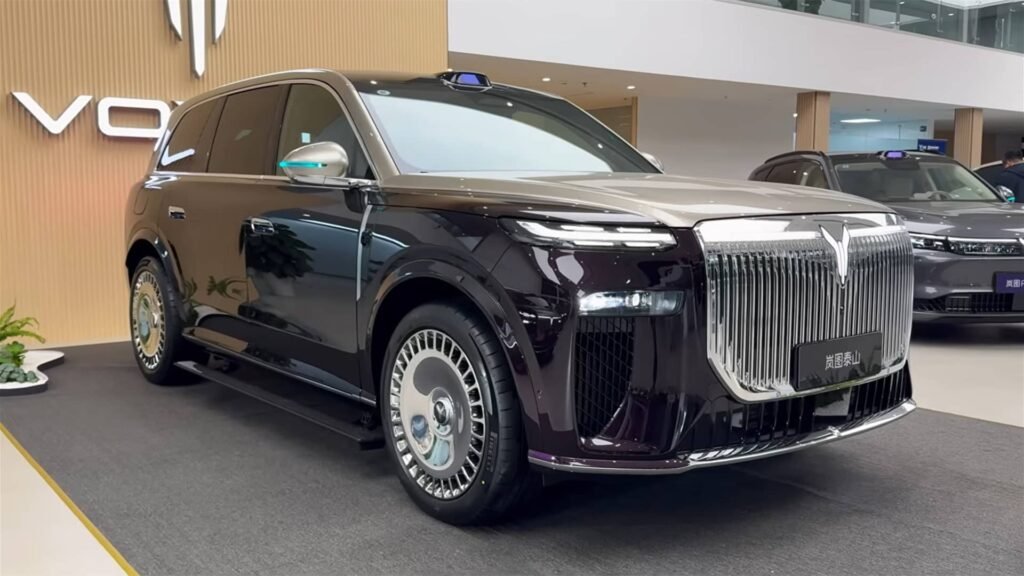
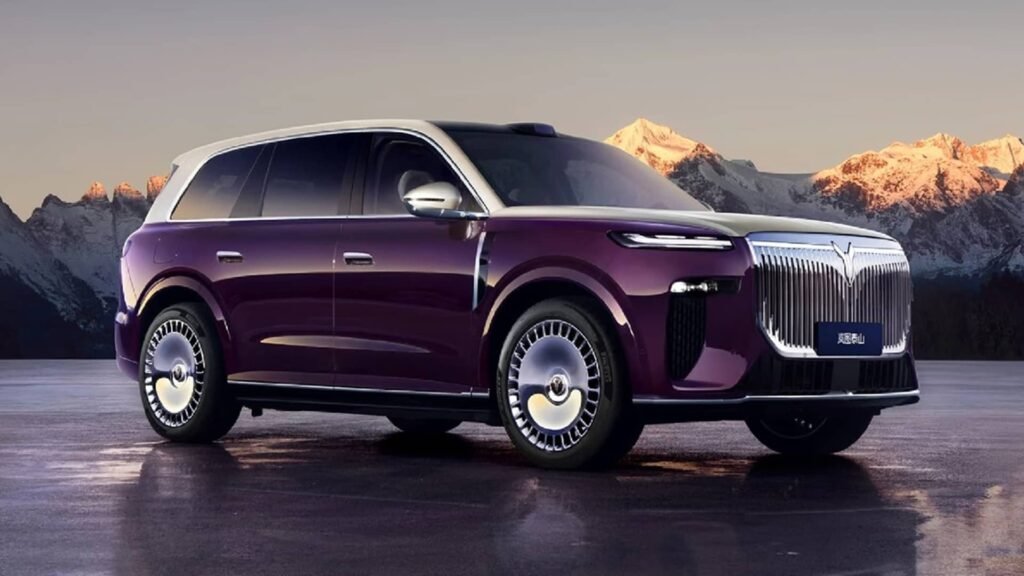
Standing next to the Taishan, you feel small. At over 17 feet (5,230mm) long with a wheelbase stretching 122 inches (3,120mm), it dwarfs a Range Rover and rivals the Rolls-Royce Cullinan in sheer physical presence. Yet, unlike the brick-like proportions of traditional American SUVs, the Taishan looks sculpted, as if carved by water rather than stamped by steel.
The “Waterfall” Front End
The centerpiece is the massive “Waterfall Grille.” Usually, oversized grilles scream “tacky,” but here, the thick, vertical chrome slats feel cold, heavy, and undeniably premium. This isn’t plastic chrome; it’s solid, tactile metal.
But the real magic lies in the lighting. Chinese OEMs are now executing LED technology with a sophistication that makes Audi’s matrix lights look archaic.
- The Greeting Ritual: Approach the vehicle with the key, and the entire front end awakens. Lights ripple outward like water droplets. The “Voyah Wings” logo pulses like a heartbeat. It’s not just unlocking; it’s a theatrical greeting that makes you feel like Tony Stark entering his garage.
- Sensor Integration: Those dark panels in the bumper aren’t fog lights. They house the sensory suite for Huawei ADS 4.0.
| Feature | Traditional Luxury (GLS/Cullinan) | Voyah Taishan |
|---|---|---|
| Grille Material | Plastic Chrome / Mesh | Solid Vertical Chrome Slats |
| Lighting Tech | Matrix LED / Laser | Interactive Ripple DRL + Crystal Tail Lights |
| Welcome Sequence | Simple Unlock | Full “Heartbeat” Pulse & Light Ripple |
| Aerodynamics | Boxy, High Drag | Sculpted “Water-Carved” Profile |
2. The Sensor Overkill: Huawei ADS 4.0 & 4 LiDARs
If you thought Tesla’s camera-only approach was bold, Taishan’s sensor suite is outright paranoid—in the best way possible. While US manufacturers are removing radar to cut costs, Voyah has partnered with Huawei to deploy the ADS Ultra system.
Seeing in 4D
This isn’t just driver assistance; it’s a mobile supercomputer.
- Quad LiDAR Setup: Most cars fight to put one LiDAR on the roof. The Taishan has four. One 192-line unit sits atop the roof, while three additional units are seamlessly integrated into the bodywork.
- 360° Redundancy: Combined with millimeter-wave radars, ultrasonic sensors, and high-definition cameras, the car constructs a real-time 4D map of its surroundings.
- Night Vision Capability: It can detect a pedestrian in pitch-black darkness from 200 yards away. It sees the car in front of the car in front of you.
Expert Insight: “The sensor density on the Taishan isn’t just about safety; it’s about data fidelity. With four LiDARs, the system achieves centimeter-level precision in adverse weather where cameras fail. It’s essentially a NASA control room on wheels.” — Senior Autonomous Driving Analyst, 2026.
This level of hardware ensures that parking lot dings are a thing of the past. The car perceives obstacles with a clarity that human eyes simply cannot match.
3. Engineering Defying Physics: 16° Rear-Wheel Steering
Here is the feature that breaks the brain. Look at the rear wheels. Now watch them turn.
The Taishan boasts 16 degrees of rear-wheel steering. To put that staggering number in perspective:
- Mercedes S-Class: ~10 degrees
- Tesla Cybertruck: ~10 degrees
- Voyah Taishan: 16 degrees
The “Civic” Turning Radius
This engineering marvel allows a 17-foot land yacht to execute a U-turn on a standard two-lane road without reversing. It can “crab walk” diagonally into tight parallel parking spots. The turning radius is comparable to a Honda Civic.
This isn’t just a party trick; it transforms the driving dynamics of a massive vehicle. At low speeds, the rear wheels turn opposite the front for agility. At high speeds, they turn in unison for stable, lane-change confidence. It defies the laws of physics that usually govern large SUVs.
| Vehicle | Rear-Wheel Steering Angle | Turning Radius Impact |
|---|---|---|
| Mercedes S-Class | 10° | Good for class |
| Cadillac Escalade IQ | 10° | Improved agility |
| Voyah Taishan | 16° | Compact Car Agility |
| Standard Large SUV | 0° | Wide, cumbersome turns |
4. Powertrain Revolution: The “Perfect” Hybrid?
The industry is split between EVs (range anxiety) and Hybrids (limited electric range). The Taishan laughs at this dichotomy. It is a Plug-in Hybrid (PHEV) that behaves like a pure EV.
The Numbers Are Stupid
- Battery Capacity: 65 kWh. Let that sink in. That is larger than the battery in a Standard Range Tesla Model 3. It is not a “hybrid battery”; it is an EV battery with a gas generator attached.
- Electric Range: 230 miles (CLTC) of pure electric driving. You can commute, shop, and run errands for a week without burning a drop of gas. For 95% of daily use, this is an EV.
- Total Range: With the 1.5L turbo range extender engaged, total range exceeds 870 miles. You can drive from Los Angeles to Salt Lake City non-stop. Your bladder will give out before the car does.
- Performance: Dual-motor AWD delivers 510 HP and 600 lb-ft of torque. Despite weighing 3 tons, it hits 0-60 mph in 5.5 seconds. The acceleration isn’t just fast; it’s a surging freight train effect.
800V Architecture & 5C Charging
Most PHEVs charge painfully slowly. The Taishan utilizes an 800-volt architecture supporting 5C ultra-fast charging.
- Charge Time: 20% to 80% in 12 minutes.
- Real World Impact: You can plug in, buy a snack, use the restroom, and return to a nearly full battery. It charges faster than your smartphone.
| Metric | Typical PHEV (e.g., Volvo XC90) | Tesla Model Y Long Range | Voyah Taishan |
|---|---|---|---|
| Battery Size | 18–25 kWh | 75 kWh | 65 kWh |
| Pure Electric Range | 30–40 miles | 330 miles | 230 miles |
| Total Range | ~500 miles | ~330 miles | 870+ miles |
| Fast Charge Speed | Slow (AC mostly) | 250 kW DC | 5C Ultra-Fast (12 min) |
| Refuel Flexibility | Yes | No | Yes |
5. Interior: First-Class Airline Pods on Wheels
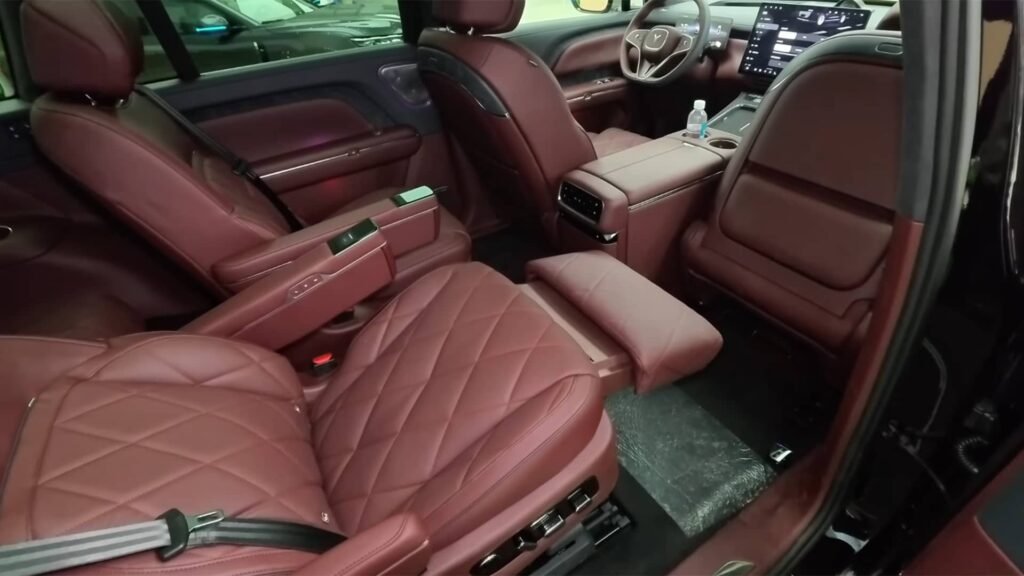
Open the door, and the first thing you notice is the smell. It’s not chemical plastic; it’s rich, earthy Nappa leather and microfiber suede. Every surface, including the bottom of the door bins, is lined with felt to prevent rattles. When you close the door, it doesn’t “clang”; it thuds like a bank vault.
The Harmony OS 5.0 Cockpit
The dashboard is dominated by a triple-screen layout running Huawei’s Harmony OS 5.0.
- Performance: 4K OLED resolution with zero lag. Swiping feels faster than an iPad Pro.
- Ecosystem: Seamlessly drag videos from the center screen to the passenger display. The passenger can connect Bluetooth headphones and watch Netflix while you navigate.
The Second Row: Zero Gravity & Ice Cream
The six-seater configuration features two captain’s chairs that redefine luxury.
- Zero Gravity Mode: Press a button, and the seat reclines fully, extending a leg rest and tilting your body so your knees are above your heart.
- Hot Stone Massage: The rollers heat up, offering a spa experience on the highway.
- The Fridge: This isn’t a cooler blowing AC air. It’s a compressor-driven refrigerator nestled in the center console. Temperatures range from -6°C (ice cream) to 50°C (baby formula). Yes, you can drink an ice-cold cola with actual condensation on the can while stuck in traffic.
- Entertainment: A 17-inch OLED screen folds down from the ceiling, complete with a remote.
Audio: 2,300 Watts of Pure Power
The Tian Lai sound system features 32 speakers, including headrest and ceiling units. Pumping out 2,300 watts with Dolby Atmos, it creates a soundstage that puts the Burmester systems in Mercedes to shame. You don’t just hear the music; you feel the bass in your bone marrow.
Practicality: The Third Row That Works
Unlike the “penalty box” third rows in German rivals, the Taishan offers actual legroom for adults. With dedicated AC vents, USB-C ports, and cup holders, two adults can sit comfortably for hours.
| Feature | Mercedes GLS | Tesla Model X | Voyah Taishan |
|---|---|---|---|
| Seat Material | Leather (Optional Nappa) | Vegan Leather | Full Nappa + Microfiber Suede |
| Rear Entertainment | Optional Screens | Yoke Screen | 17″ Fold-down OLED + Tablet Control |
| Refrigeration | None | None | Compressor Fridge (-6°C to 50°C) |
| Massage Function | Basic | None | Hot Stone + Acupressure |
| Third Row Space | Tight for Adults | Very Tight | Adult-Legroom Compatible |
| Audio Power | ~1,000 Watts | ~900 Watts | 2,300 Watts (32 Speakers) |
6. The Price Tag: An Existential Threat to the West
Here is the number that keeps Detroit and Stuttgart awake at night.
If this car wore a Mercedes badge, it would easily command $130,000. As a Range Rover, it would be $150,000 and likely suffer from electrical gremlins within a year. As a Tesla Model X, it would exceed $100,000.
The Voyah Taishan starts at $53,000.
Even the fully loaded “Ultra” trim with laser headlights and the largest battery barely touches $70,000.
The Geopolitical Implication
This pricing strategy is not just aggressive; it’s predatory. For the price of a Honda Pilot or Ford Explorer, you get a vehicle with more technology than the International Space Station.
- Why Tariffs Exist: This explains the panic in Washington and Brussels. If the Taishan were allowed into US dealerships tomorrow at $53k, the Chevrolet Tahoe, Jeep Grand Cherokee, and even the entry-level BMW X5 would become obsolete overnight. Domestic automakers simply cannot compete with this level of specification at this price point.
- Value Proposition: You are getting 230 miles of EV range, 800V charging, 16° rear steering, 4 LiDARs, and a fridge/massage cinema for half the price of a comparable European luxury SUV.
Final Verdict: The Paradigm Shift
The Voyah Taishan is not merely a “good Chinese car.” It is a global benchmark that happens to be made in China. It exposes the complacency of legacy automakers who have been coasting on brand prestige while ignoring technological substance.
Who is this for?
- The Pragmatic Lux Buyer: You want Rolls-Royce comfort without the Rolls-Royce maintenance bill.
- The Tech Early Adopter: You believe in LiDAR redundancy and true AI driving, not camera guesses.
- The Family Hauler: You need three rows that adults can actually sit in, plus entertainment that keeps kids quiet.
The Hard Truth:
We were told to wait for the future of mobility. We were told it would be expensive. The Voyah Taishan proves that the future is already here, it’s incredibly capable, and it’s shockingly affordable. The only question remaining isn’t whether this car is good—it’s whether Western automakers can survive its arrival.
If you had $55,000 today, would you buy a dated, gas-guzzling SUV from 2015, or would you buy this spaceship with a fridge, massage seats, and self-driving capabilities? The answer is obvious. And that’s exactly what scares the competition.
Disclaimer: Specifications and pricing are based on current global market data and manufacturer announcements as of early 2026. Availability varies by region due to trade regulations and tariffs. Always verify local dealership offerings.