If you’ve stepped into a showroom late in 2025 or early 2026, you’ve likely noticed that the sales pitch has fundamentally shifted. Dealers are no longer just talking about leather quality or zero-to-sixty times; they are talking about “predictive envelopes” and “sensor fusion.”
We are currently witnessing the most significant leap in automotive safety since the invention of the three-point seatbelt. Smart Collision Avoidance Systems (SCAS) have evolved from reactive “beeping” gadgets into proactive, AI-driven co-pilots. But how much of this is marketing, and how much is life-saving reality?
As of December 2025, the data is clear: these systems are no longer a luxury—they are the new baseline for American roads.
From “Alerts” to “Anticipation”: The AI Evolution
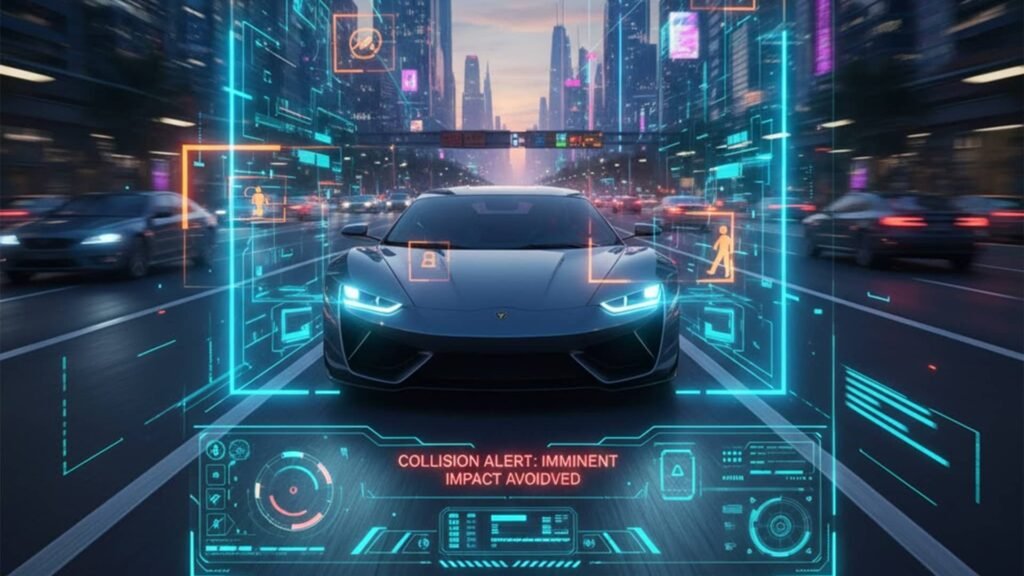
In 2024, most collision systems were reactive. If a car stopped suddenly in front of you, your car would wait for a specific distance threshold before slamming the brakes. In 2026, the tech has moved into the predictive phase.
The latest suites from manufacturers like Audi (Q5/A6 e-tron) and Hyundai (2026 Palisade) use Large Language Model (LLM) logic and neural networks to “reason” through traffic. Instead of just seeing a “stationary object,” the car now identifies a “delivery truck with hazards on” and anticipates that a courier might step out from behind it. This nuance is the difference between a jarring emergency stop and a smooth, preemptive deceleration.
The Lidar vs. Vision Power Struggle
The industry remains split on the “eyes” of the car.
- The Multi-Sensor Approach (Volvo, Genesis, Audi): These brands use Lidar (Laser Imaging, Detection, and Ranging). In 2026, Lidar has become more compact and affordable, allowing the Volvo EX90 to detect a pedestrian in pitch-black darkness up to 250 meters away—far beyond the reach of traditional high beams.
- The Vision-Only Approach (Tesla): Tesla continues to refine its “End-to-End” neural network, relying solely on high-resolution cameras. While critics point to “occlusion” issues (cameras getting blinded by sun or snow), Tesla’s massive real-world data loop has made its 2025 Model 3 collision avoidance remarkably fluid in dense urban environments.
Comparison: 2026 Top-Tier Collision Avoidance Suites
| System Name | Leading Brand | Key Tech Highlight | IIHS 2025-26 Rating |
| Audi Pre Sense | Audi A6 e-tron | Predictive Rear-End Pre-Tensioning | Top Safety Pick+ |
| Honda Sensing® | 2026 Passport | ACE™ Body Structure Integration | Top Safety Pick+ |
| Subaru EyeSight® | 2026 Forester | Dual-Camera Wide Angle Vision | Top Safety Pick+ |
| Genesis SmartSense | 2026 G80 | Highway Driving Assist II (HDA 2) | Top Safety Pick+ |
| Toyota Safety Sense 3.0 | 2025-26 Camry | Proactive Driving Assist (PDA) | Top Safety Pick |
V2X: The Silent Revolution
The most “hidden” growth in 2026 safety is Vehicle-to-Everything (V2X) communication.
Modern “Smart Zones” in major cities like San Francisco and Austin now broadcast data directly to your car. If an ambulance is approaching an intersection three blocks away, or if a traffic light is about to turn red around a blind corner, your car receives this “digital warning” before your eyes ever see the hazard.
This creates what engineers call a “360-degree awareness bubble.” It’s not just about what your car sees; it’s about what the entire city sees. According to recent 2025 PMC research, V2X integration can reduce intersection collisions—the most common type of urban accident—by nearly 40%.
The Consumer Catch: Why Safety Now Costs More to Fix
While these systems are drastically reducing fatalities, they are having a painful side effect on your wallet: Repair Inflation.
In 2026, a “fender bender” is a relic of the past. If you tap a pole in a 2026 Kia Seltos or Honda Passport, you aren’t just replacing plastic; you are replacing radar modules and recalibrating high-definition cameras.
- Diagnostic Fees: Almost every minor repair now requires a $400–$800 “Calibration Fee” to ensure the AI “eyes” are still aligned.
- Insurance Premiums: Because these “smart” parts are so expensive to replace, insurance companies are increasingly “totaling” vehicles with what looks like minor cosmetic damage.
Buying Advice: What Matters in 2026?
If you are prioritizing collision avoidance, don’t just look at the brand—look at the hardware generation.
- Look for “Good” IIHS Pedestrian Scores: Some systems work perfectly on cars but fail to see children or cyclists. The 2026 Subaru Forester and Tesla Cybertruck currently lead in these specific tests.
- Standard vs. Optional: Ensure the “Active” features (Automatic Emergency Braking) are standard across all trims. In 2026, most brands have made this mandatory, but some “entry-level” luxury trims still gatekeep the best tech behind “Pro” packages.
- Night-Vision Integration: If you live in a rural area, prioritize vehicles like the Cadillac Escalade IQ or Volvo EX90 that offer thermal imaging or Lidar for superior nighttime detection.
The Bottom Line
Smart Collision Avoidance is no longer a “nice-to-have” feature—it is the digital firewall between you and the rising unpredictability of modern roads. While it comes with a “tech tax” in the form of higher insurance and repair costs, the 52% reduction in rear-end collisions reported in late 2025 makes it the most valuable investment you can make in your next vehicle.
Useful Links: