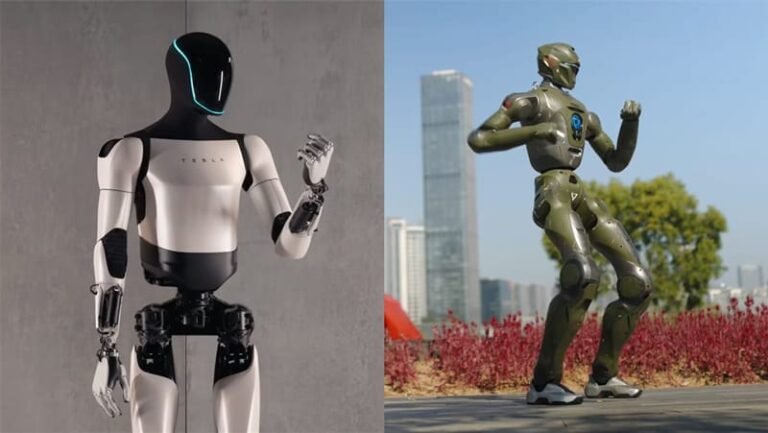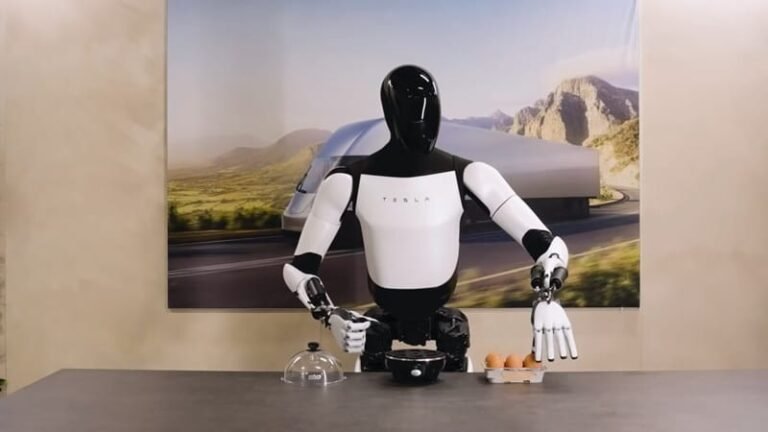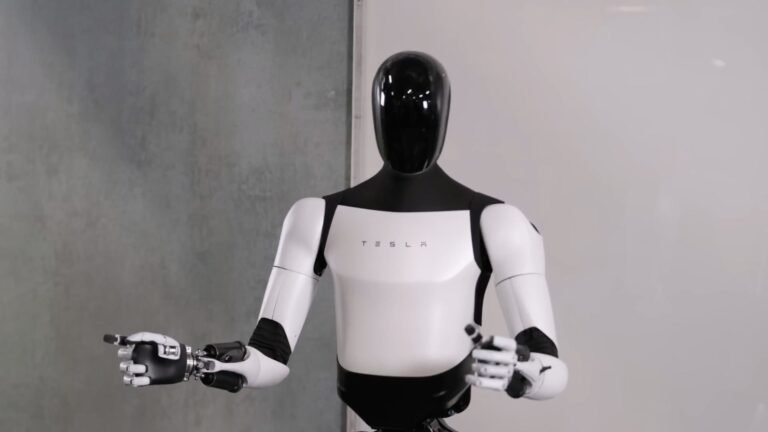
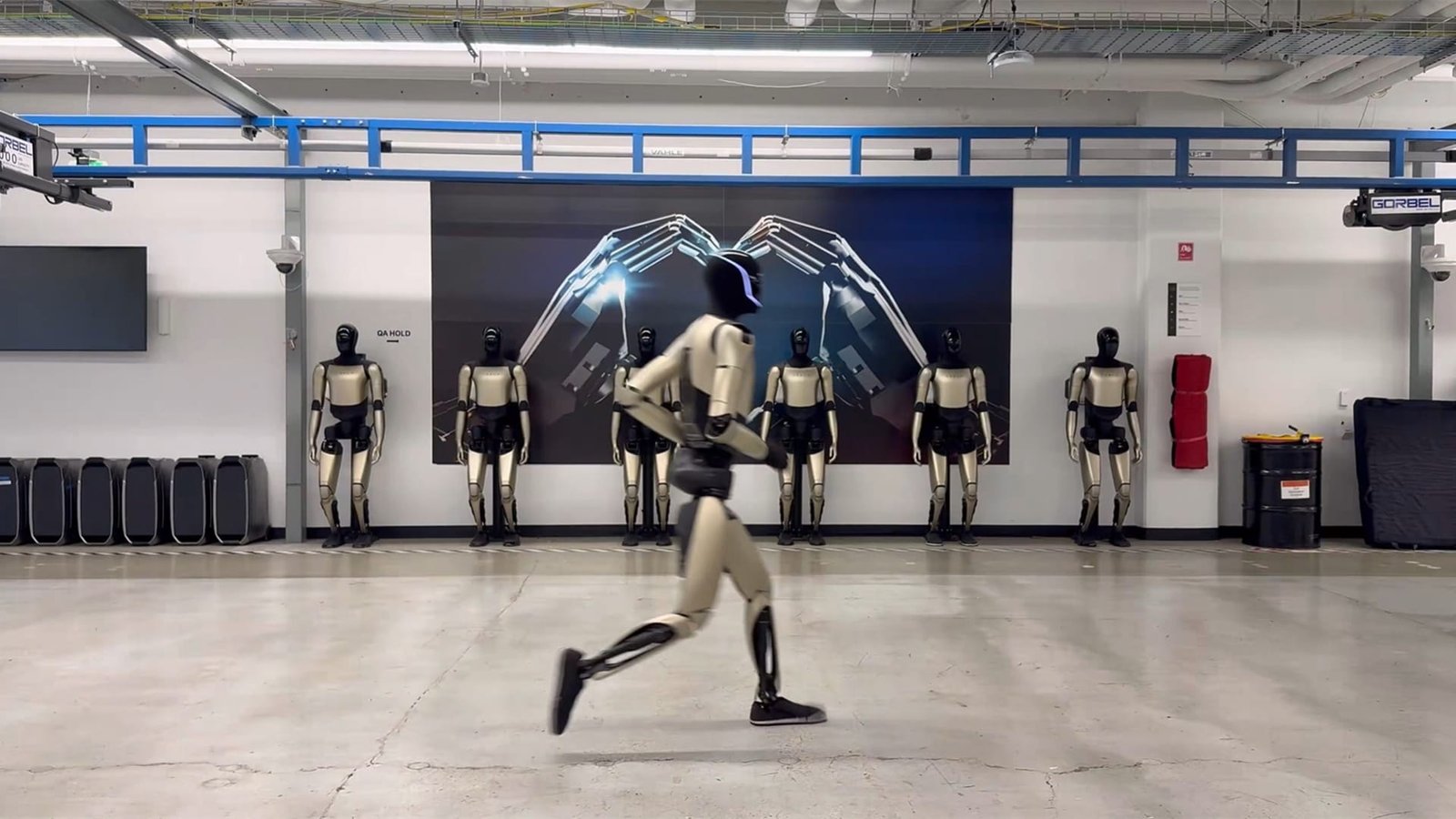
When a four-second clip of the Tesla Optimus robot jogging surfaced online, the global tech community reacted with rare silence—followed by shock. It wasn’t running fast. It wasn’t performing flips. In fact, countless robots have already demonstrated more dramatic athletic feats. Yet none of them triggered the same tectonic shift in public perception.
The reason is simple: Optimus isn’t operating on the same logic as traditional robots. It didn’t run because an engineer scripted the motion. It ran because it decided to.
A Robot That Thinks Before It Moves
Most humanoid robots seen in commercial demos rely on exhaustively pre-planned sequences. Every angle, every shift in balance, every step is choreographed. Some are remotely guided in real time. They perform beautifully, but only when the script is perfect.
Optimus does something fundamentally different.
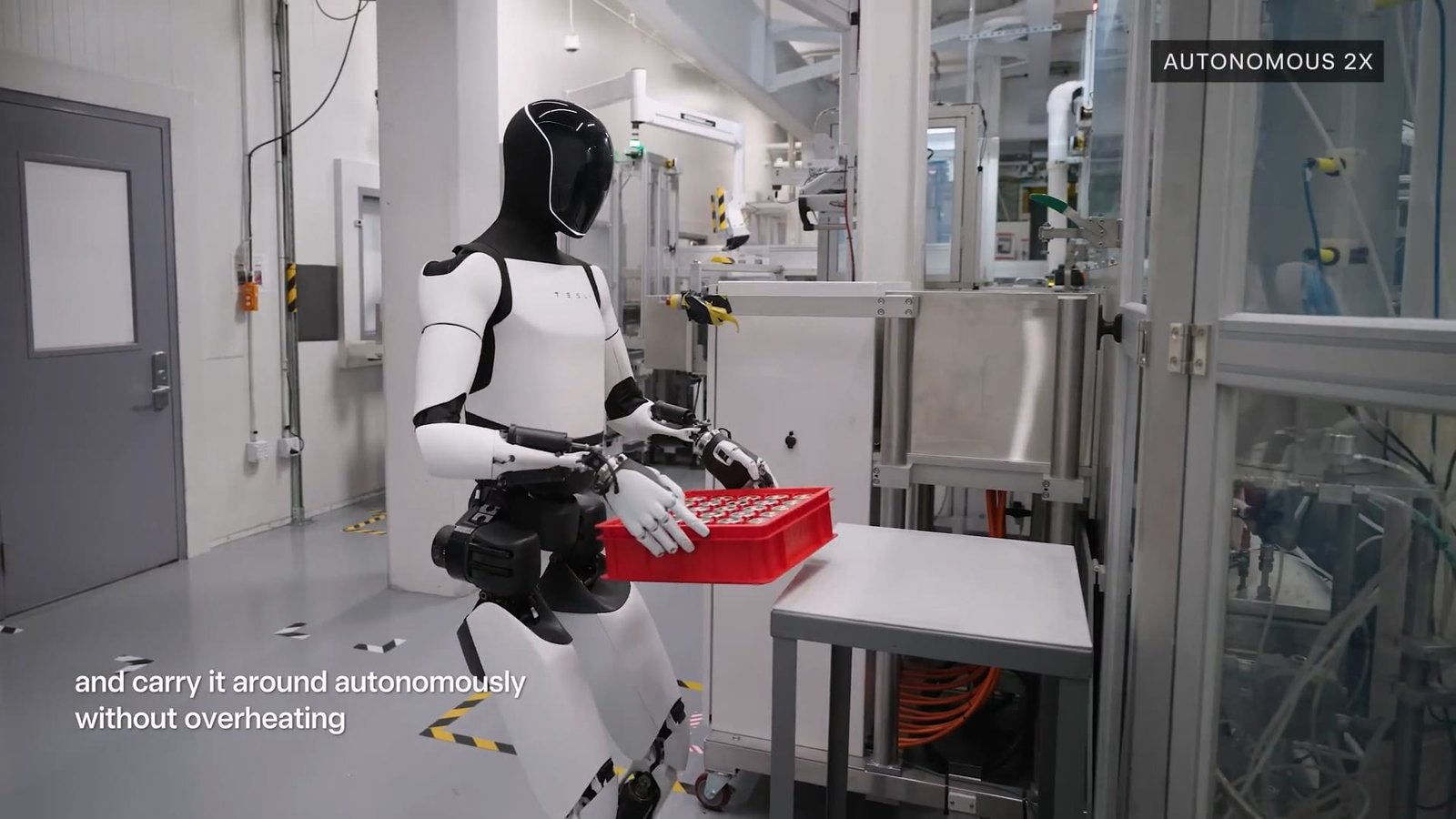
Its movements are generated by AI-driven decision-making, powered by the same FSD (Full Self-Driving) compute Tesla uses in its vehicles. Using pure visual sensing and reinforcement learning, the robot observes its environment, predicts outcomes, and adapts dynamically—without scripts and without remote guidance.
The result? A robot capable of self-directed, self-balanced locomotion, responding to the real world with continuously updated neural policies rather than predetermined code.
The Speed of Evolution: Why It Scares the Industry
Two years ago, the first Optimus prototype moved with the stiffness of a mannequin—slow, uncertain, and limited.
Today, the robot’s latest iteration has achieved:
- 30% increase in walking speed
- Stable slow-run capability with dynamic balance
- Significant gait refinement through neural training
- Autonomous navigation and docking for charging
One of the most astonishing demonstrations wasn’t the running clip, but the robot locating a charging station on its own. It used onboard cameras to search, navigate, position itself, and align with the port—without instructions.
This marks a profound change:
Optimus has entered the stage of autonomous self-maintenance.
It doesn’t just follow tasks. It knows when it needs power and acts accordingly.
This is not an upgrade; it is a technological phase shift.
The Hidden Complexity: Sensors and Human-Like Control
The robot’s stability is supported by over 200 coordinated sensors feeding a real-time control system. Tesla’s automotive-grade servo actuators manage joint torque with surgical precision, enabling natural human-like balance.
These behaviors are trained by an end-to-end neural network that models human locomotion. Instead of telling the robot how to move, engineers train it on what successful movement looks like, and Optimus learns the rest.
This is the same philosophy that drives Tesla’s autonomous driving:
Hardware robust enough to scale + software that improves exponentially.
The Hands: The True Frontier of Robotics
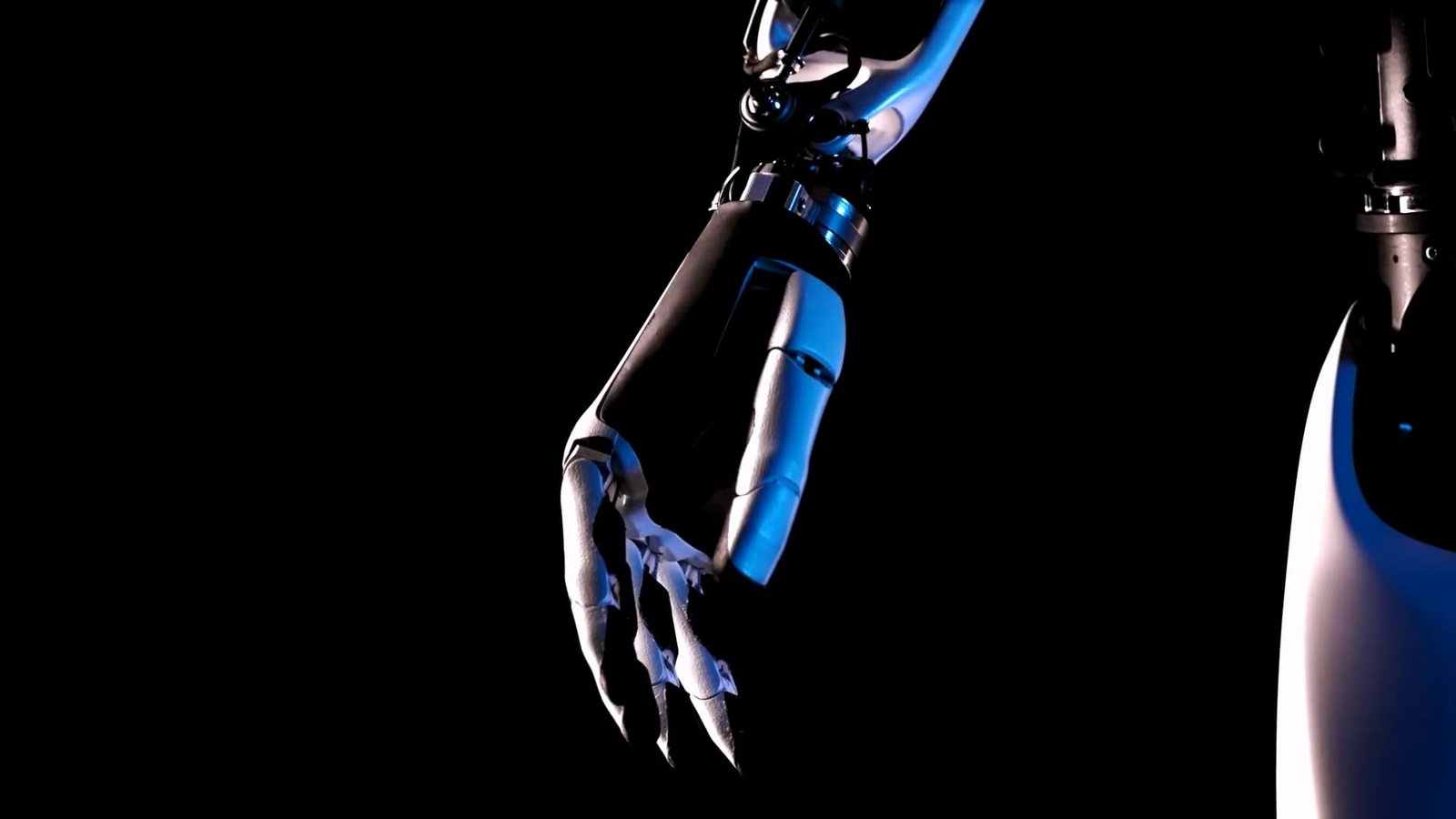
Elon Musk has said the hardest part of humanoid robotics isn’t mobility—it’s the hands. Human hands contain 27 bones and 33 muscles, a miracle of mechanical evolution.
Early Optimus prototypes offered only 11 degrees of freedom.
Today’s articulating dexterous hand offers 22 degrees of freedom, using tendon-like cable drive systems modeled after human forearms. This allows the robot to:
- Lift heavy objects
- Handle fragile items without breaking them
- Perform fine manipulation tasks
Tesla even brought in surgeons to study human anatomical mechanics, reproducing tendon routing patterns in the robot’s internal architecture.
This is the breakthrough that transforms Optimus from a research platform into a practical workforce tool.
Mass Production: The Silent Megaton Announcement
While most companies showcase lab prototypes, Tesla is quietly preparing for something more disruptive: industrial-scale manufacturing.
The Texas Gigafactory has begun setting up assembly lines targeted for:
- 1 million units per year in the near term
- 10 million units per year as the long-term goal
With projected pricing dropping to around $20,000, the robot is positioned not as a luxury technology, but as a mass-market product.
This shifts the narrative entirely.
It means robots won’t just appear in factories—they’ll enter homes, businesses, and public infrastructure.
The Countdown to a Humanoid Era
Optimus is not just running; it is learning faster than any humanoid robot in history.
As Tesla’s neural models improve, as hardware production scales, and as training data expands, the robot’s capabilities will compound—just as Tesla’s vehicle autonomy did.
The four-second clip wasn’t a demo.
It was a declaration:
The humanoid robotics era has entered its countdown.