The electric vehicle landscape shifted on its axis this week. While most manufacturers are still bragging about 15-minute charging sessions or modest range increments, BYD’s premium off-road sub-brand, Fangcheng Bao, just dropped a bombshell that renders current EV benchmarks obsolete.
Meet the Fangcheng Bao Tai 7 EV.
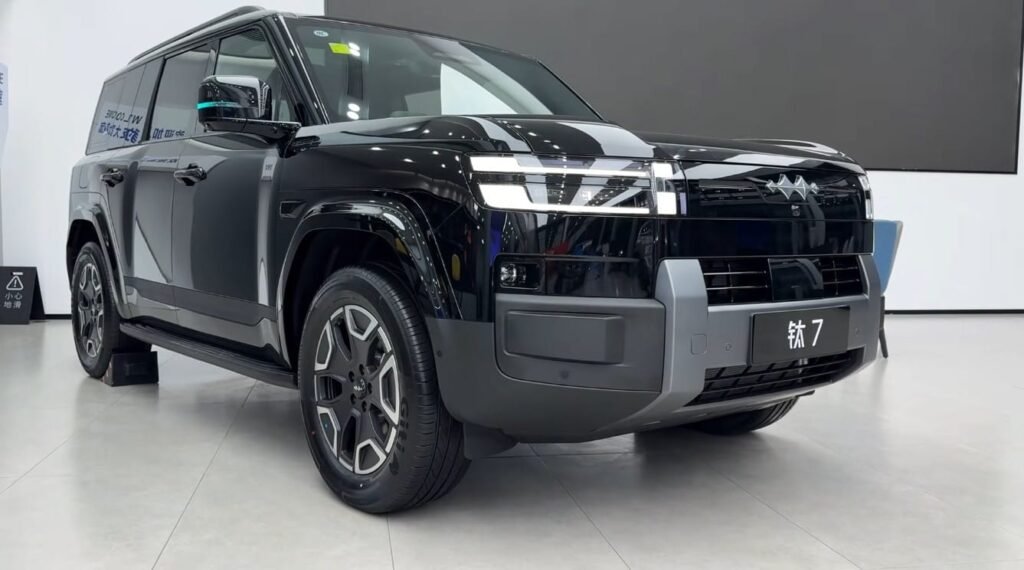
Unveiled alongside the groundbreaking second-generation Blade Battery technology on March 5, 2026, this isn’t just another electric SUV. It is a direct assault on the two biggest pain points of EV ownership: charging time and range anxiety. With a claimed 10%-97% charge in just 9 minutes and a massive 755 km (CLTC) range, the Tai 7 EV doesn’t just compete; it redefines the physics of what we thought was possible for a hardcore off-roader.
As someone who has tracked the evolution of EV battery chemistry from the early Nissan Leaf days to today’s 800V architectures, I can tell you: this changes everything. Here is the deep dive into why the Tai 7 EV is the most significant automotive launch of 2026.
The “Flash Charge” Breakthrough: Why 9 Minutes Matters More Than You Think
Let’s cut through the marketing fluff. For years, the industry standard for “fast charging” has been hovering around 20 to 30 minutes to reach 80%. That’s enough time to grab a coffee, check emails, and get frustrated.
The Tai 7 EV, equipped with BYD’s proprietary Second-Generation Blade Battery and new Flash Charge technology, shatters this ceiling.
The Numbers Don’t Lie
The engineering team at BYD hasn’t just tweaked the software; they’ve fundamentally altered the thermal management and ion flow dynamics within the cell structure.
| Charging Metric | Time Required | Real-World Equivalent |
|---|---|---|
| 10% to 70% | 5 Minutes | Time to tie your shoes & stretch legs |
| 10% to 97% | 9 Minutes | One quick bathroom break |
| Full Cycle (0-100%) | ~12 Minutes* | Less than a typical gas stop + payment |
| Peak Charging Power | Estimated 600kW+ | Surpasses current Tesla V4 Superchargers |
*Estimated based on tapering curves typical of high-speed charging protocols.
Why this is a game-changer: In practical terms, the “charging stop” ceases to be a logistical hurdle. On a road trip from Los Angeles to San Francisco, you aren’t planning your day around charger availability; you are simply refueling as fast as you can walk into a station. This level of speed effectively neutralizes the primary advantage of Internal Combustion Engine (ICE) vehicles.
Expert Insight: The shift from 400V to an ultra-high-voltage architecture (likely 800V or higher) combined with the new Blade chemistry allows for massive current intake without the traditional heat penalties that usually force chargers to throttle down. This is the “Holy Grail” of EV engineering finally hitting production.
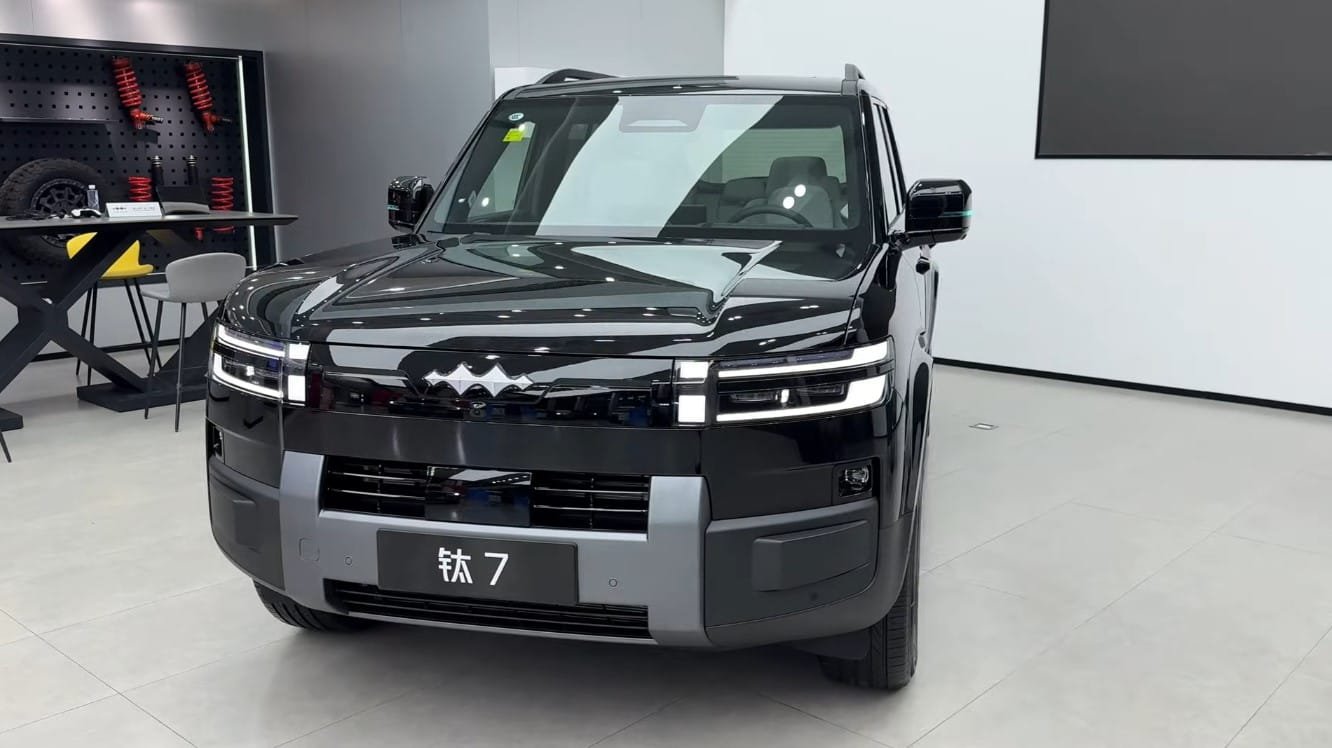
Design Philosophy: Hardcore Aesthetics Meet Aerodynamic Efficiency
The Tai 7 EV retains the polarizing yet undeniably rugged “hardcore box” design language that made the Leopard 5 a cult hit among off-road enthusiasts. However, removing the ICE powertrain has allowed designers to optimize proportions in ways the PHEV version couldn’t.
Exterior Breakdown
- Front Fascia: The double-layer headlight assembly isn’t just for show. The upper strip houses the main beam, while the lower “Double-L” LED signature provides distinct daytime running light (DRL) visibility. This vertical stacking improves aerodynamics by smoothing airflow over the hood.
- Side Profile: At 4,999 mm long and 1,995 mm wide, the Tai 7 is a substantial presence. The flat roofline maximizes interior headroom, crucial for tall passengers wearing helmets during off-road excursions.
- Rear Utility: The side-hinged tailgate with the iconic “small backpack” (external storage module) remains. In the EV version, this module likely houses charging adapters or emergency recovery gear, keeping the trunk space purely for cargo.
Dimensions & Off-Road Geometry
Don’t let the sleek battery pack fool you; this vehicle is built for the dirt. The ground clearance and approach/departure angles are class-leading for an electric platform.
| Specification | Metric (mm/degrees) | Competitor Comparison (Avg.) |
|---|---|---|
| Length | 4,999 mm | Similar to Jeep Wrangler Unlimited |
| Width | 1,995 mm | Wider than Ford Bronco |
| Height | 1,865 mm | Optimized for center of gravity |
| Wheelbase | 2,920 mm | Maximizes cabin space |
| Approach Angle | 24° | Superior to most crossovers |
| Departure Angle | 25° | Critical for steep descents |
| Ground Clearance | High (Exact TBC) | Designed for rock crawling |
The “boxy” shape, often criticized by aerodynamicists, is mitigated here by the sheer efficiency of the second-gen battery. You don’t need a teardrop shape to get 755 km when your energy density and consumption rates are this optimized.
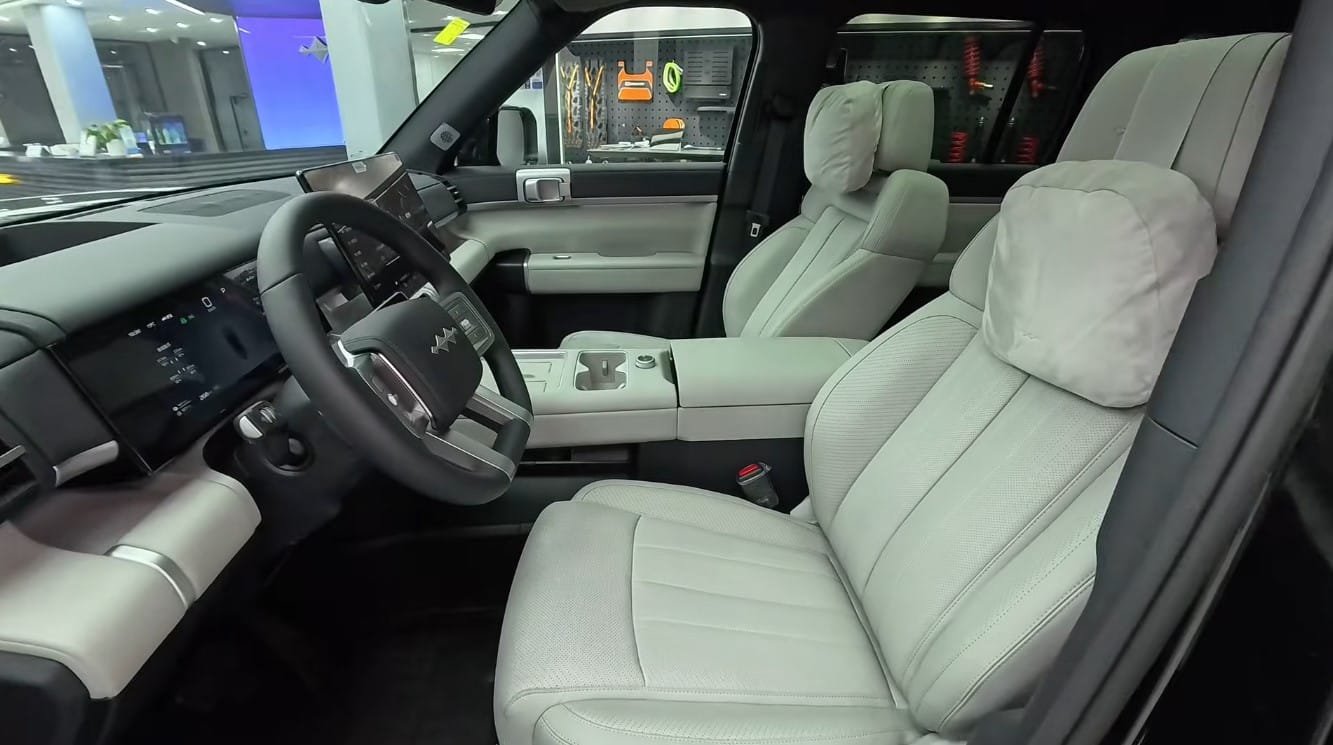
Performance Specs: Silent Power vs. Raw Torque
The removal of the engine unlocks a different kind of performance profile. Electric motors deliver instant torque, which is arguably more valuable in off-road scenarios than high-revving horsepower.
Powertrain Options
The Tai 7 EV offers two distinct configurations to suit different driving needs:
- RWD Long Range (The Efficient Cruiser):
- Motor: Single rear-mounted unit.
- Power: 300 kW (approx. 402 hp).
- Target Audience: Overlanders and highway commuters prioritizing maximum range.
- Range: 755 km (CLTC). This is the headline number. In real-world mixed driving, expect a solid 600+ km, which is staggering for a vehicle of this size.
- AWD Performance (The Trail Master):
- Motors: Dual motor setup (Front + Rear).
- Total Power: 515 kW (approx. 690 hp).
- Target Audience: Rock crawlers, dune bashers, and acceleration junkies.
- Capability: With nearly 700 horsepower and instant torque vectoring, this thing will climb hills that require a locker-equipped diesel truck to tackle slowly.
| Feature | RWD Version | AWD Version |
|---|---|---|
| Max Power | 300 kW (402 hp) | 515 kW (690 hp) |
| Drive Type | Rear-Wheel Drive | All-Wheel Drive |
| Est. 0-100 km/h | ~5.8 Seconds | ~3.9 Seconds |
| Primary Use Case | Highway/Expedition | Extreme Off-Road/Sport |
| Battery Tech | Gen 2 Blade Cell | Gen 2 Blade Cell |
The Second-Gen Blade Battery: Safety Meets Density
The core of the Tai 7 EV’s success lies in the battery. The first-generation Blade Battery was already renowned for passing the nail penetration test without catching fire. The Second-Generation iteration takes this further.
- Higher Energy Density: By optimizing the cell-to-pack (CTP) integration, BYD has squeezed more kilowatt-hours into the same footprint, enabling the 755 km range without bloating the vehicle’s weight.
- Thermal Resilience: The “Flash Charge” capability implies a revolutionary cooling system. Likely utilizing a direct cooling plate integrated between cells, the battery can absorb massive energy influxes without degrading.
- Structural Integrity: As part of the CTB (Cell-to-Body) technology, the battery pack acts as a structural member of the chassis, increasing torsional rigidity—critical for off-road durability.
Safety First: In an era where EV fires make headlines, the Blade chemistry (LFP – Lithium Iron Phosphate) remains inherently safer than NCM (Nickel Cobalt Manganese) alternatives used by many competitors. It is chemically stable even under extreme stress.
Market Impact: Who Should Be Worried?
The launch of the Fangcheng Bao Tai 7 EV sends a shockwave through several segments:
- Traditional Off-Roaders: The Jeep Wrangler 4xe and Ford Bronco now face an electric rival that refuels faster than they can fill a gas tank and offers superior low-end torque.
- Luxury EV SUVs: The Tesla Model X and Rivian R1S must now justify their price premiums when a competitor offers faster charging and comparable range in a more rugged package.
- Charging Infrastructure: This vehicle demands high-power chargers (350kW+). It accelerates the necessity for grid upgrades and ultra-fast charging networks globally.
The Verdict
The Fangcheng Bao Tai 7 EV is not merely an update; it is a statement. It proves that electric off-roaders do not need to compromise on range or refueling time. By solving the charging bottleneck with a literal 9-minute solution, BYD has removed the last logical barrier for mass adoption of electric adventure vehicles.
If you are in the market for a capable, future-proof SUV in 2026, the Tai 7 EV just moved to the top of the list. The era of “range anxiety” is officially over; welcome to the era of “flash mobility.”
Frequently Asked Questions (FAQ)
Q: How realistic is the “9-minute charge” claim? A: The 9-minute figure refers to charging from 10% to 97% using a compatible ultra-high-power DC fast charger (likely 600kW+). While public chargers of this magnitude are still rolling out globally, the vehicle is hardware-ready. In real-world scenarios with current 350kW chargers, times may be slightly longer but still industry-leading.
Q: What is the real-world range of the Tai 7 EV? A: While the CLTC rating is 755 km, real-world highway driving (at 120 km/h) and off-road usage will reduce this. A conservative estimate for mixed driving is approximately 600–650 km, which remains exceptional for a boxy SUV.
Q: Is the Tai 7 EV available outside of China? A: Following BYD’s aggressive global expansion strategy, the Tai 7 EV is expected to enter European, Australian, and select Asian markets by late 2026 or early 2027. North American availability depends on evolving trade regulations.
Q: Can the Tai 7 EV tow? A: While official towing capacities for the EV variant were not explicitly detailed in the initial launch, the dual-motor version’s 515 kW output suggests a towing capacity rivaling or exceeding the PHEV version (which tows up to 2.5 tons), likely making it capable of hauling large trailers or boats.
Q: How does the “Second-Gen Blade Battery” differ from the first? A: The second generation offers higher volumetric energy density (more range in less space), improved thermal management for faster charging, and enhanced structural integration into the vehicle chassis for better rigidity and safety.