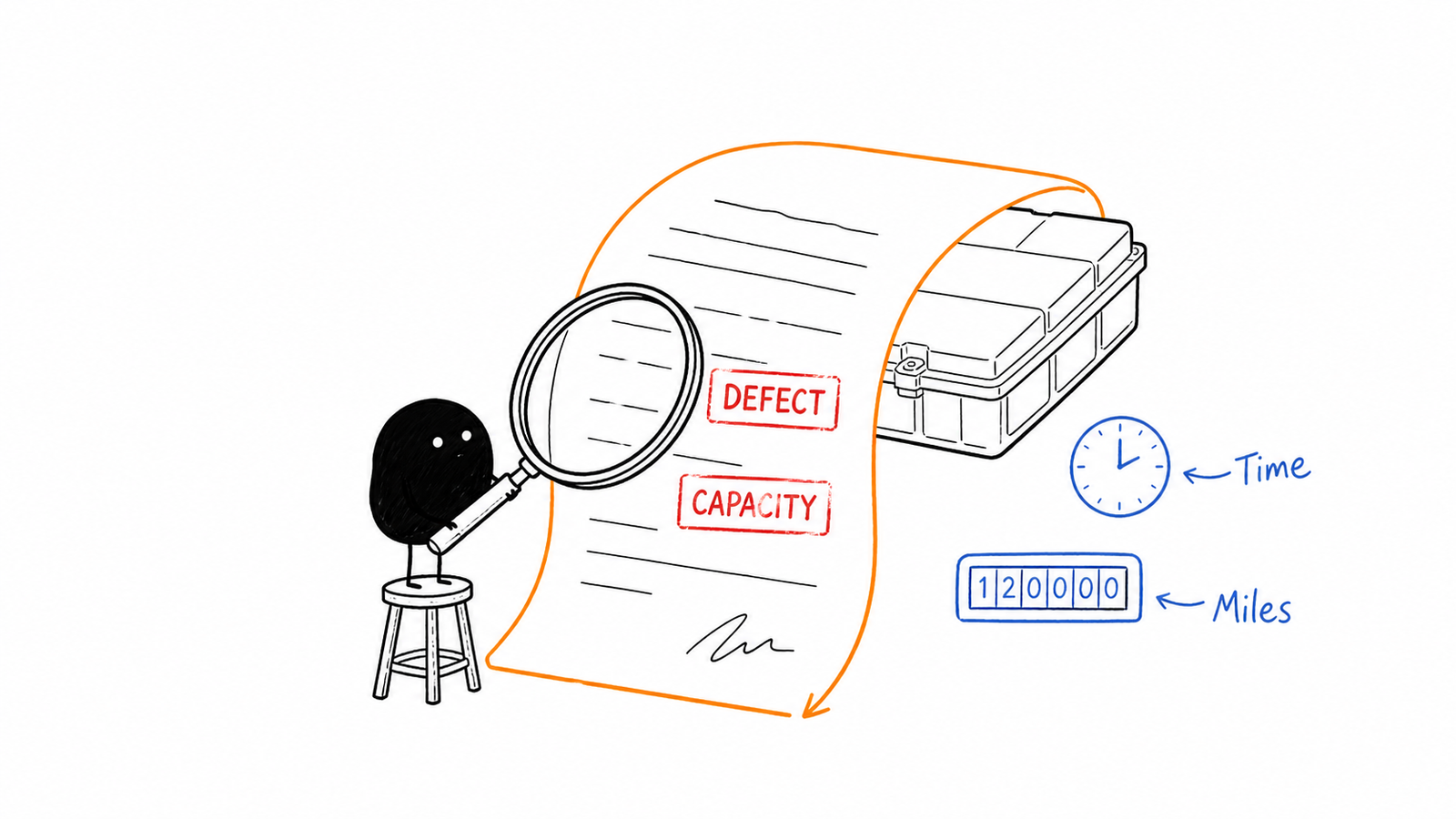
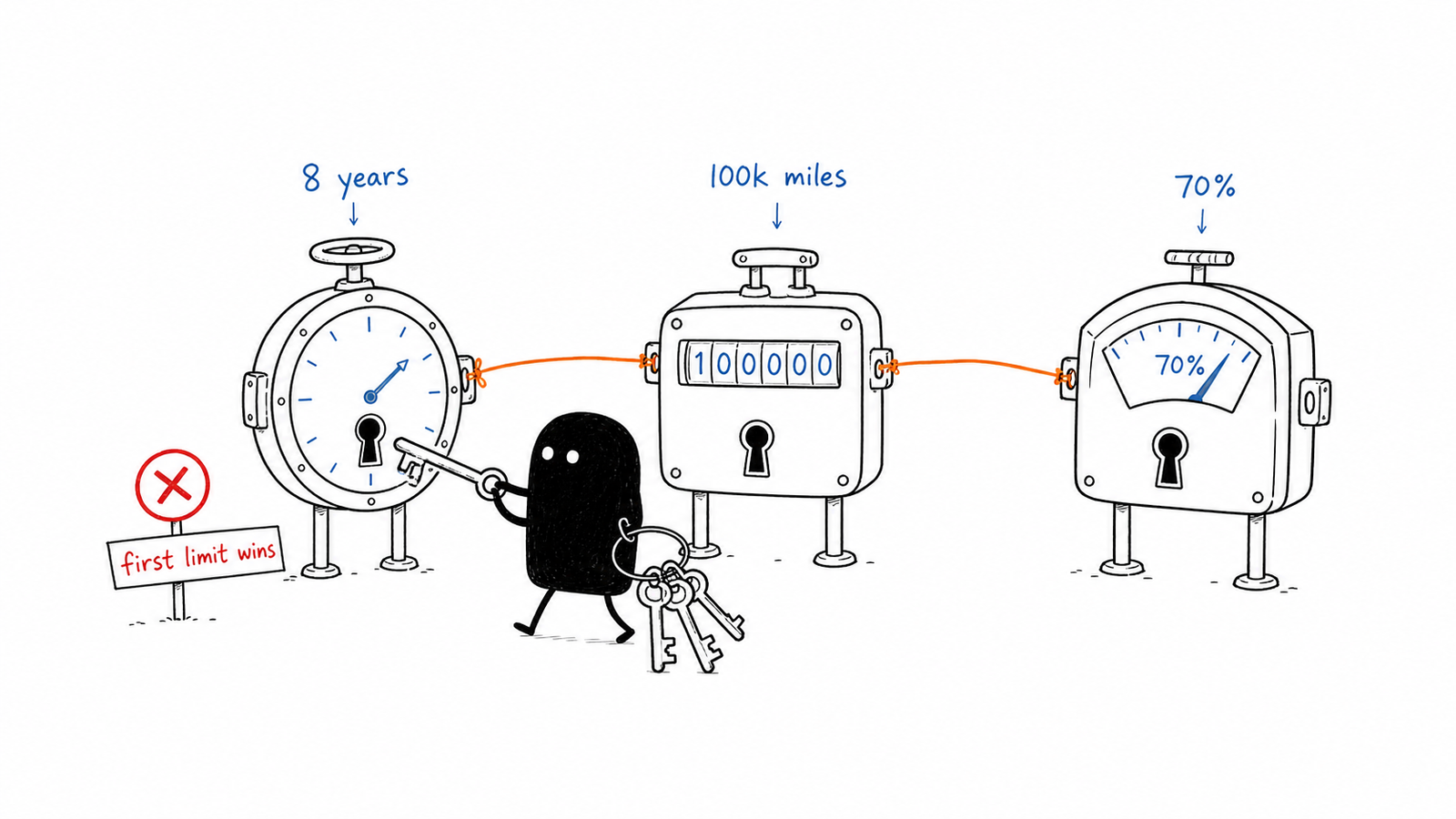
An EV battery warranty usually protects against manufacturing defects and, on many models, capacity falling below a stated threshold while the car is still inside both a time and mileage limit. It does not promise that an eight-year-old battery will feel new, restore 100% capacity, or cover damage from a crash, flood, misuse or unauthorized pack repair. The most common U.S. pattern is eight years/100,000 miles with about 70% capacity retention, but that is not universal. Hyundai advertises 10 years/100,000 miles, Chevrolet’s 2027 EV warranty uses a 75% capacity floor, and model-specific Tesla mileage limits vary. Your VIN’s warranty booklet—not a dealer’s summary—controls the answer.
EV battery warranty: the 30-second answer
| Your question | Short answer | Evidence that decides it |
|---|---|---|
| Is the battery covered if it fails? | Often, if the cause is a defect and the vehicle remains within the warranty period. | VIN-specific booklet, diagnostic codes and dealer diagnosis. |
| Is normal degradation covered? | Only when the warranty states a capacity floor and the measured capacity crosses it. | Manufacturer-approved capacity test, not dashboard range. |
| Do I get a new battery? | Not necessarily. Repair, module replacement, refurbished parts or a replacement pack may satisfy the warranty. | The remedy clause in the warranty. |
| Does 70% mean 70% of EPA range? | No. It normally refers to battery capacity under the manufacturer’s test method. | Warranty definition and service measurement. |
| Does the warranty transfer to a used-car buyer? | Often, but transfer rules and exclusions vary. | VIN, in-service date, title history and written manufacturer confirmation. |
| Which limit matters most? | Whichever expires first: time or mileage. | Original in-service date and current odometer. |
XCarspace verdict: the headline term is only the outer fence. A buyer should compare five details: defect coverage, capacity threshold, time, mileage, and the remedy the manufacturer may choose. A longer warranty can be weaker for your situation if it omits a clear degradation standard or expires on mileage before you need it.
What “70% battery capacity” actually means
A 70% retention clause is a warranty trigger, not a prediction of normal battery life. It typically says that while the warranty remains active, the manufacturer will repair or replace covered components if its approved test shows capacity below 70% of the battery’s original value. The exact definition, test method and remedy belong to the manufacturer.
Suppose a vehicle originally had 75 kWh of usable battery energy. A simple 70% threshold would equal:
75 kWh × 0.70 = 52.5 kWh
If the manufacturer’s test reports 54 kWh, the arithmetic is 54 ÷ 75 = 72%. That result would sit above a 70% capacity trigger even if the owner dislikes the car’s winter range. If the test reports 51 kWh, the ratio is 68%, potentially crossing the threshold—provided the vehicle is still within the time and mileage limits and no exclusion applies.
This example is explanatory, not a claim procedure. Manufacturers may use buffers, software data, controlled tests or other methods rather than a consumer’s kWh estimate. Tesla explicitly warns that displayed range is an imperfect measure of battery capacity because temperature, driving and other factors change the range estimate. A dashboard showing 210 miles instead of 300 does not, by itself, prove 70% capacity.
The familiar “300 miles becomes 210 miles” calculation is still useful for trip planning: 300 × 0.70 = 210. It is not a substitute for a warranty test. EPA-rated range, real-world range, predicted dashboard range and battery energy capacity answer different questions. Our EV range-needs guide helps decide whether the car remains useful; the warranty decides who pays for a covered repair.
How major U.S. EV battery warranties differ
The table below is a comparison of selected official U.S. warranty pages and booklets checked August 9, 2026. It is not a complete market list, and it does not replace the booklet for a specific model year, trim or VIN.
| Brand/example | Published battery term | Published capacity protection | Buyer detail that matters |
|---|---|---|---|
| Tesla | 8 years; 100,000, 120,000 or 150,000 miles depending on model/version | Minimum 70% retention | The mileage limit changes by vehicle. Tesla says the balance of the original battery warranty applies to its pre-owned vehicles. |
| Ford EVs | 8 years/100,000 miles | Ford says excessive capacity loss is included; current Mach-E and Lightning materials state 70% retention | Use the warranty guide for the exact model year rather than a general support answer. |
| Hyundai hybrid/EV battery | 10 years/100,000 miles | Hyundai’s current page states the battery will not degrade beyond 70% of original capacity during the period | The live warranty page lists the battery term for original and subsequent owners, but the handbook controls exclusions and remedy. |
| Chevrolet 2027 EV warranty | 8 years/100,000 miles | Repair or replacement if capacity falls below 75% of original value | The official booklet says the dealer determines capacity and the remedy may use new or refurbished components. |
| Volkswagen EVs | 8 years/100,000 miles | At least 70% net capacity | VW says the repair may restore the battery to 70%, not to an as-new 100% condition. |
| Nissan LEAF/ARIYA | 8 years/100,000 miles | Nissan describes protection below 9 of 12 capacity segments for applicable vehicles | Nine displayed segments is the published trigger language; do not casually translate the gauge into an exact laboratory percentage. |
The comparison exposes a common shopping mistake: “10 years” does not automatically beat “8 years.” A driver covering 25,000 miles per year reaches 100,000 miles in four years. In that case, a ten-year/100,000-mile warranty and an eight-year/100,000-mile warranty can expire at the same odometer reading. Conversely, a low-mileage owner can lose coverage on time with tens of thousands of miles unused.
Defect coverage and degradation coverage are not the same
A pack can have a covered defect while retaining more than 70% capacity. Examples could include a failed internal component, isolation fault, battery-management fault or manufacturing problem that the automaker confirms is covered. The capacity floor does not give a manufacturer permission to ignore every defect above that number.
The reverse is also important. Gradual capacity loss is expected in lithium-ion batteries. It becomes a warranty matter only if the written terms promise a capacity floor and the manufacturer’s measurement crosses that floor during the coverage period. A car that feels slower to charge or shows less predicted range may have a battery issue, but it may also be reacting to cold weather, a high state of charge, software limits, charger constraints, tire changes or recent driving.
For used-EV shopping, separate three questions:
- Condition: What does the best available diagnostic say about state of health, faults and physical integrity?
- Fitness: Does the car still cover the buyer’s hardest recurring trip with reserve?
- Coverage: Which defects and capacity losses will the manufacturer pay to remedy, and for how long?
A car can be fit for a 35-mile commute but outside warranty. Another can be under warranty yet unsuitable for a 220-mile winter route. Our used-EV battery-health inspection guide provides the diagnostic and physical-inspection side of that decision.
What the warranty may provide—and what it usually does not promise
Repair can be the remedy
Many owners imagine a sealed crate containing a brand-new battery. Warranty language is usually more flexible. Hyundai’s handbook allows component repair and a new or refurbished battery when replacement is necessary. Chevrolet’s 2027 booklet likewise permits repair or replacement using new or refurbished components. Volkswagen states that capacity work may restore the pack to the protected floor rather than 100%.
That is not automatically a bad outcome. Replacing a faulty module or component can be technically appropriate and avoids discarding healthy material. The buyer’s task is to learn the post-repair capacity, the warranty that remains on the original vehicle coverage, and whether the repair invoice identifies the parts and diagnostic result.
Common exclusion categories
Exact exclusions vary, but official booklets commonly distinguish a manufacturing problem from damage caused by collision, flooding, fire, abuse, ignored warnings, improper maintenance, unauthorized opening of the pack or modifications that cause the failure. Hyundai’s warranty handbook, for example, excludes battery damage from collision, unauthorized pack service, direct flame and flooding. It also requires owners to retain maintenance records and deliver the vehicle to an authorized dealer for warranty service.
An aftermarket accessory does not magically erase an entire warranty. The useful question is whether the modification or repair caused the failure and what the written warranty and applicable law say. Do not ask a general salesperson for a verbal ruling. Ask the manufacturer or authorized service department to identify the specific clause in writing.
Collision insurance and the battery warranty also solve different risks. A manufacturing defect can belong to the warranty; impact or flood damage may belong to an insurance claim, subject to the policy. The XCarspace EV insurance guide explains why vehicle-specific repair exposure belongs in the quote before purchase.
A five-step battery warranty claim process

1. Freeze the facts before the deadline
Record the VIN, odometer, original in-service date, warning messages, dates and symptoms. Photograph the display and save app notifications. If the car is close to a time or mileage limit, contact the manufacturer or authorized dealer immediately and create a dated service record. Do not keep driving merely to reproduce a serious high-voltage warning.
2. Obtain the exact warranty document
Download the U.S. warranty booklet for the correct model year and retain a copy. Highlight the battery term, capacity clause, covered components, exclusions, owner obligations, transfer language and dispute process. Marketing pages are useful summaries; the booklet is the contract-level evidence.
3. Request the manufacturer-approved test
Ask what test determines a capacity claim and request the numeric result where available. A screenshot of predicted range is not enough. Ask the service adviser to separate a defect diagnosis from a capacity diagnosis and to identify any open recalls or service campaigns by VIN.
4. Preserve the evidence chain
Keep repair orders even when the dealer reports “no fault found.” Save maintenance records, prior battery repairs, charging-error logs and correspondence. Ask that your reported symptom and odometer be written accurately on the repair order. If a dealer says the battery is above threshold, request the test result and method rather than accepting a spoken percentage.
5. Get the decision and remedy in writing
A useful decision states whether the claim is approved, which part failed, the measured capacity when relevant, the remedy, expected capacity after repair and remaining warranty. A denial should identify the warranty clause and technical reason. Escalate through the manufacturer’s customer-care and dispute process if the written evidence does not match the decision. State consumer-protection law varies, so seek qualified local advice for a serious unresolved dispute.
Four buyer scenarios that expose the hidden rules
Seven years, 96,000 miles, 68% tested capacity
This is the strongest capacity-claim scenario in a warranty with an eight-year/100,000-mile term and a 70% floor. Time, mileage and capacity appear to be inside the claim window. Approval still depends on the manufacturer’s test, exclusions and VIN-specific terms. The owner should open the claim before adding another 4,000 miles.
Five years, 72,000 miles, 73% capacity
The owner may dislike the reduced range, but 73% remains above a 70% capacity trigger. A separate defect could still be covered. If no defect exists, the buying question becomes whether 73% capacity fits the driver’s routine and price—not whether the warranty should make the battery new.
Eight years and two months, 61,000 miles
A low odometer does not save a warranty that expired on time. “Eight years/100,000 miles” means whichever occurs first. The same logic hurts a high-mileage driver in reverse: a four-year-old EV at 101,000 miles can be outside a 100,000-mile term.
Four years, 40,000 miles, battery fault at 92% capacity
Capacity retention is not the only coverage path. A confirmed defect in a covered component may qualify even with a healthy overall capacity percentage. This is why “your battery is above 70%” is not a complete response to every battery fault.
How to compare battery warranties before buying
Use this order, not the headline number:
- Get the VIN and original in-service date.
- Confirm whether the warranty follows the vehicle and whether title history changes coverage.
- Write down the earlier of the time and mileage expiration points.
- Separate defect coverage from capacity coverage.
- Record the exact capacity threshold and test method.
- Read exclusions for collision, flood, misuse, modifications and unauthorized service.
- Read the remedy: repair, refurbished component, replacement battery and post-repair capacity.
- Ask an authorized service department to confirm the remaining coverage in writing.
For a used EV, price the uncovered period as risk. A car with 14 months and 8,000 miles of remaining battery coverage does not have an “eight-year warranty” in the buyer’s hands. It has 14 months or 8,000 miles, whichever arrives first. Place that risk beside depreciation, insurance and charging costs in the XCarspace total-cost-of-ownership calculator.
What would change our recommendation?
- High annual mileage: mileage can erase the value of a long time term quickly.
- No explicit capacity floor: defect coverage may be strong, but predictable degradation is harder to evaluate.
- A higher capacity threshold: Chevrolet’s published 75% floor is more protective on that single metric than 70%, all else equal.
- Manufacturer-backed used coverage: written confirmation and recent diagnostics can reduce uncertainty.
- Flood, salvage or unexplained pack repair: title and repair history can change coverage and safety risk; pause until verified.
- A short ownership horizon: remaining warranty may cover your entire ownership period even if long-term capacity is uncertain.
- A large purchase discount: a documented lower-capacity EV can be rational when its remaining range fits the job and the discount funds repair risk.
The recommendation reverses when the seller markets “battery warranty remaining” but will not provide the in-service date, VIN-specific terms or a diagnostic. Missing proof is not proof of failure, but it is uncertainty—and uncertainty should reduce the price.
Frequently asked questions
Are all EV batteries covered for eight years or 100,000 miles?
No. Eight years/100,000 miles is common in the U.S., but terms vary by brand, model, version, model year and jurisdiction. Tesla mileage limits vary by vehicle, Hyundai publishes 10 years/100,000 miles, and other warranties use different capacity language. Verify the VIN-specific booklet.
Will a 70% warranty give me a battery with 100% capacity?
Not necessarily. The manufacturer may repair components or install new, remanufactured or refurbished parts. Some warranties expressly say the remedy may restore the battery only to the protected floor or an age-appropriate condition.
Is dashboard range proof of battery degradation?
No. Predicted range changes with temperature, speed, recent consumption, climate use, terrain and software assumptions. Use the manufacturer-approved capacity test for a warranty claim and model-specific diagnostics for a used-car inspection.
Does fast charging void an EV battery warranty?
Do not assume that normal use of the vehicle’s supported charging system voids coverage. Follow the owner’s manual and warranty instructions. Damage caused by misuse, unauthorized modifications or ignoring warnings can be excluded; the manufacturer should identify the causal clause if it denies a claim.
Does an EV battery warranty transfer to a second owner?
Many original battery warranties follow the vehicle for their remaining term, but transfer procedures and title exclusions vary. Tesla says its new-vehicle warranty transfers after ownership transfer, and Volkswagen states its battery coverage can transfer for the remainder. Confirm the specific VIN in writing before purchase.
What should I ask a dealer to print?
Ask for the original in-service date, current mileage, remaining battery-warranty end date and mileage, open campaigns, battery diagnostic result, prior high-voltage repairs and the exact warranty booklet. For a claim, ask for the test method, measured result and written approval or denial.
Final verdict
An EV battery warranty is valuable, but it is narrower than the sales shorthand. The strongest contract combines clear defect coverage, a measurable capacity floor, useful time and mileage limits, transferability and a defined remedy. The first limit reached ends the protection, and crossing a capacity threshold does not necessarily buy a brand-new pack.
Before buying, reduce the warranty to one sentence with numbers: “This VIN is covered until this date or this odometer reading, whichever comes first, for these defects and capacity below this threshold, with these permitted remedies.” If the seller or service department cannot verify that sentence, the warranty is not yet a decision-grade asset.
Methodology and primary sources
This guide was researched and updated August 9, 2026 for U.S. buyers. Brand comparisons use official manufacturer support pages or warranty booklets available on that date. Terms can change by model year, trim, battery, state and vehicle history. Calculations are explanatory examples using stated assumptions; they are not manufacturer test results or legal advice.
- Tesla: Vehicle Warranty and Battery Capacity Retention
- Ford: Hybrid and Electric Vehicle Battery Warranty
- Hyundai USA: Hybrid and Electric Battery Warranty
- Chevrolet: 2027 Electric Vehicle Limited Warranty Booklet
- Volkswagen: High-Voltage Battery Limited Warranty
- Nissan USA: Lithium-Ion Battery and Capacity Coverage