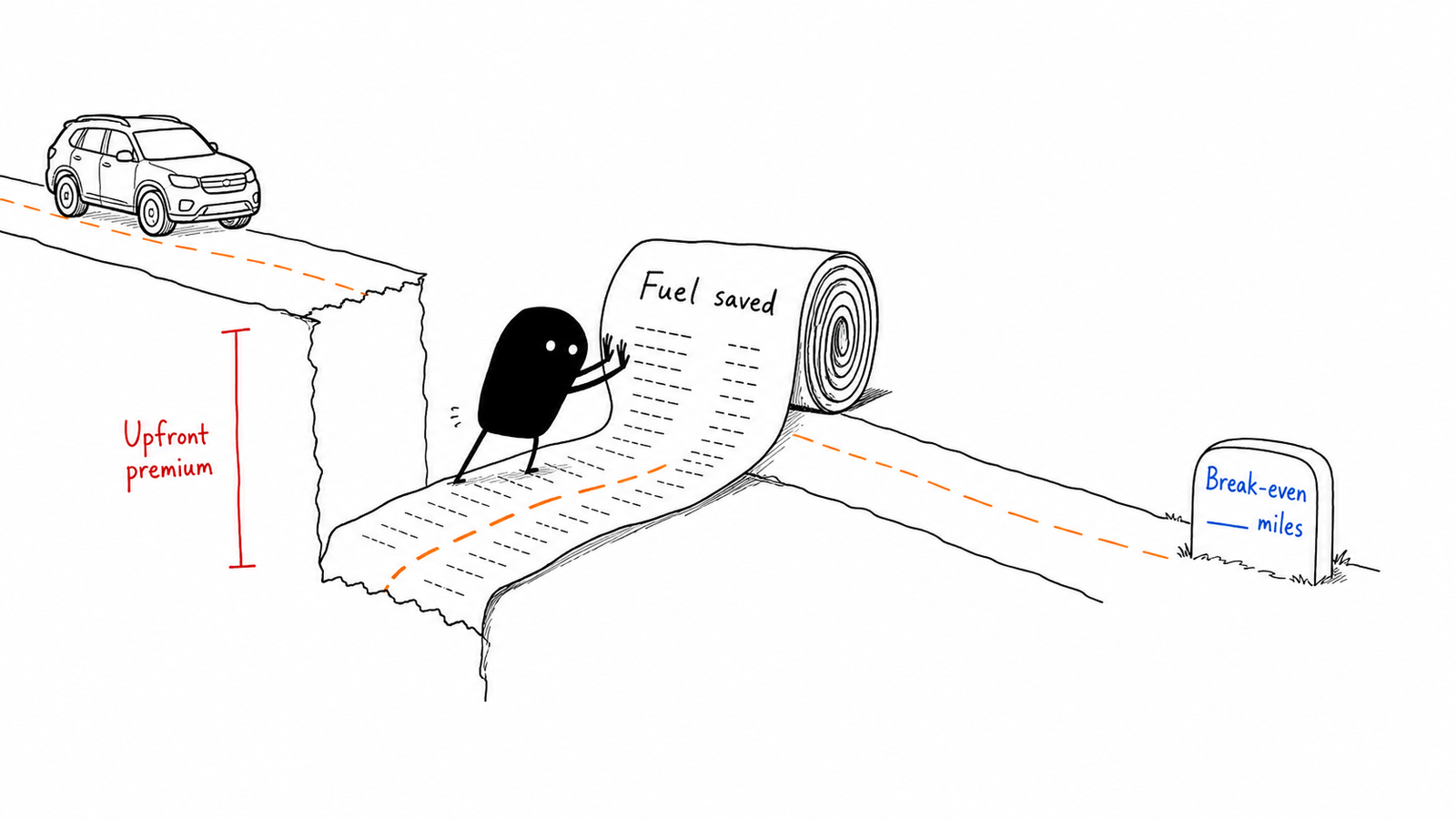
A hybrid SUV is financially worth it when its fuel savings recover the real purchase-price premium before you plan to sell it. At the July 27, 2026 U.S. regular-gasoline average of $4.096 per gallon, a hypothetical 35-mpg hybrid saves about 4.68 cents per mile versus a comparable 25-mpg gas SUV. If the hybrid costs $2,500 more, fuel alone recovers that premium after roughly 53,400 miles—about 4.5 years at 12,000 miles annually. The answer changes sharply with the actual price gap, both EPA ratings, your city/highway mix and how long you keep the vehicle.
Hybrid SUV break-even: the quick answer
| Your situation | Likely verdict | Why |
|---|---|---|
| Large MPG gain, small price premium, 12,000+ miles a year | Hybrid usually pays back | Each mile saves enough fuel to recover the premium during normal ownership. |
| Mostly city and suburban driving | Hybrid advantage grows | Regenerative braking and reduced idling can make the MPG gap larger. |
| Mostly steady highway driving | Calculate carefully | The hybrid’s city advantage may shrink; compare highway ratings and route experience. |
| Trade every three years or drive under 7,000 miles annually | Fuel payback is less likely | There may not be enough miles before resale. |
| Hybrid premium is mostly extra equipment you wanted anyway | Do not charge it all to the powertrain | Compare equivalent trim, drivetrain and options. |
| Gas model is heavily discounted | Gas may win | Transaction price matters more than MSRP. |
XCarspace verdict: do not buy a hybrid SUV because “hybrids save gas.” Buy it when the savings per mile, multiplied by the miles you will actually own, exceed the premium and financing cost. In the common middle case—a $2,000 to $3,000 premium and a meaningful 8-12 mpg improvement—the hybrid can make excellent sense for a high-mileage household and poor sense for a low-mileage serial trader.
The formula dealers should show you
Start with fuel only. That isolates the value created by the hybrid system before resale, maintenance, financing and insurance complicate the decision.
Gas SUV fuel cost per mile = gasoline price ÷ gas SUV mpg
Hybrid fuel cost per mile = gasoline price ÷ hybrid SUV mpg
Fuel savings per mile = gas price × (1 ÷ gas mpg − 1 ÷ hybrid mpg)
Break-even miles = hybrid price premium ÷ fuel savings per mile
Our baseline uses a hypothetical 25-mpg gas SUV and 35-mpg hybrid SUV. The gasoline input is $4.096 per gallon, the U.S. Energy Information Administration’s U.S. regular average for July 27, 2026. That is a dated national snapshot, not a forecast and not your local price.
- Gas SUV: $4.096 ÷ 25 = $0.16384 per mile.
- Hybrid SUV: $4.096 ÷ 35 = $0.11703 per mile.
- Difference: about $0.04681 per mile.
- $2,500 premium ÷ $0.04681 = about 53,405 miles.
- At 12,000 miles annually: about 4.45 years.
This is not a claim about one model. It is a transparent sensitivity example. Replace all four inputs: the actual after-discount price difference, the two relevant fuel-economy ratings and the gasoline price you expect to pay.
How price premium changes the answer
| Hybrid premium | Break-even miles | Years at 8,000 mi/yr | Years at 12,000 mi/yr | Years at 18,000 mi/yr |
|---|---|---|---|---|
| $1,500 | 32,043 | 4.0 | 2.7 | 1.8 |
| $2,500 | 53,405 | 6.7 | 4.5 | 3.0 |
| $4,000 | 85,448 | 10.7 | 7.1 | 4.7 |
The table keeps the same 25-versus-35-mpg pair and $4.096 gasoline. It reveals why “Which powertrain gets better MPG?” is the wrong first shopping question. The same hybrid system can be a quick payback at a $1,500 transaction-price gap and a decade-long payback at $4,000 for a low-mileage driver.
Use the difference between the two out-the-door quotes, excluding taxes and fees that are identical. If the hybrid is bundled with all-wheel drive, larger wheels, a premium package or technology you would not buy on the gasoline version, price a genuinely comparable configuration. If the feature package is valuable to you, do not pretend its entire cost is a hybrid penalty.
Gas price matters, but the MPG gap matters more than it looks
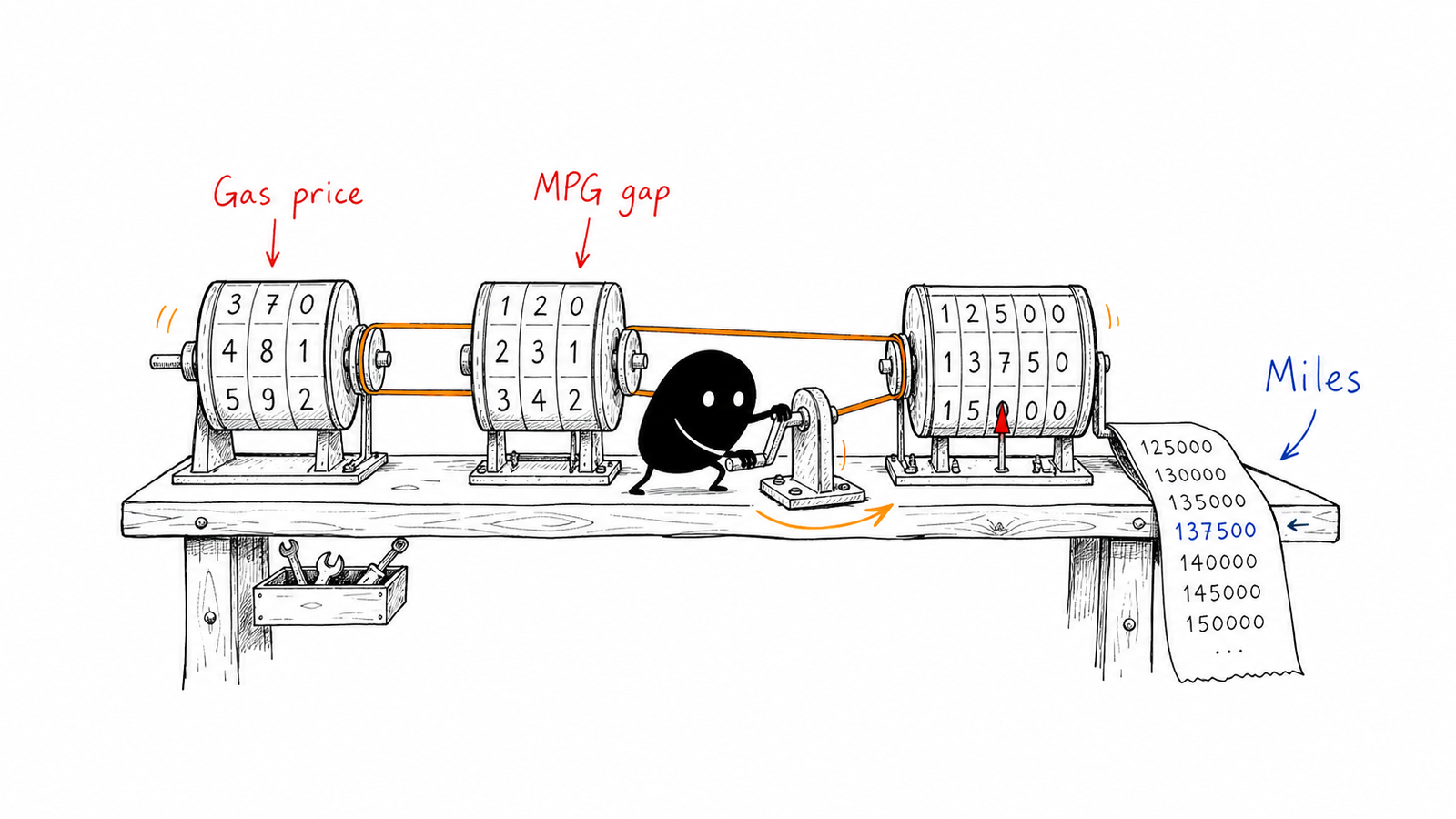
With the same $2,500 premium and 25-versus-35-mpg pair, break-even occurs at about 72,900 miles with $3 gasoline, 53,400 miles at $4.096 and 43,750 miles with $5 gasoline. Higher fuel prices speed up payback; lower prices stretch it.
| Gas SUV mpg | Hybrid SUV mpg | Savings per 12,000 miles | $2,500 break-even |
|---|---|---|---|
| 25 | 35 | About $562/year | 53,405 miles |
| 25 | 38 | About $673/year | 44,603 miles |
| 28 | 35 | About $351/year | 85,449 miles |
| 22 | 32 | About $698/year | 42,970 miles |
That non-linear MPG math is easy to miss. Moving from 22 to 32 mpg saves more fuel per mile than moving from 28 to 35 mpg, even though both hybrids look efficient. MPG is a reciprocal measure: every added mpg is worth less fuel at the high end than at the low end.
For an apples-to-apples comparison, the EPA recommends using the MPG values on the vehicle’s window sticker or FuelEconomy.gov. Its label testing provides a controlled common yardstick and accounts for city driving, highway driving, cold weather, air conditioning, high speed and acceleration. EPA also warns that your actual mileage will vary. Use the label first; then stress-test it against the type of driving your household does.
City drivers usually make the hybrid math work faster
A conventional hybrid cannot be plugged in. The engine and regenerative braking charge its battery, while the electric motor can reduce idling and assist the engine. The Department of Energy explains that hybrids capture energy normally lost during braking. EPA notes that a hybrid can be more efficient in town than on the highway because it can reuse some braking energy and reduce idling.
That is why a delivery route, suburban school run or congested commute may produce a stronger advantage than long, uninterrupted highway travel. Compare the city ratings if that describes most of your week. For a rural driver who spends 80% of the time at steady highway speed, compare highway ratings and do not borrow the hybrid’s impressive city number.
Driving style can erase part of either label result. Speed, hard acceleration, roof cargo, extra weight, temperature, hills, tires and air-conditioning use all affect fuel economy. The correct response is not to abandon the calculation. It is to use a realistic MPG pair and run a low-savings case before committing.
The break-even point is not the whole ownership cost
Fuel-only break-even is the cleanest first test, but a final purchase decision must include four adjustments.
1. Financing the premium
If you borrow the extra $2,500, the premium is not merely $2,500. Estimate the incremental interest attributable to that amount. A simple conservative shortcut is to add the total expected interest on the premium to the numerator. Cash buyers should still recognize that the money has an opportunity cost, though false precision is not useful.
2. Insurance
Get VIN-specific quotes for both finalists. Do not assume a hybrid is always more or less expensive to insure. Trim, replacement parts, theft history, driver profile, location and insurer can matter more than the powertrain label. A $20 monthly difference equals $1,200 over five years—large enough to move a close decision.
3. Maintenance and repair exposure
A hybrid still has an engine, cooling systems, fluids, emissions equipment and a traction battery. Regenerative braking can reduce use of the friction brakes, but that does not guarantee a lower total repair bill for every model. Compare the manufacturers’ maintenance schedules, warranty terms and model-specific reliability record. Do not assign a made-up universal maintenance credit to “hybrid.”
4. Resale value
The purchase premium is not necessarily lost. If the hybrid brings $1,500 more at resale, only part of the initial gap needed to be recovered through fuel. But a forecasted resale value is uncertain. Use current same-age used examples as a sensitivity check, not a promise about the market five or eight years from now.
For the complete version of the calculation, use the XCarspace total-cost-of-ownership calculator. Fuel payback is one layer; financing, insurance, depreciation and maintenance can reverse a narrow win.
Three buyers, three honest answers
The 18,000-mile suburban family
This household spends weekdays in traffic, keeps vehicles seven years and sees a $2,500 premium for a comparable hybrid. In our baseline, break-even arrives near year three. Even if gasoline falls to $3, the calculation reaches about 72,900 miles, or just over four years at this mileage. The hybrid is a strong default if the cargo space, towing rating and insurance quote also fit.
The 6,000-mile remote worker
This buyer keeps a car five years but drives only about 30,000 miles during that period. A $2,500 premium does not recover through baseline fuel savings before trade-in. The hybrid may still be desirable for quiet low-speed operation, range, lower fuel use or expected resale. It should not be sold as an automatic money saver.
The highway-heavy sales driver
Annual mileage is high, but the relevant MPG gap may be smaller than the combined label suggests. If the gas version returns 28 mpg and the hybrid 35 mpg, our $2,500 example needs about 85,400 miles. At 24,000 miles a year, that is still only 3.6 years. High annual mileage can rescue a modest efficiency gap, but the buyer should use highway figures and an insurance quote before deciding.

What changes the recommendation?
- A dealer discount: every $500 removed from the premium cuts baseline break-even by about 10,700 miles.
- Falling gasoline prices: savings per mile shrink, so payback takes longer.
- A bigger real MPG gap: city use, a less efficient gas version or a better full hybrid can shorten payback sharply.
- Short ownership: resale may return part of the premium, but fuel has fewer miles to work.
- More expensive insurance: add the difference; five years of small monthly charges can erase fuel savings.
- Towing or heavy highway use: use efficiency under that load, not the best combined label.
- A mild hybrid badge: verify the actual MPG improvement. A 48-volt system with a small gain is not financially equivalent to a full hybrid with a large gain.
If you are comparing powertrain types rather than two versions of one SUV, start with the XCarspace hybrid, PHEV, EV and gas guide. If your shortlist includes a battery EV, the EV versus hybrid buyer guide adds charging access and five-year energy costs.
The five-minute dealer worksheet
- Get written out-the-door quotes for genuinely comparable gas and hybrid versions.
- Subtract the gas quote from the hybrid quote.
- Record the relevant EPA city, highway or combined MPG for each.
- Use a local gasoline price and run at least $1 below and above it.
- Calculate fuel savings per mile and break-even miles.
- Divide break-even miles by your honest annual mileage.
- Add incremental loan interest and the difference between insurance quotes.
- Check the warranty, maintenance schedule, cargo capacity and towing rating.
- Run a resale sensitivity case, but do not treat it as guaranteed.
- Buy the hybrid only if the full ownership case works or its non-financial benefits are worth the remaining premium to you.
If you need a shortlist after doing the math, see XCarspace’s 2027 family hybrid SUV guide. Recheck every model-year price and specification with the manufacturer before ordering.
Frequently asked questions
How many miles does it take for a hybrid SUV to pay for itself?
There is no universal mileage. In our 25-versus-35-mpg example at $4.096 gasoline, a $1,500 premium breaks even near 32,000 miles, $2,500 near 53,400 miles and $4,000 near 85,400 miles. Use your actual price gap and EPA ratings.
Is a hybrid SUV worth it for mostly highway driving?
It can be, especially for a high-mileage owner, but the MPG advantage may be smaller than in city driving. Compare the two highway ratings and divide break-even miles by your annual highway mileage.
Is hybrid maintenance more expensive?
Not automatically. A hybrid adds high-voltage components but can reduce engine idling and friction-brake use. Costs vary by model, warranty, service schedule and repair history. Use model-specific evidence instead of adding a universal hybrid penalty or credit.
Should I include resale value in hybrid break-even?
Yes, as a sensitivity case. If the hybrid retains part of its original premium, fuel does not need to recover the entire gap. Because future used-car values are uncertain, calculate both a no-resale-advantage case and a reasonable current-market case.
What is the biggest mistake in hybrid payback math?
Comparing MSRP for mismatched trims and then using combined MPG for a driving pattern that is mostly highway. Use real transaction prices, equivalent equipment and the rating closest to your routine.
Final verdict
A hybrid SUV is worth the premium when it reaches break-even comfortably before your planned trade date. In the baseline case, $2,500 buys a ten-mpg improvement and returns through fuel after about 53,400 miles. That is attractive to a 15,000-mile household and weak for someone who drives 6,000 miles and trades often.
The honest answer is a mileage, not a slogan. Get two comparable quotes, use the correct MPG pair and calculate the crossing point. If the result is close, let insurance, resale evidence, warranty coverage and the way the SUV drives decide—not the word “hybrid” on the liftgate.
Methodology and primary sources
This XCarspace analysis was prepared August 2, 2026. All tables are fuel-only sensitivity examples using $4.096 per gallon unless stated otherwise. The baseline compares hypothetical 25-mpg and 35-mpg SUVs, a $2,500 premium and 12,000 annual miles. Calculations use unrounded values; displayed figures are rounded. Excluded from the fuel-only tables: taxes, financing, insurance, maintenance, repairs, depreciation, resale value, incentives and the value of time.