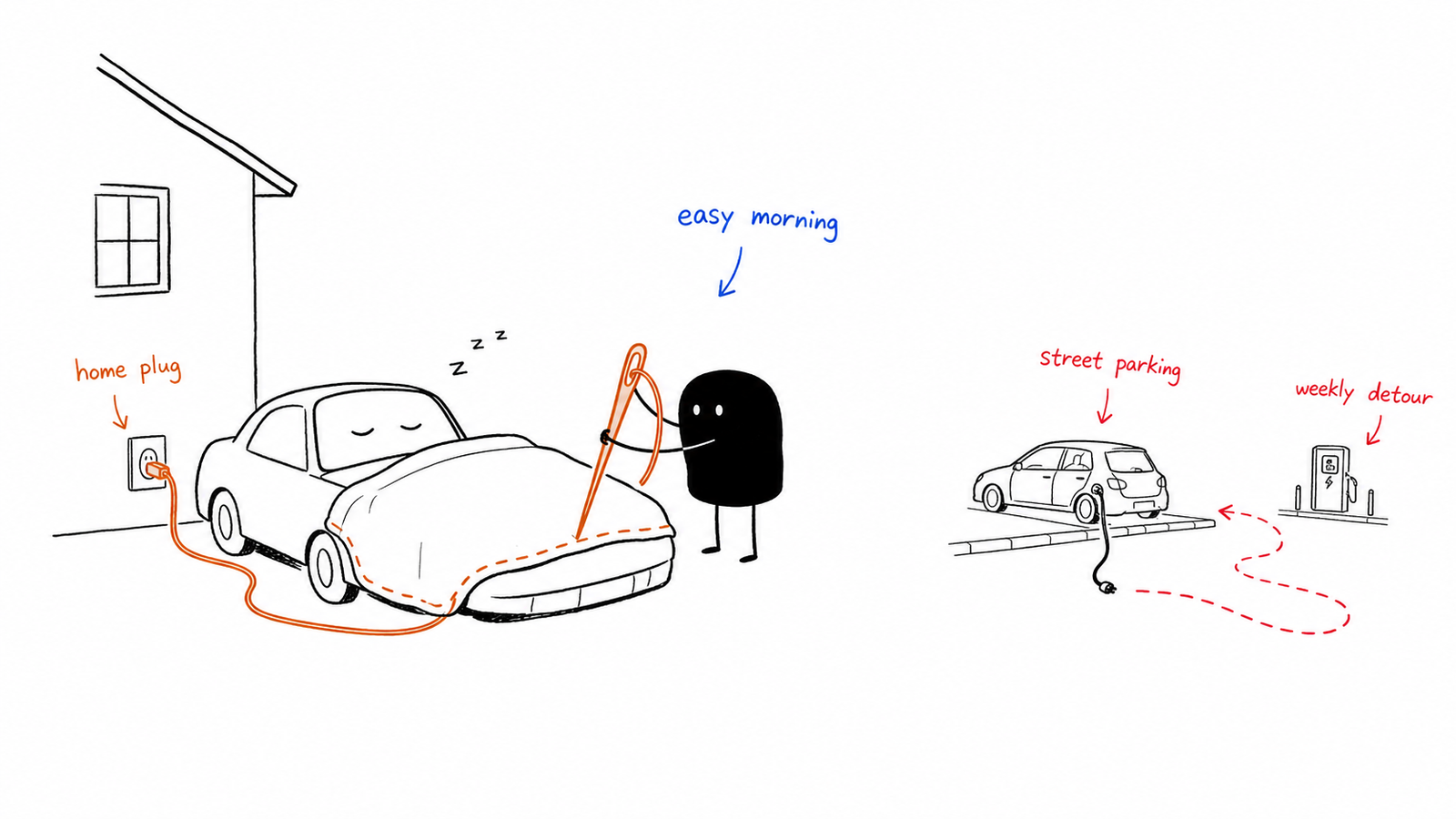
Updated July 27, 2026. Here is the uncomfortable truth: the powertrain matters less than where the car sleeps. An electric vehicle parked beside a reliable home charger can be quieter, simpler and less expensive to run than a hybrid. The same EV parked on a city street can become a weekly logistics problem. A conventional hybrid reverses that tradeoff. It gives up electric-only driving, but asks almost nothing from the owner.
That is why there is no honest one-word answer to “EV or hybrid in 2027?” The right answer depends on charging access, trip pattern, climate, purchase price and how long you plan to keep the vehicle. This guide makes those tradeoffs explicit and uses a five-year cost model instead of assuming that an EV is automatically cheaper or that a hybrid is automatically safer.
EV vs Hybrid in 2027: The 30-Second Answer
| Your Situation | Better Default Choice | Why |
|---|---|---|
| You own a home and can charge overnight | EV | Home charging turns refueling into a background task and usually delivers the lowest energy cost. |
| You rent or park on the street | Hybrid | Public charging can erase both the convenience and part of the operating-cost advantage. |
| You frequently drive 300–500 miles in a day | Hybrid | Five-minute refueling remains easier than planning charging stops around location, speed and availability. |
| Your driving is mostly local and predictable | EV | Daily driving can be covered at home with little routine maintenance. |
| You live in a very cold climate and have no garage charging | Hybrid | Cold weather affects every vehicle, but it creates a larger range-planning penalty for EVs. |
| You tow regularly | Hybrid, in most cases | Towing can make charging stops much more frequent and less convenient. |
| You have workplace charging or unusually cheap overnight electricity | EV | Cheap, reliable charging changes the ownership math dramatically. |
| You need one vehicle to handle every possible trip | Hybrid | It is the lower-friction answer when your driving pattern is unpredictable. |
XCarspace verdict: Buy an EV when charging is boring. Buy a hybrid when charging would become a recurring appointment. If you cannot explain exactly where the EV will charge during a normal week, do not let a salesperson solve that uncertainty with a larger advertised range number.
The First Question Is Not Range. It Is Charging Access
Many EV comparisons start with EPA range. Buyers should start one step earlier: where will the vehicle charge on an ordinary Tuesday night?
A dedicated home charger changes the product. You arrive, plug in and leave with the energy you need the next morning. Public charging is a different ownership model. It requires a functioning charger in the right place, at the right time, at an acceptable price. Even a 350-mile EV can feel inconvenient if every charge requires a special trip. A 250-mile EV can feel effortless if it charges while you sleep.
The U.S. Department of Energy says Level 2 charging equipment typically costs about $500 to $4,000 before installation and incentives. Homes with adequate electrical service generally cost less to equip; panel or service upgrades can add significantly to the project. Get a written electrical quote before agreeing to an EV purchase, not after the car is in the driveway.
Apartment residents should apply an even harder test. A charger shown on a property map is not the same as an assigned, enforceable place to charge. Ask how many chargers serve how many vehicles, what happens when one is broken, whether gasoline cars occupy the spaces, and whether pricing can change. If the answers are vague, treat the charger as a bonus rather than infrastructure.
If you rent or park on the street, use our 2027 guide to owning an EV without home charging to calculate the public-charging cost, time tax and reliability threshold before choosing the electric option.
The 2027 Incentive Reality: Do Not Budget for the Old Federal EV Credit
For U.S. buyers, one of the biggest changes in the 2027 purchase calculation is federal policy. The IRS states that the New Clean Vehicle Credit and Previously-Owned Clean Vehicle Credit are not available for vehicles acquired after September 30, 2025. A 2027 shopper should therefore not subtract the old federal consumer credit from an advertised EV price.
State, local, utility and manufacturer incentives may still exist, but they are not interchangeable. A manufacturer discount reduces the price immediately. A utility rebate may require approved equipment or a specific electricity plan. A state benefit can depend on income, vehicle price or available program funding. Count an incentive only after you verify that you, the vehicle and the purchase date qualify.
This matters because many EV-versus-hybrid articles still begin with an outdated assumption: “The EV costs $7,500 less after the tax credit.” For a normal 2027 consumer purchase, that is not a safe assumption.
Five-Year Cost: The Calculation Dealers Rarely Finish
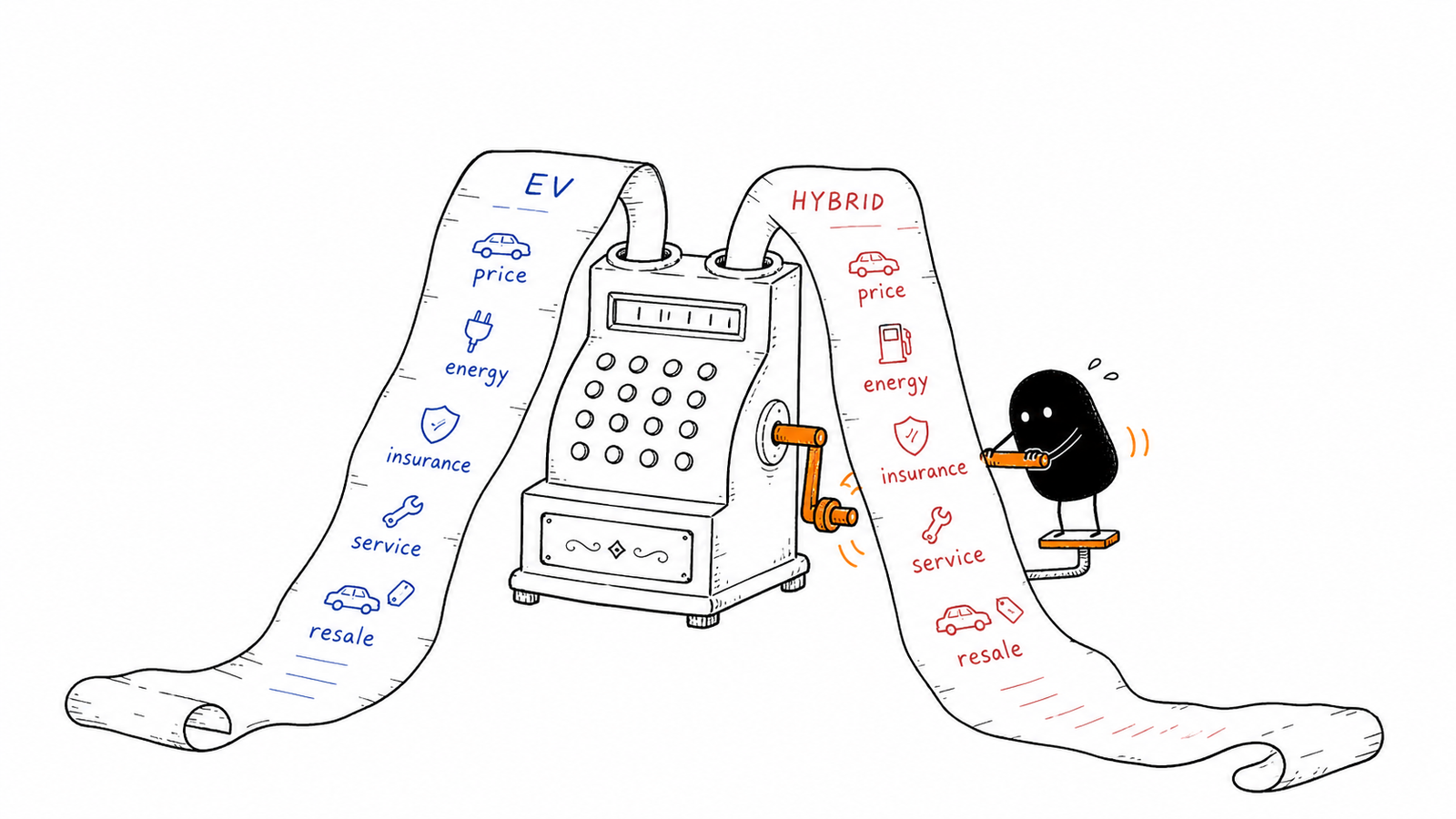
The useful ownership formula is simple:
Five-year cost = purchase price − verified incentives + charging equipment + energy or fuel + insurance + maintenance + expected depreciation.
The difficult part is not the formula. It is refusing to hide assumptions. The following comparison is an illustrative U.S. scenario, not a promise about a particular vehicle.
Baseline Assumptions
- 12,000 miles driven per year
- EV efficiency: 30 kWh per 100 miles at the vehicle
- 10% additional electricity for charging losses
- Hybrid efficiency: 45 mpg
- 2027 U.S. residential electricity forecast: 18.70 cents per kWh
- 2027 U.S. regular gasoline forecast: $3.09 per gallon
Those energy-price assumptions come from the U.S. Energy Information Administration’s July 2026 Short-Term Energy Outlook. They are national forecasts, not your local rate. Electricity prices can vary substantially by state, utility, time-of-use plan and charging location.
Annual Energy Cost in the Baseline Scenario
| Vehicle | Annual Energy Use | Assumed Price | Annual Cost |
|---|---|---|---|
| EV | 3,960 kWh from the wall | $0.187/kWh | About $741 |
| 45-mpg hybrid | 267 gallons | $3.09/gallon | About $824 |
That is only about an $83 annual energy advantage for the EV—or roughly $417 across five years if prices and driving remain unchanged. This is the number many buyers do not expect. An efficient hybrid can run close enough to an EV that purchase price, insurance and depreciation matter more than the energy bill.
Change the local inputs and the result changes quickly. At 12 cents per kWh, the EV’s annual electricity cost falls to about $475. At a hypothetical 45 cents per kWh for frequent public fast charging, it rises to about $1,782. That is why an EV charged cheaply at home and the same EV charged mainly in public are financially different products.
| Scenario | EV Annual Energy Cost | Hybrid Annual Fuel Cost | Annual Winner |
|---|---|---|---|
| Cheap home electricity: $0.12/kWh | About $475 | About $824 | EV by about $349 |
| 2027 national forecast inputs | About $741 | About $824 | EV by about $83 |
| Mostly public charging at $0.45/kWh | About $1,782 | About $824 | Hybrid by about $958 |
| $4.50 gasoline, forecast electricity price | About $741 | About $1,200 | EV by about $459 |
The public-charging price above is a sensitivity example, not a national average. Replace it with the actual prices on the networks you would use.
Maintenance Helps the EV, but It Does Not Erase Every Price Premium
Battery-electric vehicles have no engine oil, spark plugs, exhaust system or conventional multi-speed transmission service. A Department of Energy-sponsored total-cost study estimated scheduled maintenance at 6.1 cents per mile for a battery-electric vehicle and 9.4 cents per mile for a conventional hybrid. At 12,000 miles per year, that modeled difference is about $396 annually, or $1,980 over five years.
That is meaningful, but it needs context. The estimate covers scheduled maintenance, not every ownership expense. Tires, collision repairs, insurance, registration and depreciation can overwhelm the savings. Heavier vehicles and aggressive acceleration can also shorten tire life, regardless of powertrain.
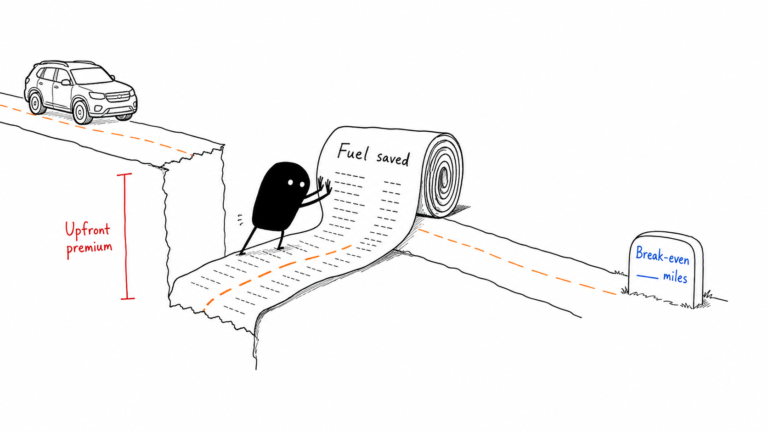
Here is a useful break-even check. If the EV costs $4,000 more than the comparable hybrid, the baseline five-year energy and scheduled-maintenance savings in this example total roughly $2,397. The EV has not recovered the full purchase premium before insurance, charger installation, financing or resale value are considered. If the EV starts at price parity or your electricity is unusually cheap, the answer can reverse.
Three Buyers, Three Different Answers
Buyer A: The Suburban Homeowner
This buyer has a garage, a predictable commute and a second vehicle available for unusual long trips. An EV is the strong default. Charging happens at home, daily range is rarely tested, and lower scheduled maintenance has time to matter. The key checks are the installed charger cost, insurance quote and actual transaction price.
Buyer B: The Apartment Renter
This buyer parks on the street or shares a small number of chargers. A conventional hybrid is the safer recommendation even if an EV looks better on a spreadsheet using residential electricity. The spreadsheet is using energy the buyer cannot reliably access. Public fast charging may cost more, require waiting and turn refueling into a planned activity.
The recommendation changes if the renter has dependable workplace charging or a guaranteed charger in the lease. “There are chargers nearby” is not equivalent.
Buyer C: The Road-Trip Family
This family drives locally most weeks but takes several long trips each year, sometimes in winter and with children or cargo. The honest answer depends on tolerance. A modern EV can complete the trips, but the family must accept route planning, charging stops and the possibility that the fastest charger is occupied or slower than expected. A hybrid gives up the quiet EV experience but preserves the current road-trip rhythm.
If this is the household’s only vehicle and trips are unpredictable, the hybrid is the lower-risk purchase. If long trips are rare, charging routes are strong and the family already stops every two or three hours, the EV may fit without meaningful sacrifice.
If long-distance travel will decide your purchase, compare the actual route with our EV vs. hybrid road-trip cost model. It calculates the public-charging price where a 1,000-mile trip becomes cheaper in the hybrid. For hot-weather planning, our summer AC range analysis shows why the same cooling load matters more on a slow trip than on a steady highway run.
Cold Weather: Treat the EPA Number as a Starting Point
Cold weather hurts every powertrain, but it does not hurt them equally. In controlled testing summarized by Argonne National Laboratory and the Department of Energy, average battery-electric range fell about 41% at 20°F and 54% at 0°F compared with operation at 72°F while maintaining a 72°F cabin. The study also found that modern EVs can still cover most typical light-duty driving needs, and technologies such as heat pumps and preconditioning can reduce the penalty.
To turn that weather penalty into a vehicle-specific purchase target, use our 2027 EV range-budget guide, which calculates required EPA range from the hardest recurring trip, expected conditions and an arrival reserve.
Those percentages are not a forecast for every vehicle or trip. Speed, wind, precipitation, tire pressure, cabin temperature, battery chemistry and whether the car was preconditioned while plugged in all matter. The practical lesson is simpler: a buyer in Minnesota should size an EV around the worst regular winter day, not the pleasant-weather EPA number.
Hybrids also lose efficiency in cold conditions. They simply preserve the familiar refueling solution. For a driver with overnight charging, preconditioning can make the EV experience surprisingly easy. For a street parker who starts every frozen morning without a plug, the hybrid has the operational advantage.
The Real-World Friction That MPG and MPGe Miss
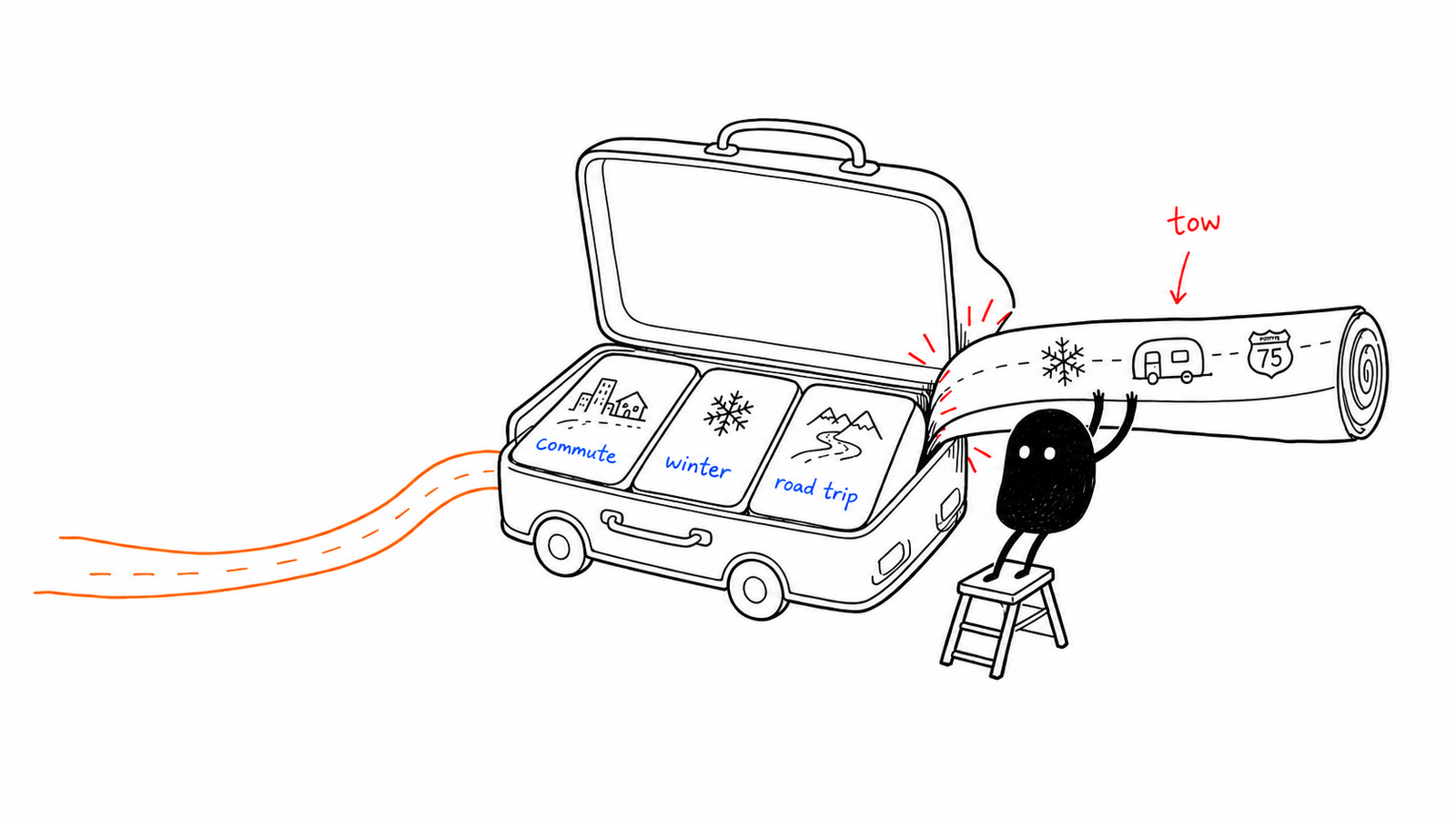
| Ownership Friction | EV | Hybrid |
|---|---|---|
| Daily refueling | Nearly invisible with home charging | Occasional gas-station visit |
| Long-trip planning | Route and charger dependent | Minimal planning |
| Cold-weather penalty | Can materially reduce usable range | Efficiency falls, but refueling remains quick |
| Scheduled maintenance | Lower | Higher, but still generally efficient and familiar |
| Home setup | May require equipment and electrical work | None |
| Unexpected detour | Depends on remaining charge and infrastructure | Usually trivial |
Convenience is not captured by an energy-cost calculation. For some owners, never visiting a gas station is worth real money. For others, spending 25 minutes at a charger during a late-night trip is a deal-breaker. A strong buying decision assigns value to time and predictability instead of pretending that every inconvenience is equal.
What About a Plug-In Hybrid?
A plug-in hybrid can be the best answer when most daily driving fits inside its electric range but the owner regularly makes long trips. It can also be the worst answer when the owner never plugs it in. Then the buyer carries the price, weight and complexity of two powertrains while using only one.
Choose a plug-in hybrid only if you have a reliable charging routine and the electric range covers a meaningful share of your real week. Do not buy one merely because it appears to split the difference.
If your final shortlist is specifically between those two plug-in options, our PHEV vs EV decision guide compares charging routines, road trips, maintenance and energy costs in more detail.
For a deeper explanation of conventional hybrids, plug-in hybrids, EVs and gasoline vehicles, see the XCarspace powertrain guide. Families specifically shopping for SUVs can also use our 2027 hybrid SUV buyer guide.
What Could Change Our Recommendation?
- Free workplace charging: This can turn an apartment renter into a strong EV candidate.
- A large EV discount: Price parity can matter more than a small difference in annual energy cost.
- A hybrid dealer markup: Paying thousands over sticker can destroy the hybrid’s conservative financial case.
- High local gasoline prices: The EV advantage expands quickly when gasoline rises and home electricity remains reasonable.
- High electricity rates: An efficient hybrid may cost nearly the same—or less—to fuel than an EV.
- A short ownership period: Three-year depreciation may matter more than maintenance savings.
- Solar panels: They can improve EV economics, but only after accounting for the cost and value of the solar system itself.
- A second household vehicle: An EV is easier to recommend when another vehicle can cover rare edge cases.
A trustworthy recommendation should be easy to overturn when the facts change. If an article declares one powertrain the universal winner, it is selling an identity rather than helping with a purchase.
Eight Questions to Answer Before You Sign
- Where will the vehicle charge during a normal week?
- What is the full charger installation quote, including any panel work?
- What do electricity and public charging actually cost where you live?
- How often do you drive more than 250 miles in one day?
- What is your hardest recurring winter or towing trip?
- What are the written insurance quotes for both vehicles?
- What is the real out-the-door price after only verified incentives?
- How long do you expect to keep the vehicle?
If you cannot answer the first three questions, you are not ready to compare ownership costs. If a dealer focuses on monthly payment while avoiding out-the-door price, charging cost or insurance, slow the transaction down.
Final Verdict: EV or Hybrid in 2027?
Choose the EV if you have dependable home or workplace charging, your routine is predictable, the purchase price is competitive and you are comfortable planning the occasional long trip. In that environment, an EV can be the easiest car you have owned.
Choose the hybrid if you lack reliable charging, frequently travel long distances, tow, park outdoors in severe cold or need one vehicle to absorb every unplanned trip. A hybrid is not the timid choice. In 2027, it may be the more rational way to buy efficiency without reorganizing your life.
The wrong question is “Which technology is better?” The useful question is “Which technology removes more friction from my actual week?” Answer that honestly, and the powertrain decision becomes much easier.
Methodology and Sources
The cost examples in this guide use 12,000 annual miles, a hypothetical 30-kWh/100-mile EV, 10% charging losses and a 45-mpg hybrid. They are sensitivity calculations, not ownership-cost promises. Transaction price, financing, insurance, depreciation, local taxes and individual driving behavior must be added for a model-specific comparison.
- U.S. Energy Information Administration: July 2026 price summary and 2027 forecasts
- Internal Revenue Service: current clean vehicle credit rules
- U.S. Department of Energy Alternative Fuels Data Center: EV charging and consumer guidance
- Argonne National Laboratory: total cost of ownership and scheduled maintenance estimates by powertrain
- Argonne National Laboratory: battery-electric vehicle performance in extreme weather
Explore the next step: The XCarspace EV & Hybrid Buyer Center connects this decision guide with charging, real-range and ownership-cost calculators.