Updated July 27, 2026. Yes, you can own an EV without home charging in 2027. But the honest answer is more useful: you should do it only if you have a dependable place to charge while you are already at work, shopping, exercising or sleeping. If your plan is to make a separate trip to a public fast charger every week, an EV can cost more to fuel than an efficient hybrid and consume dozens of hours a year.
The deciding factor is not the biggest range number on a dealer window. It is whether charging disappears into your routine. This guide shows the cost, time and reliability tests that separate a workable no-home-charging setup from a purchase you may regret.
EV Without Home Charging: The 30-Second Verdict
| Your Charging Situation | 2027 Verdict | What Must Be True |
|---|---|---|
| Assigned charger at your apartment | Usually yes | The space is enforceable, the price is reasonable and there is a backup when equipment fails. |
| Reliable workplace charging | Usually yes | You can charge often enough, access is not first-come chaos and a job change would not strand your plan. |
| Public Level 2 at a place you visit anyway | Maybe | The stop is long enough, the stalls work and the posted price does not erase the EV savings. |
| Low weekly mileage with a dependable nearby charger | Maybe | You can go several days between sessions and have at least one realistic backup location. |
| Public DC fast charging only | Usually no | It makes sense only if the charging stop overlaps with your routine and the actual local price is acceptable. |
| High mileage, unpredictable travel or one-car household | Hybrid is safer | A no-home-charging EV leaves too little margin when work, weather or family plans change. |
XCarspace verdict: Buy the EV when you can name a reliable primary charger, a backup charger and the real price of both. Buy a hybrid when your charging plan begins with “I will probably find something.”
Public Charging Is Not One Thing
“There are chargers near me” is not a charging plan. The useful questions are how fast they charge, whether they match your connector, what they cost at the hours you need them and whether they are available when you arrive.
The U.S. Department of Energy’s Alternative Fuels Data Center gives practical charging-rate ranges:
- Level 1: roughly 2 to 5 miles of range added per hour.
- Level 2: roughly 10 to 30 miles added per hour.
- DC fast charging: roughly 100 to 200 or more miles added in 30 minutes.
Those are broad rates, not promises. The car, battery temperature, state of charge and charger can all limit speed. A fast charger also slows as the battery fills, which is why repeatedly charging from a low state to 100% is rarely the quickest routine.
Level 2 is often the best no-home-charging option when the car can sit for several hours. A workplace, apartment garage or destination charger can replenish the battery while your attention is elsewhere. DC fast charging is valuable for travel and occasional recovery. Using it as your only routine fuel source is a different ownership proposition: faster, often more expensive and much more sensitive to queues or broken stalls.
The Real Annual Cost at Four Electricity Prices
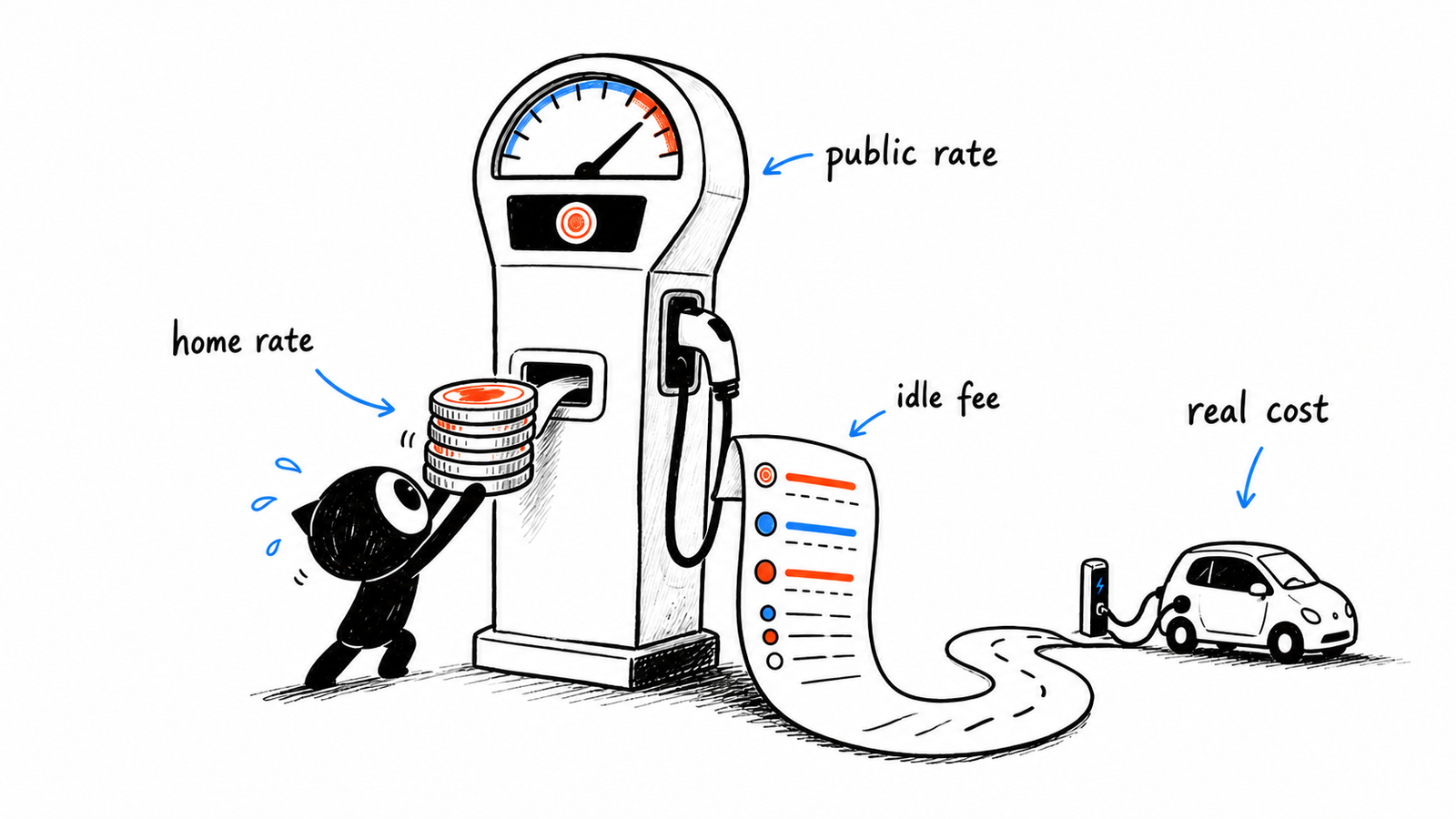
To make the comparison transparent, XCarspace modeled a generic efficient EV and an efficient conventional hybrid. This is not a prediction for every model. Replace the assumptions with the EPA consumption figure and real charging prices for the vehicles and networks you are considering.
Model Assumptions
- 12,000 miles driven per year
- EV efficiency: 30 kWh per 100 miles at the vehicle
- Charging loss allowance: 10%
- Electricity purchased: 3,960 kWh per year
- Hybrid efficiency: 45 mpg
- Gasoline used: about 267 gallons per year
- 2027 U.S. forecast: 18.70 cents/kWh residential electricity and $3.09/gallon regular gasoline
The national energy-price forecasts come from the U.S. Energy Information Administration’s July 2026 Short-Term Energy Outlook data. Your city may be dramatically cheaper or more expensive. Public-charging prices below are scenarios, not claimed national averages.
| Energy Scenario | Annual Energy Cost | Cost per Mile | Difference vs. 45-mpg Hybrid |
|---|---|---|---|
| EV at 18.70 cents/kWh | $741 | 6.2 cents | $83 less |
| EV at 30 cents/kWh | $1,188 | 9.9 cents | $364 more |
| EV at 45 cents/kWh | $1,782 | 14.9 cents | $958 more |
| EV at 60 cents/kWh | $2,376 | 19.8 cents | $1,552 more |
| 45-mpg hybrid at $3.09/gallon | $824 | 6.9 cents | Baseline |
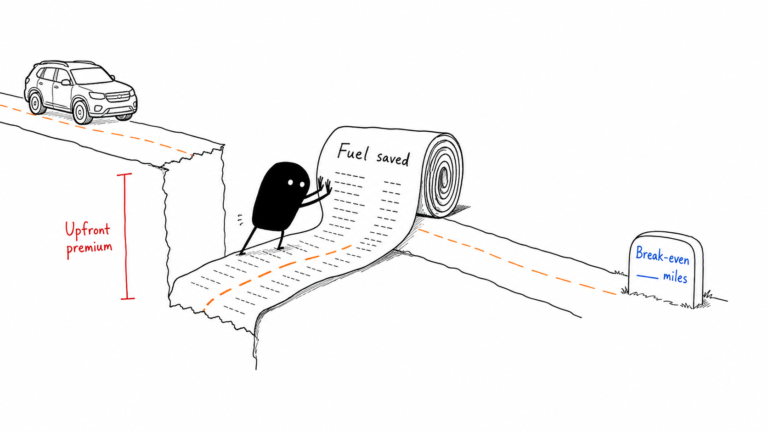
The surprise is not that expensive public charging costs more than home charging. It is how quickly the crossover happens. Under these assumptions, the EV and hybrid have the same annual energy cost at about 20.8 cents per kWh. Above that, the EV’s fuel advantage disappears.
That does not automatically make the hybrid cheaper overall. The Department of Energy cites average maintenance estimates of 6.1 cents per mile for an all-electric vehicle and 9.4 cents per mile for a hybrid. At 12,000 miles, that difference is about $396 a year. But averages cannot price your insurance, tires, repair risk, depreciation or a specific model. The right conclusion is narrower: public charging can erase the EV’s energy advantage, so do not claim “electric is cheaper” until you have checked the full ownership cost.
Also inspect the complete tariff. Some stations add session, parking or idle fees. Some memberships reduce the energy rate but add a monthly charge. A free charger that is routinely occupied is not free infrastructure; it is an unreliable perk.
The Cost Most Spreadsheets Miss: Your Time
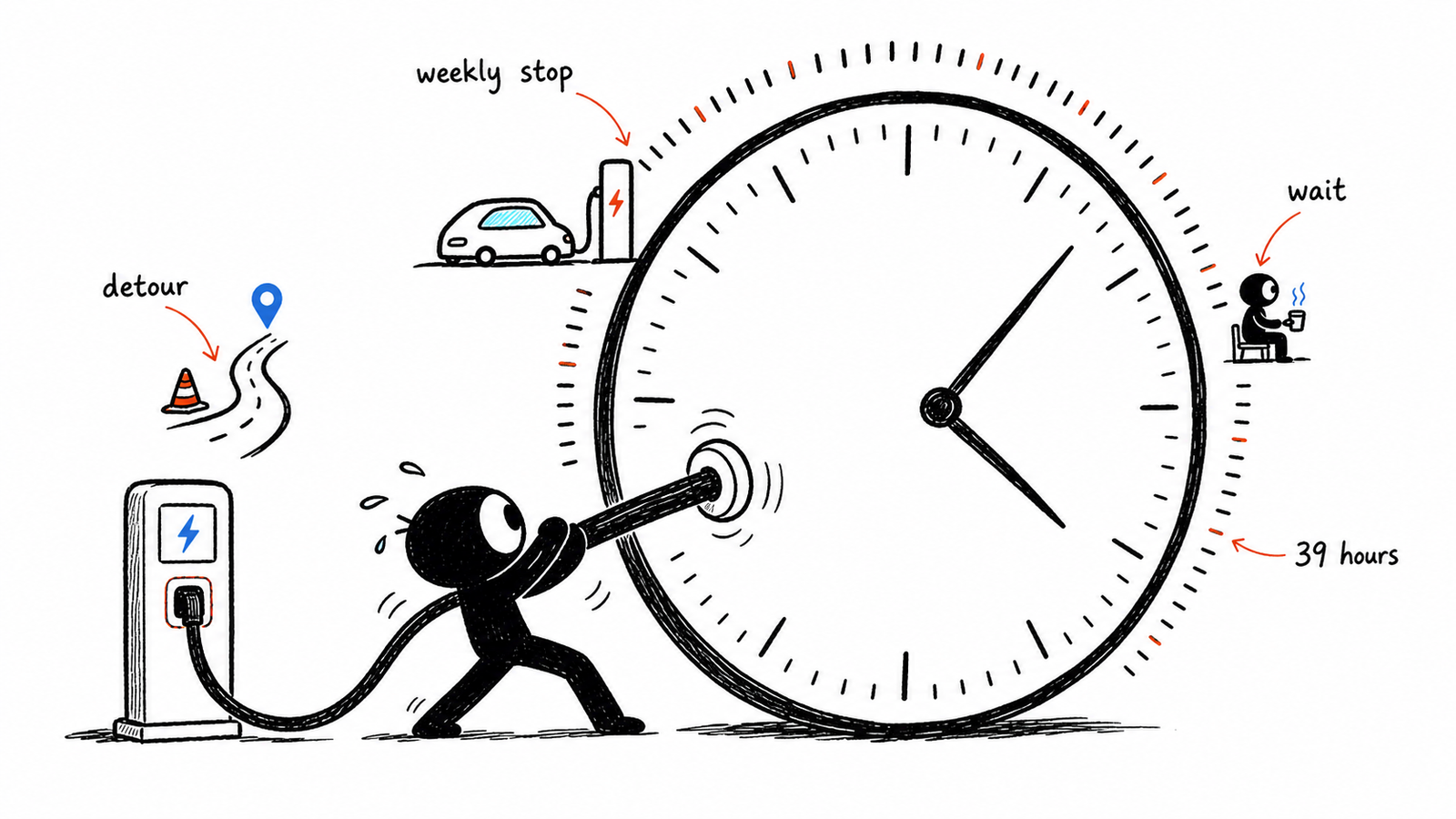
A charging session is not necessarily lost time. If the vehicle charges during an eight-hour workday, a two-hour movie or an ordinary grocery trip, the owner may spend only a minute connecting and disconnecting. That is the ideal no-home-charging setup.
The problem is the dedicated charging appointment. One 45-minute detour, wait and session every week consumes 39 hours a year. Even two 45-minute appointments per month total 18 hours a year. Add failed payment screens, occupied stalls or a second stop, and the real burden grows.
Assigning a dollar value to personal time can be artificial, so XCarspace does not hide it inside the cost table. Keep it separate and judge it honestly. Ask: would I willingly spend this amount of time every year to save the amount of money shown by my actual cost model?
Five No-Home-Charging Setups, Ranked
1. Assigned Apartment Charging: The Best Substitute for a Garage
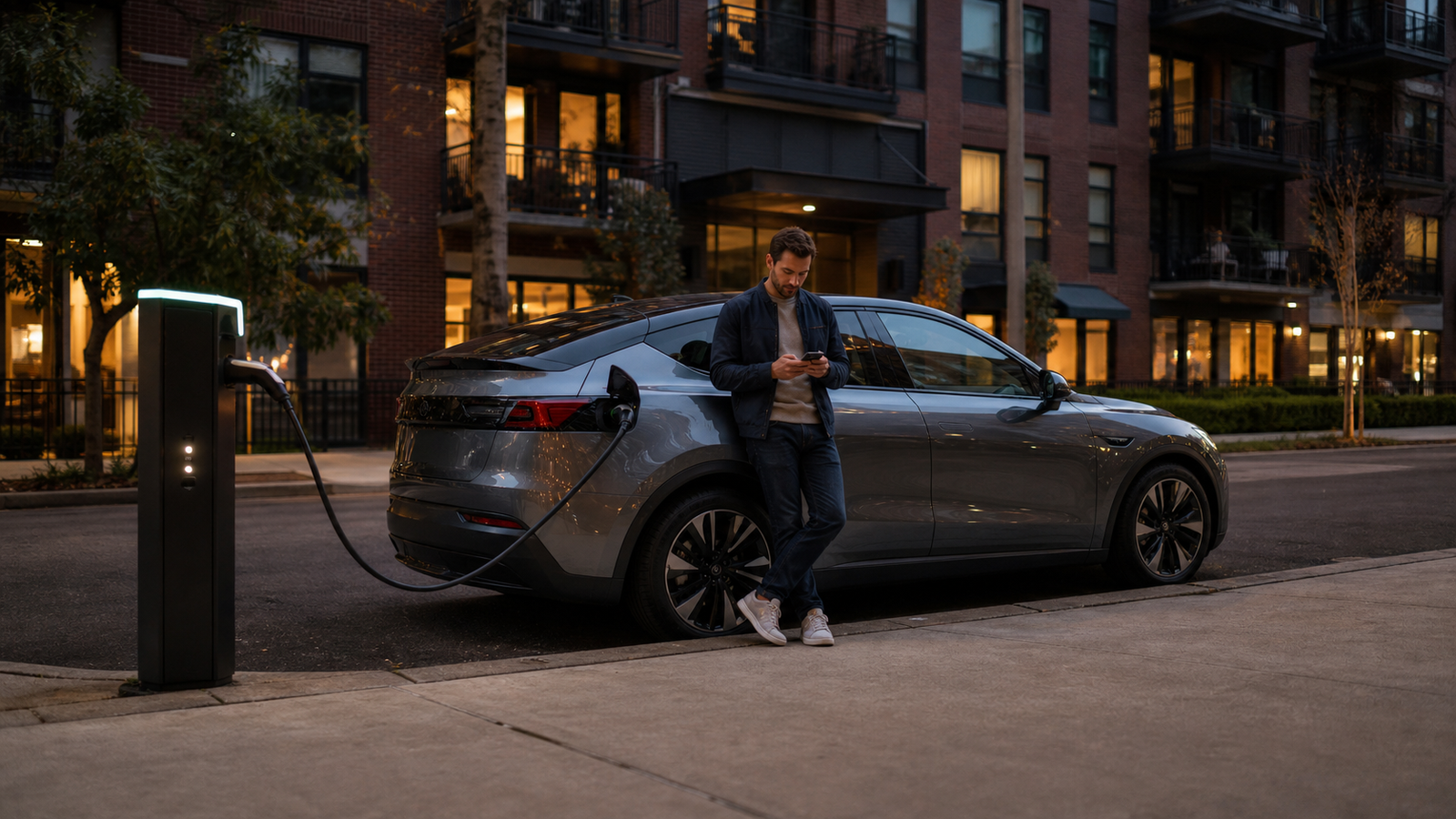
An assigned charger can make apartment EV ownership almost as easy as charging at a single-family home. “Assigned” is the important word. The lease or parking agreement should make clear who can use the stall, how pricing works and how faults are handled.
Before buying, ask the property manager for the number of charging-equipped spaces, active EVs, maximum charging power, billing rules and repair process. Visit after 7 p.m., not only during a quiet daytime tour. A single shared charger for dozens of residents is not dependable home charging.
2. Workplace Charging: Excellent Until the Job Changes
Workplace Level 2 charging can be an ideal fit because the car sits for hours. It becomes your home charger in practice. Confirm that employees may use it routinely, that access is not limited to fleet vehicles and that there are enough stalls for demand.
Then perform the job-change test: if the charger disappeared next month, would the EV still work? A purchase financed for five or six years should not depend entirely on a benefit that can vanish with an office move, schedule change or new employer.
3. Destination Charging: Good When the Dwell Time Matches
A charger at a gym, supermarket, library or parking garage works when you already spend enough time there and visit often enough. Estimate the miles actually added during a normal visit, not the charger’s maximum output. A 30-minute grocery run on Level 2 may add only a small amount of range.
Destination charging is strongest as part of a portfolio: one reliable primary location plus a second and third option. It is weak when a single busy retail charger is your entire plan.
4. Curbside or Municipal Charging: Location Is Everything
Curbside charging can solve street-parking EV ownership, but it depends on local enforcement, parking limits and pricing. Check whether you must move the car after charging, whether normal parking fees continue and whether overnight access is allowed. A charger two blocks away is convenient only if it is available when you return home.
5. DC Fast Charging Only: The Highest-Friction Choice
Fast charging can make a no-garage EV possible, but it is usually the least convincing routine. You are paying for speed, and the advertised peak rate may occur only for part of the session. A busy station can turn a 30-minute plan into an hour.
If fast charging is your only option, rent the exact EV or a model with similar charging behavior for several days. Use the stations you would actually depend on at the times you would actually arrive. A map pin cannot reveal queues, blocked stalls or a charger that repeatedly fails to initiate.
2027 Incentives: Two Old Assumptions to Remove
First, do not subtract the former federal clean-vehicle credit from a 2027 purchase price. The IRS states that the New Clean Vehicle Credit and Previously-Owned Clean Vehicle Credit are not available for vehicles acquired after September 30, 2025.
Second, a 2027 buyer should not assume the former federal home-charger credit will reimburse a new installation. The IRS says qualifying property at a main home had to be bought and placed in service from January 1, 2023 through June 30, 2026.
State, local and utility programs may still help. Check the current rules for your address, income, vehicle, charging equipment and purchase date before counting the money. A dealer’s phrase “up to” is not a verified discount.
Cold Weather Makes a Weak Plan Weaker
Every vehicle uses more energy in difficult weather, but an EV without home charging has less room to absorb the change. Cabin heat, a cold battery, snow and headwinds can reduce usable range and increase how often you need a charger. A station that is merely inconvenient in October can become a weekly problem in January.
Do not plan from the EPA range alone. Use your worst regular day, then keep a meaningful buffer for weather, detours and unavailable chargers. If the vehicle will sit outside, look for reliable battery preconditioning and route planning, and verify whether preconditioning can run effectively when the car is not plugged in.
The One-Car Household Test
A two-car household can assign the EV to predictable local driving and keep another vehicle for unusual trips. A one-car household needs the EV to handle airport runs, family emergencies, winter weekends and unplanned overtime.
The stricter the car’s job, the stronger the charging plan must be. If your one vehicle must be ready for anything and you cannot charge at home or work, a conventional hybrid remains the lower-friction answer. For the broader powertrain decision, see XCarspace’s EV vs. Hybrid in 2027 buyer guide and Hybrid vs. PHEV vs. EV vs. Gas guide.
Do a Two-Week Charging Simulation Before You Buy
You can test the ownership pattern without owning an EV. For two normal weeks, pretend your current car must visit the chargers you plan to use whenever the future EV would need energy.
- Choose a realistic EV. Use its EPA kWh/100 miles and range, not the most efficient number in the segment.
- Track your miles. Include weekends, detours, school runs and the longest recurring trip.
- Visit the primary charger at the real hour. Record available stalls, working stalls, power, price, parking rules and safety.
- Visit the backup. If it is too inconvenient to test once, it will not feel better during a low-battery problem.
- Read the payment screen. Note membership prices, session fees, taxes, idle fees and parking charges.
- Calculate energy needed. Annual kWh equals annual miles multiplied by kWh/100 miles, divided by 100, then adjusted for charging losses.
- Count dedicated minutes. Separate time that overlaps with normal life from time spent only because the vehicle needs energy.
If the simulation feels easy, the EV may fit. If you start skipping the pretend charging stops because they are inconvenient, believe that evidence before signing a loan.
Questions to Ask an Apartment, Employer or Charging Network
- Is access guaranteed, assigned or first-come?
- How many vehicles compete for each charging port?
- What is the maximum power, and does it fall when two cars charge?
- Is billing per kWh, per minute, per session or a combination?
- Are parking and idle fees added?
- Who repairs the charger, and what is the typical response time?
- Can non-charging vehicles occupy the space?
- Does your vehicle need an adapter, and is that adapter supported at this station?
- What happens if the building, employer or network changes its policy?
Frequently Asked Questions
Is it cheaper to own an EV if I only use public charging?
Not necessarily. In XCarspace’s 12,000-mile example, a 30-kWh/100-mile EV with 10% charging losses equals a 45-mpg hybrid’s energy cost at about 20.8 cents/kWh, using the EIA’s 2027 forecast of $3.09/gallon gasoline. Public rates above that make the EV more expensive for energy, although maintenance and other ownership costs can still change the total.
How often will I need to public-charge an EV?
Divide your weekly miles by the vehicle’s realistic miles per kWh, then compare the result with the usable battery window you are comfortable using. A low-mileage driver may charge every week or two. A long-distance commuter may need several sessions per week. Weather and highway driving reduce the interval.
Is workplace charging as good as home charging?
It can be nearly as convenient because the car is parked for hours. The weakness is continuity: access can disappear with a job, office or policy change. Keep a practical backup plan.
Should I buy a longer-range EV if I cannot charge at home?
Extra range reduces charging frequency, but it does not fix expensive, unreliable or badly located charging. A larger battery can also cost more and take longer to replenish. Buy enough range for your hardest recurring use, then solve charging access separately.
Would a plug-in hybrid solve the problem?
Usually not if you cannot plug in regularly. A PHEV carries both an electric system and a gasoline engine; without frequent charging, you may pay for hardware you rarely use. A conventional hybrid is often the cleaner answer for a driver without dependable charging.
Final Verdict: Buy the Routine, Not the Range Number
An EV without home charging is a good 2027 purchase when charging happens during activities already built into your life, the price is known and at least one backup exists. Assigned apartment charging and dependable workplace charging can meet that standard. A well-located destination charger sometimes can.
Public-fast-charging-only ownership is possible, but “possible” is a weak reason to spend tens of thousands of dollars. If it creates a weekly appointment, costs more per mile than a hybrid and has no reliable backup, the smarter purchase is usually the hybrid.
The brutally honest rule is simple: if charging is a place you already are, an EV can work. If charging is a trip you must repeatedly make, think twice.
Methodology: XCarspace calculations use 12,000 annual miles, 30 kWh/100 miles, a 10% charging-loss allowance, 45 mpg, and the EIA July 2026 forecast of 18.70 cents/kWh residential electricity and $3.09/gallon regular gasoline for 2027. Public-charging rates are illustrative scenarios. Prices, weather, efficiency, fees and charging losses vary. This article is general buyer education, not tax advice.