Updated July 28, 2026. Charging an EV can take less than 20 minutes or more than 20 hours. For most owners, however, that range is misleading. A typical daily drive may need roughly five to ten hours on Level 1 or one to three hours on a common Level 2 setup. On a road trip, many modern EV stops are planned around a partial DC fast charge rather than a slow trip to 100%.
The honest answer depends on six numbers: miles driven, vehicle efficiency, battery capacity, starting charge, target charge and the lower of the charger’s output or the car’s acceptance limit. This guide shows how to calculate the time instead of trusting the largest number printed on a charging station.
How Long Does It Take to Charge an EV? Quick Answer
| Charging Method | Typical Use | DOE Range Added | Practical Time Window |
|---|---|---|---|
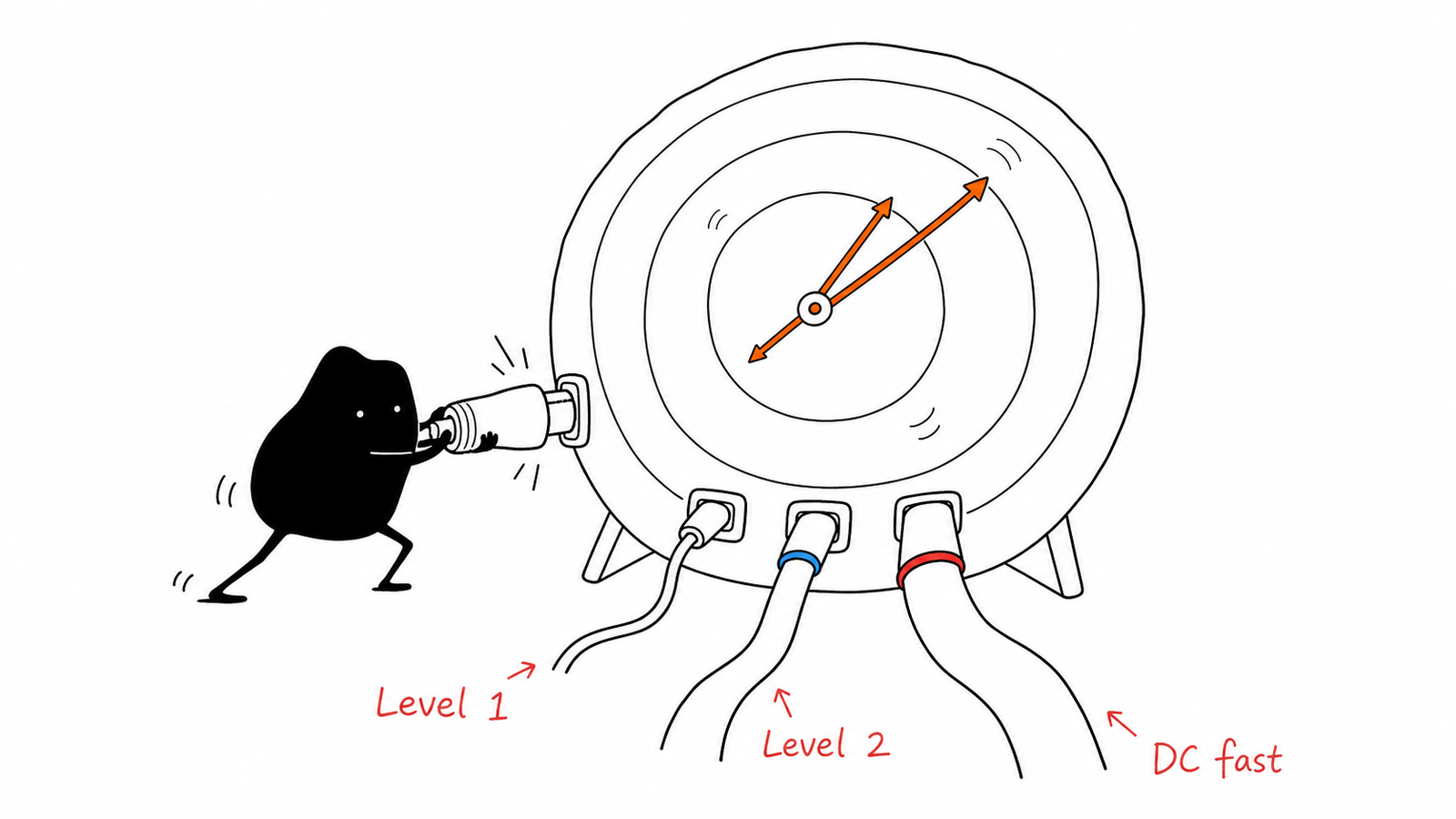
| Level 1, 120 V | Overnight recovery for lower daily mileage | About 2–5 miles per hour | Roughly 8–20+ hours, depending on energy needed |
| Level 2, 208–240 V | Home, workplace and destination charging | About 10–30 miles per hour | Often 1–3 hours for a normal day; overnight for a large refill |
| DC fast charging | Road trips and quick public top-ups | About 100–200+ miles in 30 minutes | Commonly planned as a partial charge, not 0–100% |
Those charging-rate ranges come from the U.S. Department of Energy’s Alternative Fuels Data Center consumer guide. They are useful orientation, not a promise for every car. The Department of Energy also notes that total charging time can range from under 20 minutes to 20 hours or more because battery capacity, state of charge, vehicle limits and charging equipment all matter.
XCarspace verdict: Do not ask how long the battery takes to fill from empty. Ask how long your normal day takes to replace. Most owners rarely arrive home at 0%, and they rarely need 100% the next morning.
The Charging-Time Formula That Actually Works
For AC home charging, a useful estimate is:
Charging time in hours = energy added to the battery ÷ (available charging power × charging efficiency)
Energy added to the battery is:
Usable battery capacity × the percentage-point increase in state of charge
Suppose a hypothetical EV has a 75-kWh usable battery and needs to go from 20% to 80%. The battery must gain 45 kWh:
75 kWh × 0.60 = 45 kWh
On a 7.2-kW Level 2 circuit, assuming 90% wall-to-battery efficiency for this example:
45 kWh ÷ (7.2 kW × 0.90) = about 6.9 hours
This is a planning estimate, not a model-specific claim. Charging losses vary with equipment, temperature and vehicle behavior. The calculation also excludes time spent connecting the car or waiting for a public stall.
To run the same calculation with your own battery size, starting percentage, target percentage and charger power, use the XCarspace EV Charging Time Calculator. Treat its constant-power result as a planning baseline; DC fast-charging curves and temperature can make the real session longer.
Daily Energy Replacement Matters More Than a Full Charge
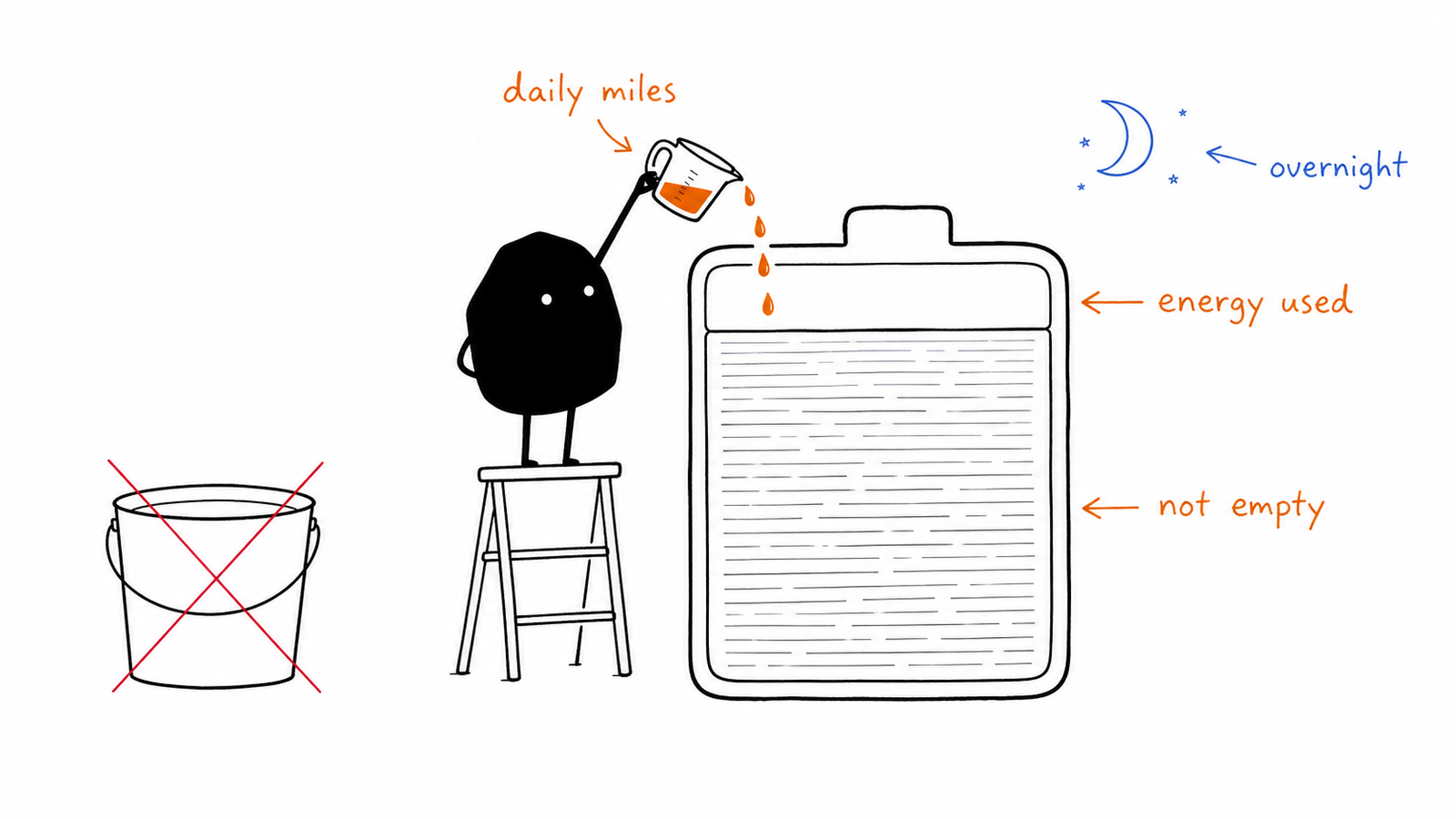
A large battery makes a full refill look intimidating, but battery size is not daily energy consumption. If you drive 30 miles and the EV consumes 30 kWh per 100 miles, the car uses 9 kWh. Allowing 10% for charging losses, the wall must supply about 9.9 kWh.
The table below uses a hypothetical EV rated at 30 kWh per 100 miles, adds a 10% loss allowance and assumes the stated charger power is continuously available. It is a reproducible sensitivity example, not a national average.
| Daily Miles | Energy From Wall | 1.4-kW Level 1 | 7.2-kW Level 2 | 9.6-kW Level 2 |
|---|---|---|---|---|
| 20 miles | 6.6 kWh | 4.7 hours | 0.9 hour | 0.7 hour |
| 30 miles | 9.9 kWh | 7.1 hours | 1.4 hours | 1.0 hour |
| 40 miles | 13.2 kWh | 9.4 hours | 1.8 hours | 1.4 hours |
| 60 miles | 19.8 kWh | 14.1 hours | 2.8 hours | 2.1 hours |
This explains why Level 1 can be enough for one household and impossible for another. A 20-mile commuter with a long overnight parking window can replace a normal day on a standard outlet. A 60-mile commuter returning late and leaving early may gradually fall behind unless longer weekend charging closes the gap.
Level 1 Charging: Slow Does Not Automatically Mean Inadequate
Level 1 uses a 120-volt outlet. The Department of Energy says it generally adds about 2 to 5 miles of range per hour and gives an example in which eight hours can replenish about 40 miles for a midsize EV. The agency’s charging-station guide uses 1.9 kW for its approximately five-miles-per-hour example, while many portable cordsets and household circuits operate at lower power.
Level 1 is a fit when all of these are true:
- Your average daily mileage is modest.
- The car is parked for ten or more hours most nights.
- A safe, dedicated and properly installed outlet is available near the parking space.
- You have a backup for unusually heavy driving days.
It is a weak fit for long commutes, irregular schedules or households that routinely use a large share of the battery on consecutive days. The failure mode is not usually one dramatic empty battery. It is a small nightly energy deficit that compounds across the week.
Have a qualified electrician evaluate the outlet and circuit. An EV is a long-duration electrical load, not the same as occasionally plugging in a small appliance.
Level 2 Charging: The Best Default for Most Homeowners
Level 2 normally uses 208- or 240-volt service. The federal consumer guide describes a broad 10-to-30-mile-per-hour range. Actual power can vary from a relatively modest installation to 19.2 kW equipment, but the wall unit is only one part of the system.
The car’s onboard AC charger sets its own ceiling. A 19.2-kW wall connector does not force 19.2 kW into a vehicle that accepts only 11 kW on AC. Shared electrical infrastructure, circuit limits and load-management settings can reduce power further.
For the hypothetical 75-kWh battery, a 10% to 100% refill requires 67.5 kWh in the battery. With 90% example efficiency, that is about 75 kWh from the wall:
- At 7.2 kW: approximately 10.4 hours.
- At 9.6 kW: approximately 7.8 hours.
- At 11 kW: approximately 6.8 hours.
Again, that is a nearly empty battery. A normal 30-mile day in the same efficiency example takes roughly one to one-and-a-half hours at common Level 2 power. The car may remain plugged in overnight, but it is not necessarily drawing full power all night.
DC Fast Charging: Peak Kilowatts Do Not Equal Average Kilowatts
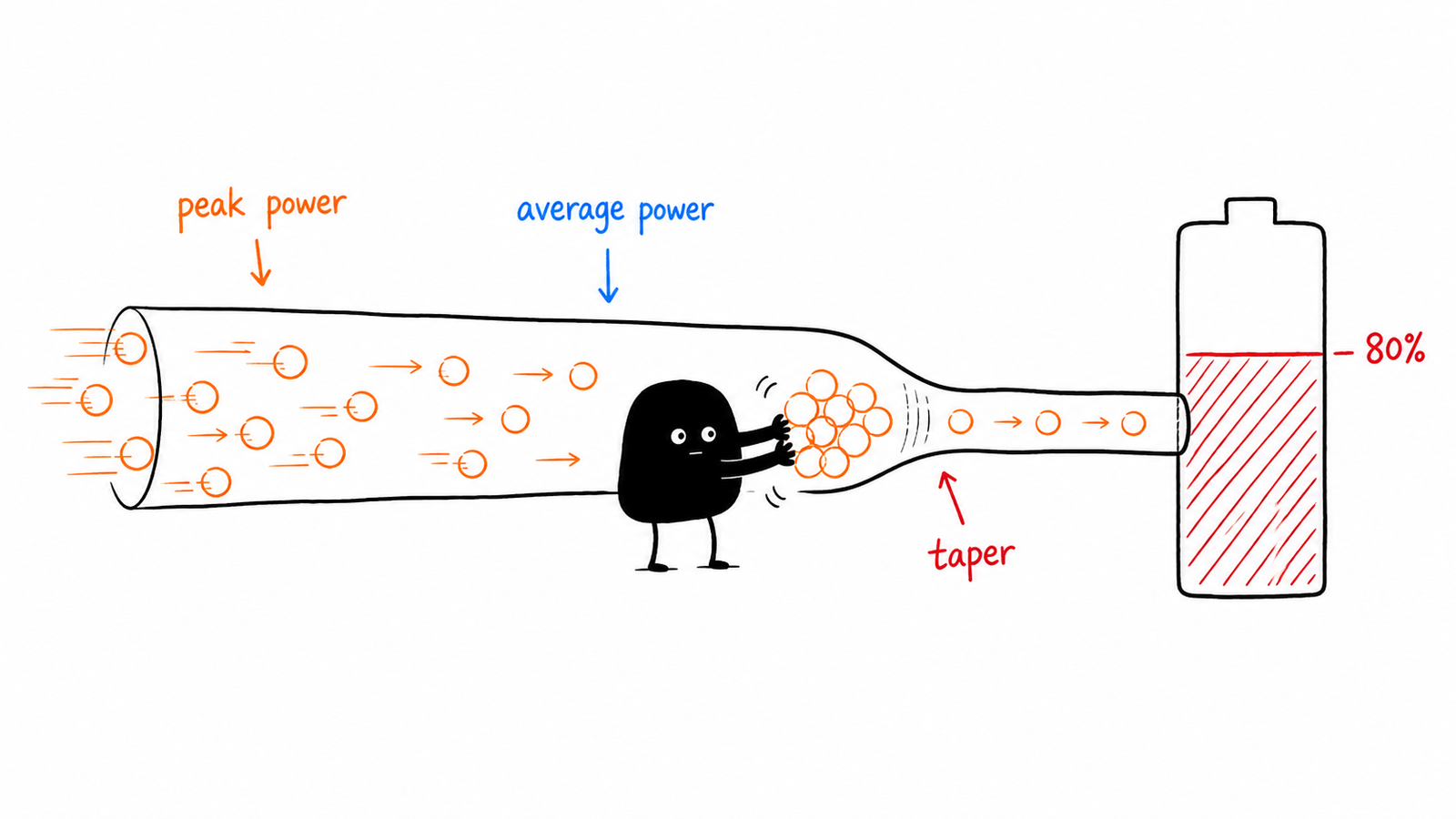
DC fast charging bypasses the vehicle’s onboard AC charger and supplies DC power to the battery system. That enables much higher power, but the number on the station is still not the speed the car will hold throughout a session.
The vehicle and charger continuously negotiate power. The limit at any moment is constrained by the station, the vehicle’s charge-acceptance curve, battery temperature and state of charge. NREL charging models explicitly treat the vehicle’s acceptance curve as a state-of-charge-dependent limit, and NREL’s high-power charging research notes that charging power generally falls significantly around 80% to 85% state of charge.
That is why the useful road-trip specification is a tested or manufacturer-stated time across a defined window, such as 10% to 80%, under stated conditions. A peak of 250 kW without a charge curve tells you very little about the whole stop.
A 20%-to-80% Mathematical Example
A hypothetical 75-kWh battery needs 45 kWh to move from 20% to 80%. If you know the average battery power during that window, the theoretical charging portion is easy to estimate:
| Average Power During Session | Energy Added | Calculated Charging Time |
|---|---|---|
| 50 kW average | 45 kWh | 54 minutes |
| 75 kW average | 45 kWh | 36 minutes |
| 100 kW average | 45 kWh | 27 minutes |
| 150 kW average | 45 kWh | 18 minutes |
These are mathematical scenarios, not claims about a particular vehicle. A charger advertised at 150 kW does not mean the car averages 150 kW. The session may begin below the station rating, briefly approach a peak and then taper.
Why Charging From 80% to 100% Can Feel So Slow
The final part of a fast charge often receives less power than the middle of the battery. Charging to 100% can still make sense before a difficult route segment, when destination charging is uncertain or when the car needs maximum available range. It is usually inefficient when another reliable charger is comfortably within reach.
Road-trip planning software often minimizes total travel time by recommending shorter, strategically placed stops. Two partial sessions can be faster than one long session that spends substantial time in the slow upper portion of the charge curve.
This does not mean owners should never charge to 100%. It means the target should serve the trip. Follow the automaker’s owner-manual guidance for routine charging and battery care because recommendations differ by battery and vehicle.
Road-Trip Charging Time Includes More Than Plug-In Time
A laboratory-style 10%-to-80% result is not the same as total trip delay. The driver experiences:
detour + stall search or queue + authentication + charging + disconnection + return to route
Sometimes the extra delay is smaller than the charging session because passengers already needed food or a restroom. Sometimes a 25-minute charge creates 40 minutes of delay because the station is off-route or occupied. That distinction matters when comparing an EV with a hybrid for family travel.
For the broader ownership decision, see XCarspace’s 2027 EV vs. hybrid buyer guide. If public stations would be your main energy source, also use our guide to owning an EV without home charging.
Seven Variables That Change the Charging Time
- Energy required: A 20-percentage-point top-up needs one-third the energy of a 60-point refill in the same battery.
- Battery capacity: A larger pack takes longer at the same power when adding the same percentage.
- Vehicle efficiency: More efficient EVs recover more miles from each kWh.
- Vehicle acceptance limit: The car may accept less power than the station can offer.
- Battery temperature: A cold or very hot battery may reduce charging power while the thermal system adjusts conditions.
- State of charge: DC fast-charging power normally changes as the battery fills.
- Shared or limited equipment: Some installations divide available power or operate below their displayed maximum.
Preconditioning can matter on a road trip because the vehicle may prepare the battery before arrival at a fast charger. Verify how the specific model activates that feature. Some require the charger to be selected in the built-in navigation system.
Three Buyer Scenarios
Apartment Driver, 25 Miles per Day
A nearby Level 2 charger can easily replace the energy, but charging speed is not the main risk. Availability and price are. The driver needs roughly 8.25 kWh from the wall in our efficiency example, which takes about 1.1 hours at 7.2 kW. If that session requires a dedicated trip, the logistical burden can matter more than the plug-in time.
Homeowner, 50 Miles per Day
The example requires about 16.5 kWh from the wall. Level 1 at 1.4 kW needs nearly 12 hours; 7.2-kW Level 2 needs about 2.3 hours. Level 1 may work with long overnight parking, but Level 2 leaves much more recovery margin after an unusually busy day.
Frequent Highway Traveler
This buyer should compare average fast-charging performance across a useful state-of-charge window, route coverage and winter behavior. A high peak number is not enough. The vehicle that holds a strong charging curve may complete a trip sooner than one with a higher advertised peak that tapers early.
What Would Change the Recommendation?
- A shorter parking window: Higher Level 2 power becomes more valuable when the car is home for only a few hours.
- A very efficient EV: Fewer kWh are needed to recover the same miles.
- Cold-weather road trips: Battery conditioning and a conservative range buffer become more important.
- Reliable workplace charging: A slower home setup may be sufficient because the car has another long dwell period.
- No dependable charging at home or work: The ownership question shifts from speed to access; a hybrid may be the lower-friction choice.
- A large onboard AC charger: It only helps if the electrical circuit and charging equipment can supply matching power.
Charging Questions to Answer Before Buying an EV
- What is the vehicle’s usable battery capacity?
- What is its EPA energy consumption in kWh per 100 miles?
- What is the maximum AC charging rate?
- What charging power will the planned home circuit actually deliver?
- What is the official or independently tested 10%-to-80% DC time?
- Does the vehicle automatically precondition for fast charging?
- Which connectors and approved adapters work with the vehicle?
- How many miles must be replaced on the hardest recurring day?
- Where is the backup charger if the primary option is unavailable?
If you are still deciding among an EV, plug-in hybrid, conventional hybrid and gasoline vehicle, the XCarspace powertrain guide explains what each system asks from the owner.
Frequently Asked Questions
How long does it take to charge an EV at home?
Level 1 may need several hours to replace a modest commute and 20 hours or more for a large refill. Common Level 2 setups can replace a normal day in roughly one to three hours and refill many large batteries overnight. Use battery energy needed divided by available charging power, adjusted for losses.
Can a regular outlet charge an electric car overnight?
Yes, if the vehicle, cordset, outlet and circuit are suitable. The Department of Energy says Level 1 generally adds 2 to 5 miles per hour. It can cover lower-mileage routines, but an electrician should confirm that the outlet and dedicated circuit are appropriate for sustained charging.
Does a 350-kW charger always charge faster than a 150-kW charger?
No. The vehicle may accept less than either station’s rating, and its accepted power changes with battery temperature and state of charge. A 350-kW stall cannot make a car exceed its own charging curve.
Why did my EV charge slower than the advertised rate?
Possible reasons include a cold or hot battery, high state of charge, the car’s acceptance limit, shared station power, equipment faults or the fact that the advertised number is a brief peak rather than the session average.
Should I install the highest-power home charger available?
Not automatically. Size the system around daily energy needs, parking time, the vehicle’s AC limit, electrical capacity and installation cost. Extra wall-unit power has no benefit when the car or circuit cannot use it.
Final Verdict
For daily ownership, an EV often spends far less time actively charging than the “empty-to-full” question suggests. A normal commute may need an overnight Level 1 session or only one to three hours on Level 2. The car can remain connected while the owner sleeps, so driver time may be measured in seconds.
Road trips are different. Judge them by the vehicle’s charging curve, a defined percentage window and total stop delay, not the station’s peak number. The fastest-looking charger does not guarantee the fastest trip.
The most useful rule is simple: calculate the energy your real day consumes, then buy enough charging speed to replace it during the time the car already sits.
Methodology: XCarspace examples use a hypothetical EV consuming 30 kWh/100 miles, a 10% AC charging-loss allowance and charger powers of 1.4, 7.2 and 9.6 kW. The 75-kWh battery examples use stated percentage windows and do not represent a specific production vehicle. Calculations exclude queues, authentication and detours unless noted. Source pages were checked July 28, 2026.