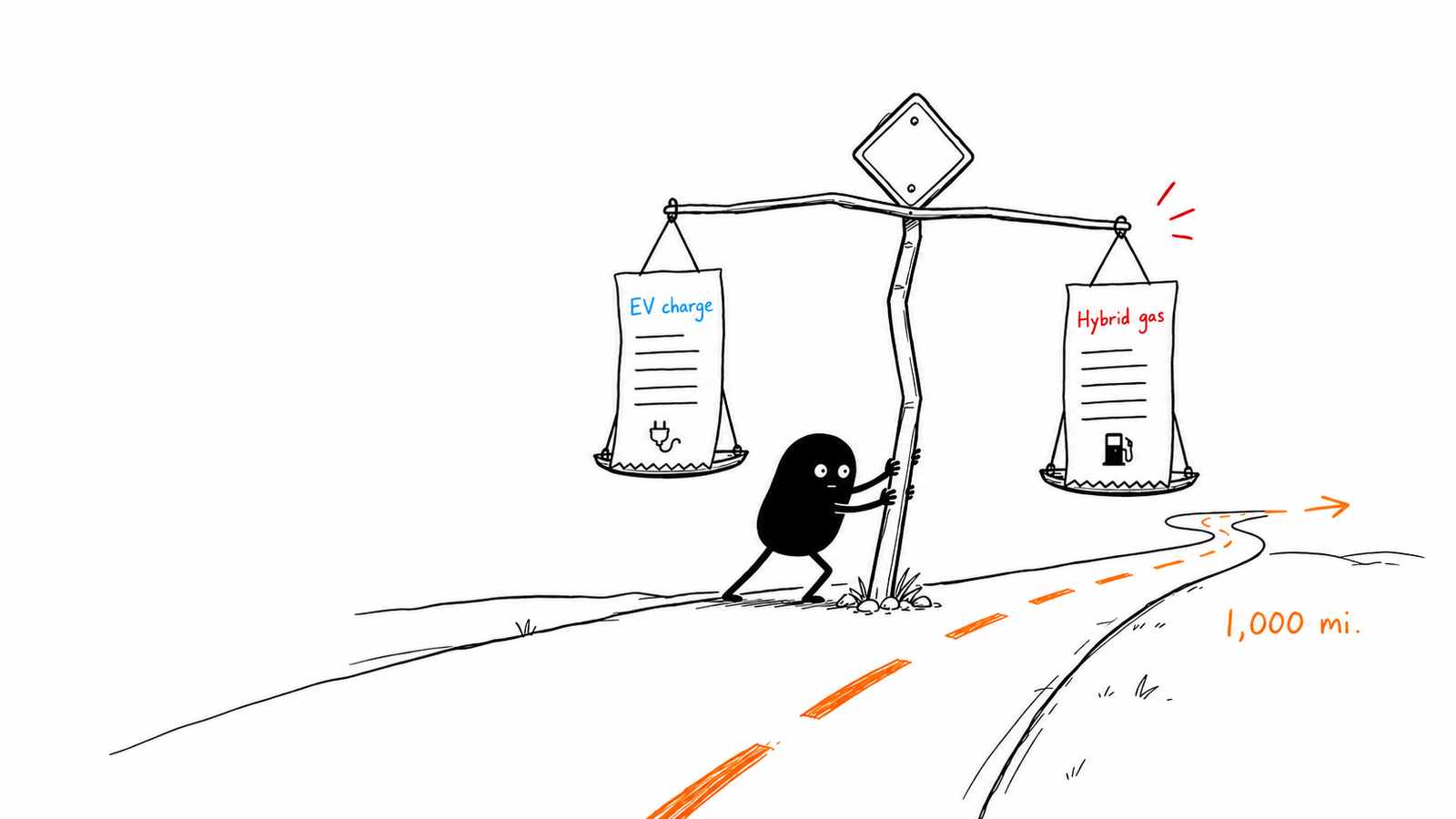
Updated July 30, 2026. On a 1,000-mile U.S. road trip, an efficient EV is cheaper than a 42-mpg hybrid only when the electricity is cheap enough. Using the current national regular-gasoline price of $4.096 per gallon, our example EV breaks even at about 30.5 cents per kWh if every road-trip kilowatt-hour comes from public charging. Start with 60 kWh bought at home and the public-charging break-even price rises to about 33.3 cents per kWh.
That is the useful answer—not “EVs always cost less” or “hybrids always win on trips.” Check the price at the chargers on your route, use your vehicle’s real highway efficiency, and include the time and detours that the energy bill ignores.
EV vs Hybrid Road-Trip Cost: The Quick Answer
| 1,000-Mile Scenario | EV Energy Cost | 42-mpg Hybrid Fuel Cost | Cheaper Choice |
|---|---|---|---|
| EV at $0.30/kWh, all public | $96.00 | $97.52 | EV by $1.52 |
| EV at $0.45/kWh, all public | $144.00 | $97.52 | Hybrid by $46.48 |
| EV at $0.60/kWh, all public | $192.00 | $97.52 | Hybrid by $94.48 |
| EV starts with 60 home-charged kWh; public energy at $0.30/kWh | $89.06 | $97.52 | EV by $8.46 |
| Same home start; public energy at $0.45/kWh | $128.06 | $97.52 | Hybrid by $30.54 |
XCarspace verdict: At today’s national gasoline price, public fast charging must be close to 30 cents per kWh for our efficient EV example to beat a 42-mpg hybrid on energy alone. A cheap charge before departure helps, but it does not make expensive corridor charging cheap. The hybrid is the safer cost choice when most of the trip depends on public charging above the low-30-cent range.
The table is a decision model, not a forecast or a claim about every vehicle. It uses a 32-kWh/100-mile EV, a 42-mpg hybrid and national energy data available July 30, 2026. Replace all three inputs before making a real purchase or trip decision.
The 1,000-Mile Cost Model
The model deliberately compares energy only. It does not mix in purchase price, insurance, depreciation, maintenance, hotel charging, parking fees or the value of your time. Those matter to ownership, but adding them to a single trip calculation would hide the question this page answers.
Inputs
- Distance: 1,000 miles.
- Hybrid efficiency: 42 miles per gallon, an illustrative efficient-hybrid input.
- EV consumption: 32 kWh per 100 miles, an illustrative highway-trip input.
- Gasoline: $4.096 per gallon, the U.S. average regular-gasoline price for the week of July 27, 2026.
- Home electricity: 18.44 cents per kWh, the U.S. residential average for May 2026.
- Public electricity: $0.30, $0.45 and $0.60 per kWh as sensitivity cases—not national averages.
The gasoline input comes from the U.S. Energy Information Administration’s weekly fuel update. The home-electricity input comes from EIA’s May 2026 Electric Power Monthly summary. Both are national snapshots. A trip in California, Texas or New England can produce a very different answer.
Public charging needs a range rather than one invented average. The Department of Energy’s Alternative Fuels Data Center says public stations can charge by kilowatt-hour, session, time or subscription, with prices also varying by membership, site host and charging rate. That is why the number shown in the app before you plug in is more useful than a broad national claim.
Formulas
Hybrid gallons = trip miles ÷ mpg
1,000 miles ÷ 42 mpg = 23.81 gallons. At $4.096 per gallon, the trip costs $97.52.
EV energy = trip miles ÷ 100 × kWh per 100 miles
1,000 miles ÷ 100 × 32 kWh = 320 kWh. Multiply 320 by the public price to get the all-public EV cost.
The EPA’s electric-vehicle label includes a consumption rate in kWh per 100 miles because that number relates directly to energy cost. Use the combined label value as a standardized starting point, then adjust it with your vehicle’s highway history or credible route-specific testing. The EPA itself describes the figure as an estimate; speed, weather, elevation, traffic, tires and cabin settings can move the real result.
The Public-Charging Break-Even Price

The all-public break-even formula is:
Break-even electricity price = hybrid trip cost ÷ EV trip kWh
$97.52 ÷ 320 kWh = $0.3048 per kWh, or about 30.5 cents per kWh.
Below that price, the EV is cheaper in this example. Above it, the hybrid is cheaper. At 30 cents, however, the EV saves only $1.52 across 1,000 miles. That is too small to dictate a vehicle purchase. One idle fee, paid parking session or charging detour can erase it.
The threshold changes as soon as either vehicle’s efficiency changes. A 48-mpg hybrid needs only 20.83 gallons for the same trip, so its fuel bill falls to about $85.33 and the EV’s all-public break-even price falls to roughly 26.7 cents per kWh. A less efficient 36-mpg hybrid costs about $113.78, pushing the EV threshold up to about 35.6 cents.
EV efficiency matters just as much. If the EV uses 38 kWh/100 miles instead of 32, it consumes 380 kWh. The all-public break-even price falls to about 25.7 cents per kWh. A large, fast, heavily loaded EV can therefore lose the energy-cost comparison even when a smaller EV would win on the same road.
Starting With a Home Charge Helps—Within Limits
Many road-trip comparisons make an unrealistic assumption: either every kilowatt-hour is bought at home or every kilowatt-hour is bought on the road. A real trip often starts with a full battery charged overnight, then depends on public charging.
Our mixed scenario assigns 60 kWh to home charging and the remaining 260 kWh to public charging. Sixty kWh at the May 2026 national residential rate costs $11.06. The public break-even formula becomes:
($97.52 hybrid cost − $11.06 home energy) ÷ 260 public kWh = $0.3325/kWh
The cheap start raises the public threshold to about 33.3 cents per kWh. At 30 cents, the EV costs $89.06 and saves $8.46. At 45 cents, it costs $128.06 and loses by $30.54.
This 60-kWh input does not describe a particular battery size. It represents energy purchased at home before departure. If your trip begins at a hotel with free destination charging, a workplace charger or a higher-priced home utility, replace it. Free charging is real savings only when it is available, compatible and convenient during the trip you are actually taking.
Cold, Speed and Load Can Reverse the Result
The 32-kWh/100-mile input is not a promise. The Department of Energy notes that all-electric vehicle efficiency and range vary with driving conditions, and that EVs are generally more efficient in city use than at highway speed. Cold weather, strong headwinds, sustained high speed, roof cargo, hills and heavy loads can all raise road-trip consumption.
Consider a difficult-weather sensitivity case at 38 kWh/100 miles. The trip now needs 380 kWh. Keep the same 60-kWh home start and buy 320 kWh publicly:
| Difficult-Condition Scenario | EV Cost | Hybrid Cost | Result |
|---|---|---|---|
| Public charging at $0.30/kWh | $107.06 | $97.52 | Hybrid by $9.54 |
| Public charging at $0.45/kWh | $155.06 | $97.52 | Hybrid by $57.54 |
| Public charging at $0.60/kWh | $203.06 | $97.52 | Hybrid by $105.54 |
In this case, the public break-even point drops to about 27.0 cents per kWh. The answer has reversed even though gasoline and charger prices did not change. That is why a buyer should not calculate a winter interstate trip using an EV’s best mild-weather commute number.
Use XCarspace’s EV range-budget guide to stress-test the hardest recurring trip, and the EV charging-time guide to estimate the stop rather than relying on peak charger power.
The Energy Bill Ignores the Time Bill
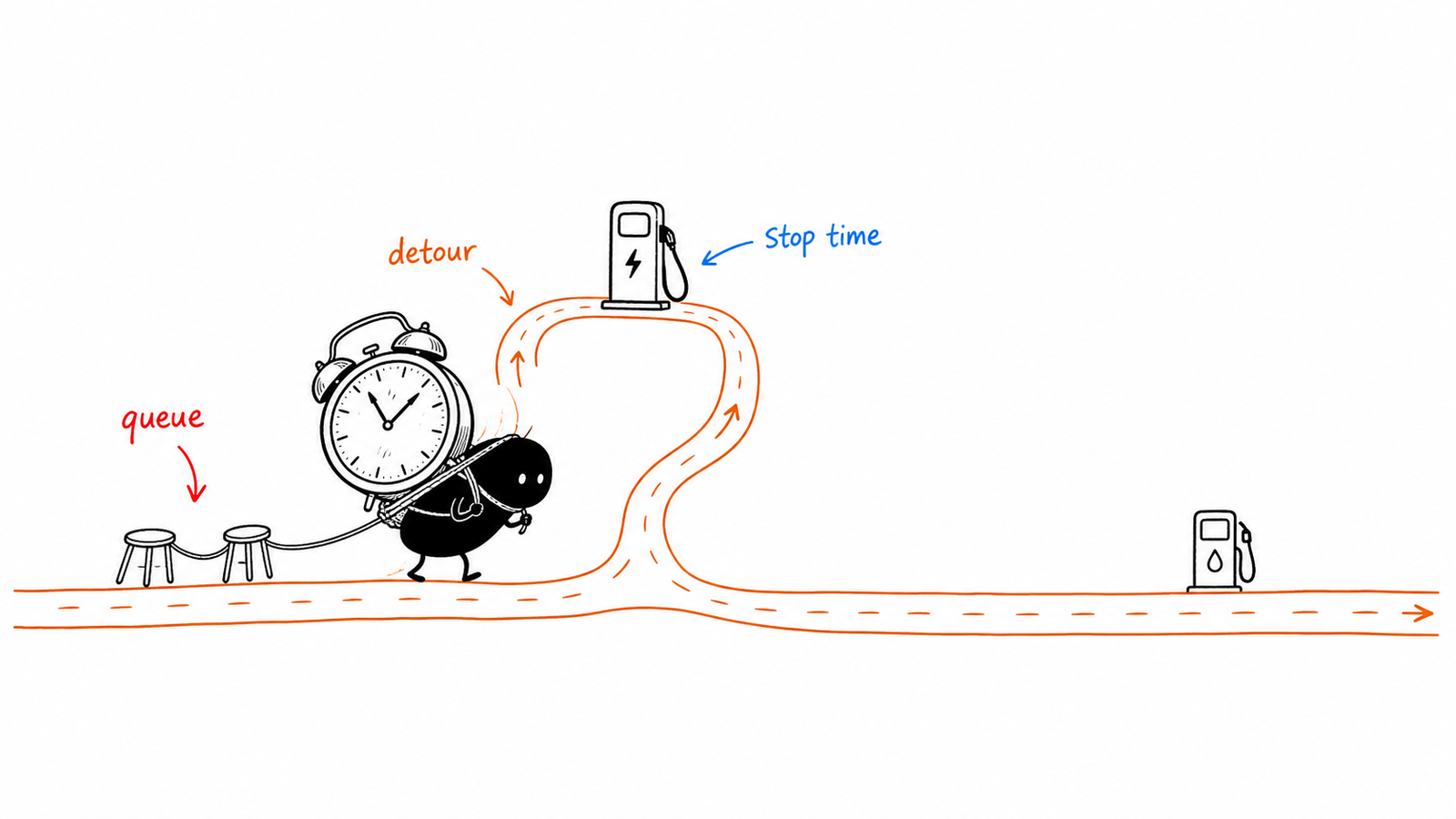
A dollar-only result can be correct and still produce the wrong buying recommendation. The trip also has a time bill.
Do not value every charging minute as lost time. A stop that overlaps lunch, a restroom break or a child’s break may add little or nothing to the day. A charger eight minutes off-route, followed by a queue and a slower-than-planned session, is different. Count incremental time: the minutes the EV adds beyond the stops your household would make anyway.
A useful trip-time audit includes:
- drive time from the route to the charger and back;
- waiting for an open, working connector;
- plug-in and payment setup;
- actual charging time across the planned state-of-charge window;
- extra time caused by reduced charging power or a vehicle sharing site power;
- time that overlaps a meal or planned rest break.
If two adults alternate driving and want the shortest possible travel day, a hybrid’s predictable fuel stop has real value. If a family already stops for 25 minutes every two or three hours, an EV may fit the existing rhythm. Neither household is “right” in the abstract.
The same distinction applies to charger reliability. A route with several compatible alternatives is less risky than one built around a single location. Before buying an EV for regular interstate travel, run the route in at least two planning apps and inspect recent station status. XCarspace’s guide to EV ownership without home charging explains why reliable access matters more than the simple number of pins on a map.
Three Road-Trip Buyers, Three Answers
The Home-Charging Family With Two Vacation Trips
This household drives locally most of the year, charges cheaply at home and takes two 1,000-mile vacations. An EV can still be the better ownership choice even if the hybrid saves $30 or $50 on each vacation. The road trips are a small share of annual driving, while home charging controls the rest. Compare five-year ownership cost rather than letting two unusual days decide the car.
The Frequent Interstate Driver
This buyer travels 600 to 1,000 miles several times per month and buys most trip energy at public fast chargers. The hybrid is the strong default when corridor prices sit above the break-even point. It also reduces planning risk and protects the travel schedule when weather or charger availability changes.
An EV can still work if the buyer has a highly efficient model, low contracted charging rates, reliable destination charging and stops that overlap normal breaks. Those conditions should be verified, not assumed.
The Apartment Renter Who Also Road-Trips
This is the hardest EV case. The buyer may pay public prices both during the normal week and on long trips, so the cheap home-start advantage disappears. A larger battery reduces session frequency but does not lower the price per kilowatt-hour. Unless workplace or apartment charging is dependable and sensibly priced, an efficient conventional hybrid is usually the lower-friction choice.
Trip energy is only one layer of the purchase decision. Use the EV & Hybrid Buyer Center to compare charging access and range constraints, then add depreciation, insurance and maintenance through the Car Ownership Cost Center.
What Changes the Recommendation?
- Lower gasoline prices: The hybrid’s fuel bill falls, so the EV needs cheaper electricity to break even.
- Higher gasoline prices: The EV can tolerate a higher public-charging price.
- A more efficient hybrid: Every mpg improvement makes the hybrid harder to beat on a highway trip.
- A smaller, more efficient EV: Fewer kWh per 100 miles raises the break-even charging price.
- Cold, speed, wind or cargo: Higher EV consumption can reverse a narrow win.
- Free or low-cost destination charging: It reduces both cost and the amount of corridor energy required.
- A membership rate: It matters only after the subscription cost is allocated across real sessions.
- Idle, parking or session fees: Add them to the EV total rather than hiding them inside a per-kWh comparison.
- Time-sensitive travel: The hybrid’s predictable stop may matter more than a small energy-price difference.
Your Five-Minute Pre-Trip Check
- Write down the trip miles.
- Use the EV’s expected highway kWh/100 miles for the actual weather and load.
- Use the hybrid’s realistic highway mpg, not its best city result.
- Record the current gasoline price on the route.
- Open the charging networks you will use and record member and non-member prices.
- Separate home, hotel and public kilowatt-hours.
- Add session, idle, parking and subscription costs.
- Count only charging time that extends stops you would make anyway.
- Identify a backup charger for every essential stop.
For a broader purchase decision, use the XCarspace EV vs. hybrid buyer guide. For your own numbers, the fuel-versus-electric cost calculator compares annual driving rather than one trip.
Frequently Asked Questions
Is an EV cheaper than a hybrid on a road trip?
Sometimes. In our 1,000-mile example, the EV beats a 42-mpg hybrid only below about 30.5 cents per kWh with all-public charging. Your break-even price changes with gasoline price and both vehicles’ efficiency.
How much does it cost to charge an EV for 1,000 miles?
A 32-kWh/100-mile EV needs 320 kWh in this example. That costs $96 at $0.30/kWh, $144 at $0.45/kWh or $192 at $0.60/kWh. Fees and detours are excluded.
Does charging at home before a road trip make a big difference?
It helps, but the impact is limited on a very long trip. Buying 60 kWh at the May 2026 national residential average saves about $7 compared with buying that energy at 30 cents per kWh, or about $25 compared with 60-cent charging.
Should I use EPA kWh/100 miles for the calculation?
Use it as the standardized starting point. For a purchase or route decision, replace it with credible highway consumption in similar speed, temperature and load conditions. If you already own the EV, recent trip and charging receipts are better inputs.
What is the biggest mistake in EV-versus-hybrid trip math?
Comparing residential electricity with road-trip gasoline when the EV will actually use public fast charging. Price the energy source the trip will use, not the cheapest rate available somewhere else.
Final Verdict
For this 1,000-mile example, the EV needs public electricity near 30 cents per kWh to match a 42-mpg hybrid at $4.096 gasoline. Starting with a cheap home charge moves the public threshold into the low-30-cent range. A 45- or 60-cent route gives the hybrid a clear energy-cost advantage.
That does not make the hybrid universally cheaper to own. An EV charged at home for ordinary driving can recover money during the other 50 weeks of the year. But if frequent road trips dominate your mileage, public charging price and real highway consumption deserve more weight than the promise of low electric “fuel” cost.
The honest rule is simple: calculate the trip with the charger prices you can actually buy. If the result is close, choose based on time, reliability and the rest of the ownership year—not a $2 spreadsheet victory.
Methodology and Primary Sources
This XCarspace model uses 1,000 miles, a hypothetical 42-mpg hybrid and a hypothetical 32-kWh/100-mile EV. Gasoline is the EIA U.S. regular average for July 27, 2026. Residential electricity is the EIA U.S. average for May 2026. Public prices are sensitivity inputs, not national averages. Results are rounded to the nearest cent; formulas use unrounded values.
Excluded: vehicle purchase price, financing, depreciation, insurance, maintenance, tires, lodging, parking, charger subscriptions, idle fees, route detours and the value of time unless specifically discussed. This is an energy-cost comparison, not a total-cost-of-ownership claim.
- U.S. Energy Information Administration: Gasoline and Diesel Fuel Update
- U.S. Energy Information Administration: May 2026 electricity summary
- U.S. Environmental Protection Agency: Electric Vehicle Fuel Economy Label
- U.S. Department of Energy Alternative Fuels Data Center: Public charging pricing structures
- U.S. Department of Energy Alternative Fuels Data Center: All-Electric Vehicles