
Updated July 30, 2026. How much does AC reduce EV range? In controlled Argonne National Laboratory testing, battery-electric vehicles averaged a 14% range reduction at 95°F versus 72°F while the cabin was held at 72°F. That is a useful summer planning buffer, not a universal penalty. A shaded, pre-cooled EV on a steady highway trip may lose less; a dark car starting after hours in the sun, crawling through traffic with maximum cooling, can lose more.
The reason is simple: air conditioning consumes power by the hour, while range is earned by the mile. Our calculations show why the same cooling load looks modest at highway speed but much larger during a slow, short trip.
How Much Does AC Reduce EV Range? Quick Answer
| Summer Situation | Practical Range Effect | What to Do |
|---|---|---|
| 95°F mixed driving, cabin held at 72°F | Argonne test average: about 14% less range | Use 10–15% as an initial planning buffer, then replace it with vehicle-specific data. |
| Steady 65-mph highway trip | Our 2-kW AC example cuts calculated range about 9% | Keep a normal reserve and avoid treating the EPA number as a promise. |
| Slow 25-mph trip after a hot soak | The same 2-kW load can add one-third to trip energy in our model | Vent the cabin, pre-cool while plugged in and use shade. |
| Mild heat after preconditioning | Often smaller than the severe-hot-soak case | Schedule preconditioning before departure when charging. |
| Extreme heat, full cabin, maximum cooling | Potentially greater than 14% | Plan with the car’s recent energy history and a larger arrival reserve. |
XCarspace verdict: Do not switch off cooling to chase a few miles when heat threatens comfort or safety. For a 95°F trip, begin with a 10–15% summer range buffer, precondition while plugged in, and check how your own car performs at the speed and cabin setting you will actually use. The percentage is usually less frightening once the trip is long and steady, but it can look severe on a slow drive that begins with a heat-soaked cabin.
What the Best Controlled Test Actually Found
Argonne’s Advanced Mobility Technology Laboratory tested battery-electric vehicles on a dynamometer at 0°F, 20°F, 72°F and 95°F. The cabin thermostat was maintained at 72°F. Compared with the 72°F reference, average BEV range fell 14% at 95°F. The cold penalties were much larger: 41% at 20°F and 54% at 0°F.
The Argonne extreme-weather results are more useful than a social-media claim about one car on one day, but they still are not a promise for every EV. The result averages the vehicles and weighted city/highway cycles in that study. Cabin color, glass area, compressor efficiency, battery cooling, humidity, solar load and the temperature selected by the driver can move the outcome.
The U.S. Environmental Protection Agency also tells buyers that accessory use such as air conditioning and high-speed driving can significantly lower EV range. The Department of Energy’s all-electric vehicle guide likewise notes that extreme temperatures reduce range because more energy is needed to heat or cool the cabin.
The defensible conclusion is not “AC always costs 14%.” It is “14% is a credible 95°F mixed-driving reference, and your trip can land on either side of it.”
Why Speed Changes the AC Penalty
An EV’s traction motor consumes energy according to distance, speed, elevation, wind and load. The air-conditioning compressor consumes energy according to time and cooling demand. Those two clocks create the summer-range effect.
The reusable calculation is:
AC energy = average AC power in kW × trip hours
Trip hours = miles ÷ average speed
A two-kilowatt cooling load running for one hour uses 2 kWh. Cover 65 miles during that hour and the cooling energy is spread across 65 miles. Cover only 25 miles in traffic and the same 2 kWh is spread across 25 miles. The compressor has not become less efficient merely because the car is moving slowly; it has simply had more time per mile to draw energy.
This is also why the first few miles after a hot soak can look terrible on the efficiency display. The cabin, seats, dashboard and glass may all be hot. Initial cool-down demands more work than maintaining an already comfortable cabin. A ten-minute errand can end before the load settles.
The XCarspace Highway AC Model
To make the relationship visible, start with an illustrative EV—not a named model:
- usable battery energy: 75 kWh;
- propulsion and normal accessory consumption without AC: 30 kWh/100 miles;
- steady speed: 65 mph;
- distance: 100 miles;
- average AC load sensitivities: 1, 2 and 3 kW.
These AC loads are scenarios, not claims about a national “typical” compressor. Real power changes constantly as the cabin cools and the system cycles. The model holds everything else constant so you can see what the hourly load does.
A 100-mile trip at 65 mph takes 1.538 hours. The no-AC energy use is 30 kWh. Add the cooling energy, divide the 75-kWh usable battery by the new consumption rate, and the calculated range changes like this:
| Average AC Load | AC Energy Over 100 Miles | Total Consumption | Calculated Range | Range Reduction |
|---|---|---|---|---|
| Off | 0 kWh | 30.00 kWh/100 mi | 250 miles | 0% |
| 1 kW | 1.54 kWh | 31.54 kWh/100 mi | 238 miles | 4.9% |
| 2 kW | 3.08 kWh | 33.08 kWh/100 mi | 227 miles | 9.3% |
| 3 kW | 4.62 kWh | 34.62 kWh/100 mi | 217 miles | 13.3% |
The range calculation is 75 kWh ÷ consumption per mile. It assumes the average cooling load continues across the whole usable battery and that speed, terrain and weather remain constant. Real trips do not behave that neatly. The value is the sensitivity: at highway speed, a sustained 2-kW cooling load costs about 23 miles in this example, while a 3-kW load costs about 33 miles.
Do not add Argonne’s 14% to this table. The controlled test already captures temperature, HVAC and related effects within its test conditions. The table is a separate mechanism model, not an extra penalty to stack on top.
Slow Trips Can Look Much Worse
Now consider a 30-mile city trip averaging 25 mph. Assume the EV would use 24 kWh/100 miles without air conditioning. The trip takes 1.2 hours and propulsion plus normal accessories require 7.2 kWh.
| Average AC Load | AC Energy | Total Trip Energy | Energy Increase |
|---|---|---|---|
| 1 kW | 1.2 kWh | 8.4 kWh | 16.7% |
| 2 kW | 2.4 kWh | 9.6 kWh | 33.3% |
| 3 kW | 3.6 kWh | 10.8 kWh | 50.0% |
That does not mean summer always cuts city range in half. The 3-kW row assumes the load persists for the full 1.2 hours, which may be unrealistic after the cabin reaches its target. It shows why a heat-soaked short trip can display a dramatic percentage: the cooling energy is large compared with the modest propulsion energy required at lower speed.
The reverse can happen on a long drive. The initial cool-down becomes a smaller share of total energy as miles accumulate. Once the cabin is stable, the compressor may draw much less than it did in the first minutes. A single percentage cannot describe both trips honestly.
Preconditioning Moves the Hardest Cooling Off the Battery

Preconditioning means cooling the cabin—and, when the vehicle manages it, preparing the battery—before departure. The useful version happens while the EV is plugged in. Grid power can handle part of the initial thermal load instead of drawing all of it from the traction battery after the trip begins.
National Renewable Energy Laboratory research identifies thermal preconditioning, solar-load reduction, improved glazing and zonal cooling as ways to reduce climate-control demand. In older simulation work covering hot and cold conditions, NREL found that preconditioning could restore some range, with the benefit varying widely by vehicle, weather and drive cycle. Treat any quoted maximum as a test result, not a guarantee for a current production EV.
The practical method is uncomplicated:
- Leave the vehicle connected to power.
- Use the vehicle or manufacturer app to schedule cabin temperature shortly before departure.
- Confirm that the car is drawing from the charger rather than merely starting climate control after charging has stopped.
- Set a comfortable temperature instead of selecting the coldest possible setting.
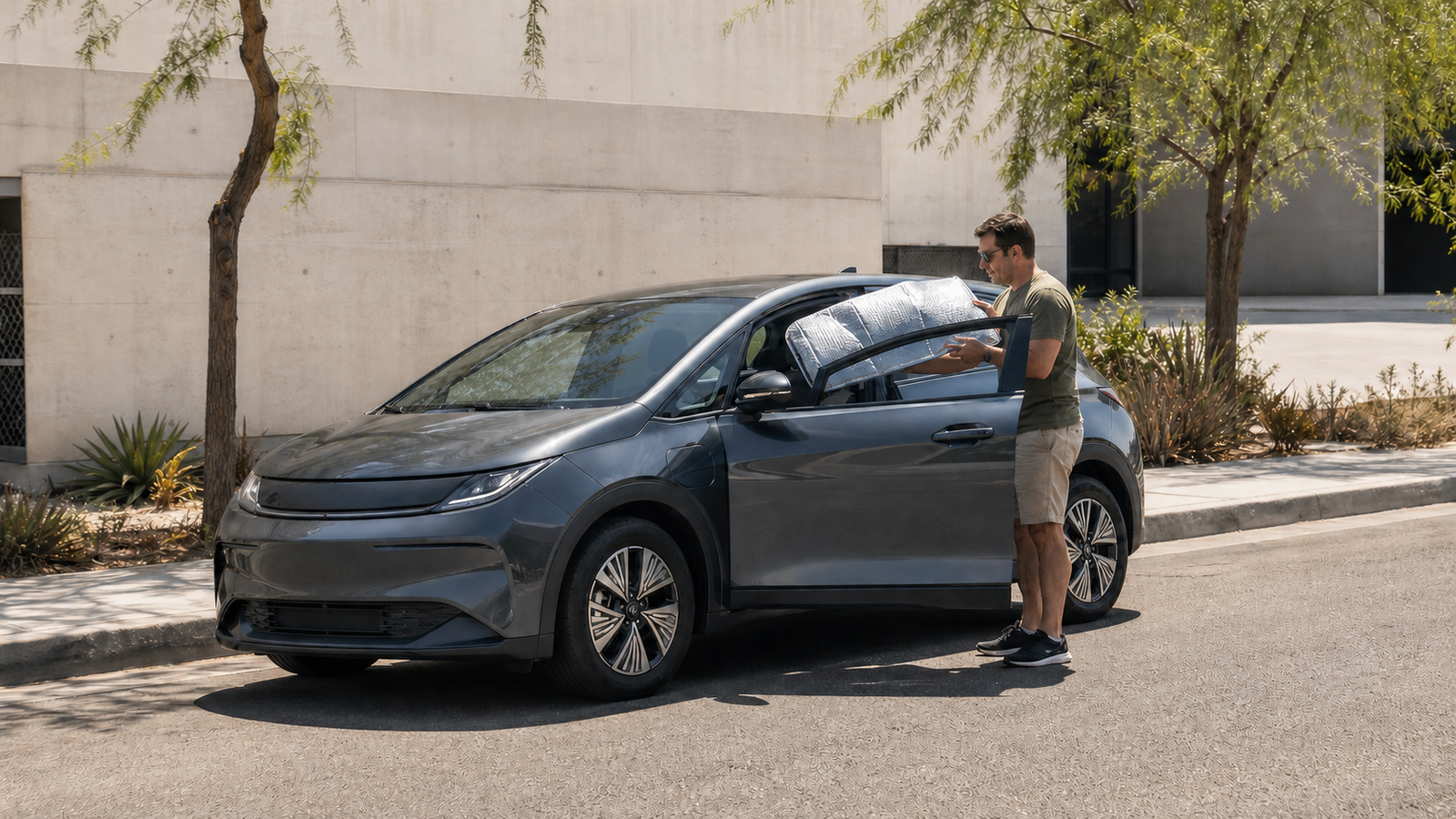
- Use shade or a windshield sunshade to reduce the heat the cabin stores while parked.
Preconditioning does not create free energy. The electricity still comes from somewhere, and it may appear on your home bill. It preserves more battery energy for driving and can improve comfort immediately. For a short trip, moving the initial cool-down off the battery can materially improve the consumption shown by the car.
Should You Open the Windows or Use AC?
Vent a heat-soaked cabin briefly before asking the air conditioner to fight trapped hot air. At low speed, opening the windows can help the cabin dump heat. Once you are traveling at highway speed, open windows create aerodynamic drag. EPA summer-driving guidance recommends using AC at highway speed because the drag from open windows can consume more fuel than air conditioning.
That EPA guidance is written for driving efficiency broadly, not as an EV-specific range guarantee. The physics still matters: an open window is not “free cooling” when it disrupts airflow around the vehicle. The sensible approach is to vent first, then close the windows and use a moderate climate setting.
Do not turn the cabin into a safety experiment. Children, older adults, pets and people with health conditions are especially vulnerable to heat. Never leave a person or animal in a parked vehicle, even briefly. Range optimization stops where heat safety begins.
What About Battery Cooling?
The cabin is not the only system managing heat. Many EVs also condition the battery to keep it within a suitable operating range. That energy can appear in the car’s consumption, especially during charging or extreme conditions. The control strategy differs by vehicle, battery state, charging plan and software.
Do not assume every watt shown as “climate” went through the dashboard vents, and do not assume turning off cabin AC disables battery thermal management. Follow the owner’s manual. If a future model has not published its thermal-management details, mark them unknown rather than inferring them from another vehicle.
Four Summer Drivers, Four Range Buffers
The 40-Mile Commuter With Home Charging
This driver can cool the cabin while plugged in and replace the energy every night. A 14% summer penalty on a vehicle with more than 200 miles of range rarely threatens the commute. Comfort and charging routine matter more than squeezing out every mile.
The Phoenix Apartment Renter
This driver starts from an exposed parking lot and cannot precondition from external power. Short trips may show poor efficiency because every departure begins with a hot cabin. A larger battery reduces charging frequency, but dependable charging access remains the bigger ownership question. Review XCarspace’s guide to owning an EV without home charging before treating range as the only problem.
The Summer Road-Trip Family
This family drives at highway speed with several passengers and cargo. Start with a 10–15% heat buffer, add a normal arrival reserve, then inspect model-specific route consumption. Cabin cooling may be only one part of the loss; speed, wind, elevation and payload can be just as important. Use the EV vs. hybrid road-trip cost model to translate higher kWh/100 miles into charging expense.
The Driver With a Tight Rural Charging Gap
This buyer should not rely on a generic percentage. Enter the route into the vehicle planner, check recent station status, preserve an alternate charger and compare the hardest summer trip with XCarspace’s EV range-budget guide. When the margin is narrow, a 10-mile detour matters more than a debate about one degree on the thermostat.
What Changes the Answer?
- Cabin temperature at departure: A car already near the target needs less initial cooling.
- Solar load: Dark surfaces, large glass areas and direct sun raise the heat stored in the cabin.
- Humidity: The system may need to remove moisture as well as heat.
- Trip speed and duration: A fixed hourly load has a larger impact per mile at low speed.
- Number of occupants: More people add heat and may require more airflow.
- Vehicle efficiency: The same 2-kW load is a larger percentage of a very efficient car’s baseline energy use.
- HVAC design: Compressor control, heat exchangers, glazing and zonal features differ by model.
- Battery thermal management: Pack cooling can add energy use that is not obvious from cabin settings.
- Charging access: Plugged-in preconditioning moves initial cooling demand away from stored battery energy.
A Practical Summer Range Checklist
- Check the forecast temperature, wind and severe-weather warnings.
- Pre-cool while plugged in when the vehicle supports it.
- Use shade or a windshield sunshade when parked.
- Vent trapped heat briefly before closing the windows.
- Use a comfortable automatic setting rather than maximum cooling for the entire trip.
- Begin with a 10–15% range buffer around 95°F, then replace it with your car’s recent data.
- Keep a separate arrival reserve; do not spend it on optimistic climate assumptions.
- Check charger availability and a backup location on tight routes.
- Never compromise occupant safety to preserve range.
If the trip requires a charging stop, XCarspace’s EV charging-time guide shows why charging curve, starting battery percentage and charger power matter more than the advertised peak alone.
To test a specific temperature and climate-control scenario, use the EV Real Range Calculator. For the broader purchase decision—including charging access, trip patterns and energy cost—continue through the EV & Hybrid Buyer Center.
Frequently Asked Questions
Does AC really reduce EV range?
Yes. The compressor and related thermal systems draw energy from the battery while driving. Argonne’s controlled testing found an average 14% range reduction at 95°F versus 72°F with the cabin maintained at 72°F.
How much range should I budget for hot weather?
Use 10–15% as an initial 95°F planning buffer, not a guarantee. Add more margin for a heat-soaked cabin, extreme heat, slow traffic, heavy load or a route with few charging alternatives. Replace the generic buffer with vehicle-specific history when available.
Does preconditioning save battery range?
It can. Cooling the cabin while the EV is still plugged in lets external power handle part of the initial load. The benefit varies with the vehicle, temperature, solar exposure, charging power and trip length.
Is it better to drive with the windows down?
Opening the windows briefly at low speed can vent trapped heat. At highway speed, open windows increase aerodynamic drag. Vent first, then close the windows and use a moderate AC setting.
Why does AC look worse on short trips?
The cabin often needs maximum cooling immediately after a hot soak, and the trip ends before that initial load is spread across many miles. A fixed kilowatt load also consumes more energy per mile when average speed is low.
Is summer worse than winter for EV range?
Usually not in the controlled data cited here. Argonne’s average reduction was 14% at 95°F, compared with 41% at 20°F and 54% at 0°F under its test conditions. Your vehicle and climate can differ.
Final Verdict
Air conditioning reduces EV range, but “how much” is a trip question rather than a fixed vehicle specification. At 95°F, Argonne’s 14% average is the strongest simple planning reference. Our model shows a plausible highway penalty in the high single digits with a sustained 2-kW load, while the same load can dominate a slow trip that starts with a hot cabin.
Pre-cool while plugged in, reduce solar heat before departure, preserve a real arrival reserve and use the car’s recent energy history. Do not stack multiple generic penalties or turn off cooling when safety and comfort require it.
The most accurate summer range number is not the one on a forum or even the one in this article. It is the number your EV records on the same route, at the same speed, in the same heat.
Methodology and Primary Sources
The highway model uses a hypothetical 75-kWh usable battery, 30 kWh/100 miles without AC, 65 mph and average AC loads of 1–3 kW. The city model uses 30 miles, 25 mph and 24 kWh/100 miles without AC. These are sensitivity inputs, not measurements of a named EV. Every table was calculated from AC energy = kW × hours, with results rounded for readability.
Excluded: wind, elevation, traffic variation, tire pressure, payload, battery aging, charging losses, battery thermal-management energy not captured by the stated AC scenario and changes in compressor power during the trip. The Argonne percentage is reported separately and is not added to the XCarspace model.
- Argonne National Laboratory: Passenger Car BEVs Under Extreme Weather
- U.S. Environmental Protection Agency: Electric and Plug-In Hybrid Electric Vehicles
- U.S. Department of Energy Alternative Fuels Data Center: All-Electric Vehicles
- National Renewable Energy Laboratory: Light-Duty Vehicle Thermal Management
- U.S. Environmental Protection Agency: Extreme Heat Driving Guidance