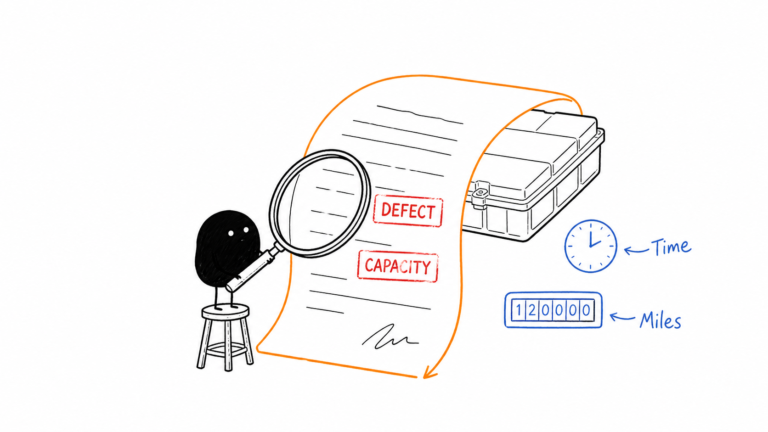
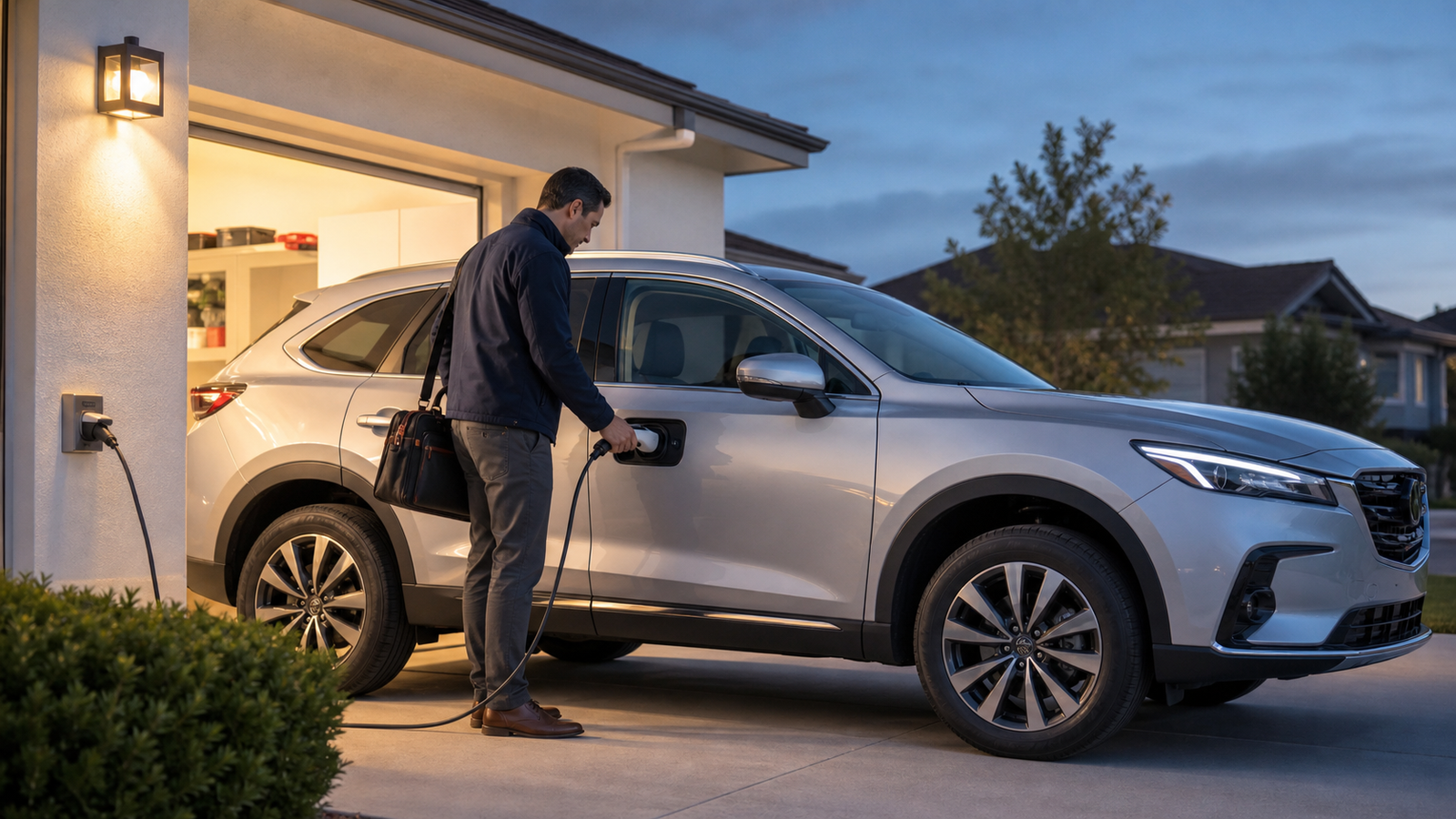
Plug in a PHEV after the last drive of the day whenever convenient home or workplace charging is available. Daily charging usually maximizes electric miles, minimizes gasoline use and does not require waiting for the battery gauge to reach empty. If electricity is expensive, the charger is inconvenient or the car will sit unused for weeks, the answer can change. The useful rule is not “charge at 20%” or “stop at 80%.” It is: charge often enough that the next day’s routine miles fit inside the vehicle’s usable electric range, while following the charging and storage instructions in that model’s owner’s manual.
How often should you charge a PHEV?
| Driving and charging situation | Best default | Why |
|---|---|---|
| Home charging and daily driving | Plug in after the final trip each day | Starts the next day with the most usable electric range |
| Two separate daily driving blocks | Charge at home overnight and at work if the second block exceeds remaining range | A second charge can replace gasoline miles |
| Driving less than the electric range every two days | Daily is easiest; every other day may produce the same electric miles | There is no fuel benefit from charging more energy than the trips use |
| No home charging | Use reliable workplace or destination charging; avoid expensive detours | A PHEV is still drivable on gasoline, but its ownership case weakens without regular charging |
| High public-charging price | Compare cents per electric mile with gasoline cost per mile before plugging in | Some public charging can cost more than gasoline |
| Long-term storage | Follow the model-specific owner’s manual | Storage guidance can differ from everyday charging guidance |
The U.S. Department of Energy says that charging a PHEV regularly minimizes gasoline consumption. Its PHEV guide is even more direct: fuel use depends on the distance driven between charges, and consistent charging maximizes the electric benefit. That is the mechanical answer. The economic answer depends on your electricity price, gasoline price, vehicle efficiency and daily miles.
Why waiting for “empty” is usually the wrong habit
A PHEV is not a gasoline tank with an electric version of the low-fuel light. Its battery-management system defines a usable window inside the physical battery capacity, while the dashboard presents the portion available for normal electric driving. The owner does not need to deliberately run that displayed range to zero before plugging in.
Waiting creates one predictable outcome: the engine burns fuel on miles that could have been electric. It does not unlock extra electric range the next morning. If your car offers scheduled charging, set the departure time or an off-peak window and connect it when you park. The car can then decide when to draw power.
Do not apply one universal “80% rule” to every PHEV. The widely repeated 80% advice often concerns the speed of DC fast charging in a battery-electric vehicle, because charging typically slows near full. Many PHEVs do not support DC fast charging at all, and their displayed battery percentage is not a laboratory measurement of the cells’ absolute state of charge. Use the charge target settings the manufacturer provides and follow that vehicle’s manual. For ordinary daily use, a full displayed usable charge is what lets a PHEV replace the most gasoline miles.
The charging-frequency math most buyers never see
The simplest way to estimate the effect of charging frequency is to separate available electric miles from total miles:
Potential electric miles per day = usable electric range × full charges per day
Electric-mile share = the smaller of 100% or potential electric miles ÷ daily miles
This is a planning model, not an EPA fuel-economy label. Weather, speed, cabin heat, blended operation and incomplete charging can change the result. It follows the same basic logic used in the DOE Vehicle Cost Calculator methodology, which models PHEV charging twice daily, daily or every other day and limits electric miles to the range available between charges.
A 30-mile commute with a 40-mile PHEV
Consider a driver who travels 30 miles per weekday and owns a PHEV with 40 miles of usable electric range under the day’s conditions.
- Charge every workday: 30 of 30 miles can be electric, or 100%.
- Charge every other workday: across two days, the car has 40 electric miles for 60 miles of driving. The modeled electric share falls to about 67%.
- Charge once per five-day workweek: 40 of 150 miles can be electric, or about 27%.
The gasoline engine makes all three routines possible. But the buyer paid for a plug, a larger battery and electric-drive capability. Charging once a week uses much less of what makes the PHEV different from a conventional hybrid.
What daily PHEV charging can save
Here is a reproducible example using July 2026 U.S. energy-price references. It is a scenario, not a promise and not a national PHEV average.
- Driving: 7,500 miles per year, or 30 miles on 250 weekdays
- Electricity use from the wall: 0.38 kWh per mile
- Gasoline-mode efficiency: 36 mpg
- Residential electricity: $0.1829 per kWh, the 2026 residential average in the July 2026 EIA Short-Term Energy Outlook summary
- Regular gasoline: $4.001 per gallon, the U.S. average for the week of July 20, 2026 in the EIA Gasoline and Diesel Fuel Update
Electric cost per mile = 0.38 kWh/mile × $0.1829/kWh = $0.0695, or 7.0 cents
Gasoline cost per mile = $4.001/gallon ÷ 36 miles/gallon = $0.1111, or 11.1 cents
Under those inputs, moving one mile from gasoline to grid electricity saves about 4.16 cents. Daily charging could make all 7,500 weekday miles electric in the idealized 30-mile/40-mile-range scenario. Charging every other day would make about 5,000 miles electric and 2,500 miles gasoline-powered. Daily instead of every-other-day charging would therefore save roughly:
2,500 miles × $0.0416 per mile = about $104 per year
Daily instead of weekly charging raises the modeled electric miles from about 2,000 to 7,500 and saves roughly $229 per year under the same inputs. Those figures exclude charging-equipment cost, demand charges, membership fees, battery preconditioning and any gasoline the vehicle uses during electric-mode acceleration or cabin heating.
Use the XCarspace Fuel vs Electric Cost Calculator with your utility bill, gasoline price and vehicle efficiencies. For the whole purchase decision—including insurance, depreciation and maintenance—use the Total Cost of Ownership Calculator.
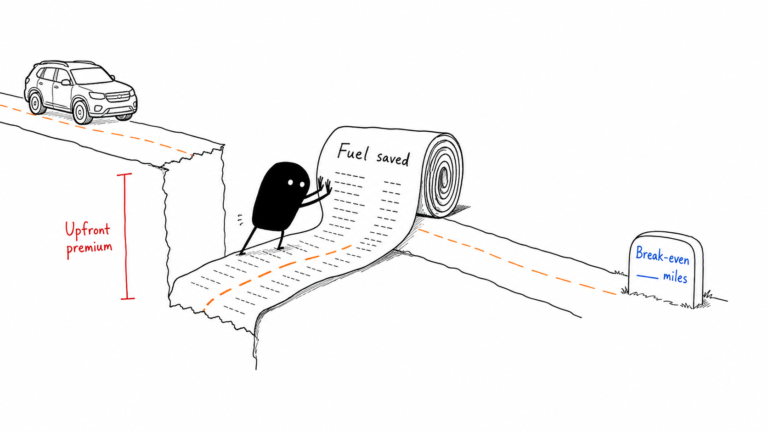
Your break-even electricity price
You can calculate the electricity rate at which electric and gasoline miles cost the same:
Break-even electricity rate = gasoline price ÷ (gasoline mpg × kWh per electric mile)
With the example above:
$4.001 ÷ (36 × 0.38) = $0.292 per kWh
Charging below about 29 cents per kWh is cheaper per mile in this example. Charging above it is more expensive. A driver with cheap overnight electricity has a strong reason to plug in daily. A driver paying a session fee plus 45 cents per kWh at a public station may rationally use gasoline instead. This is why “always plug in” is good operational advice but incomplete financial advice.
Do most PHEV owners need a Level 2 charger?
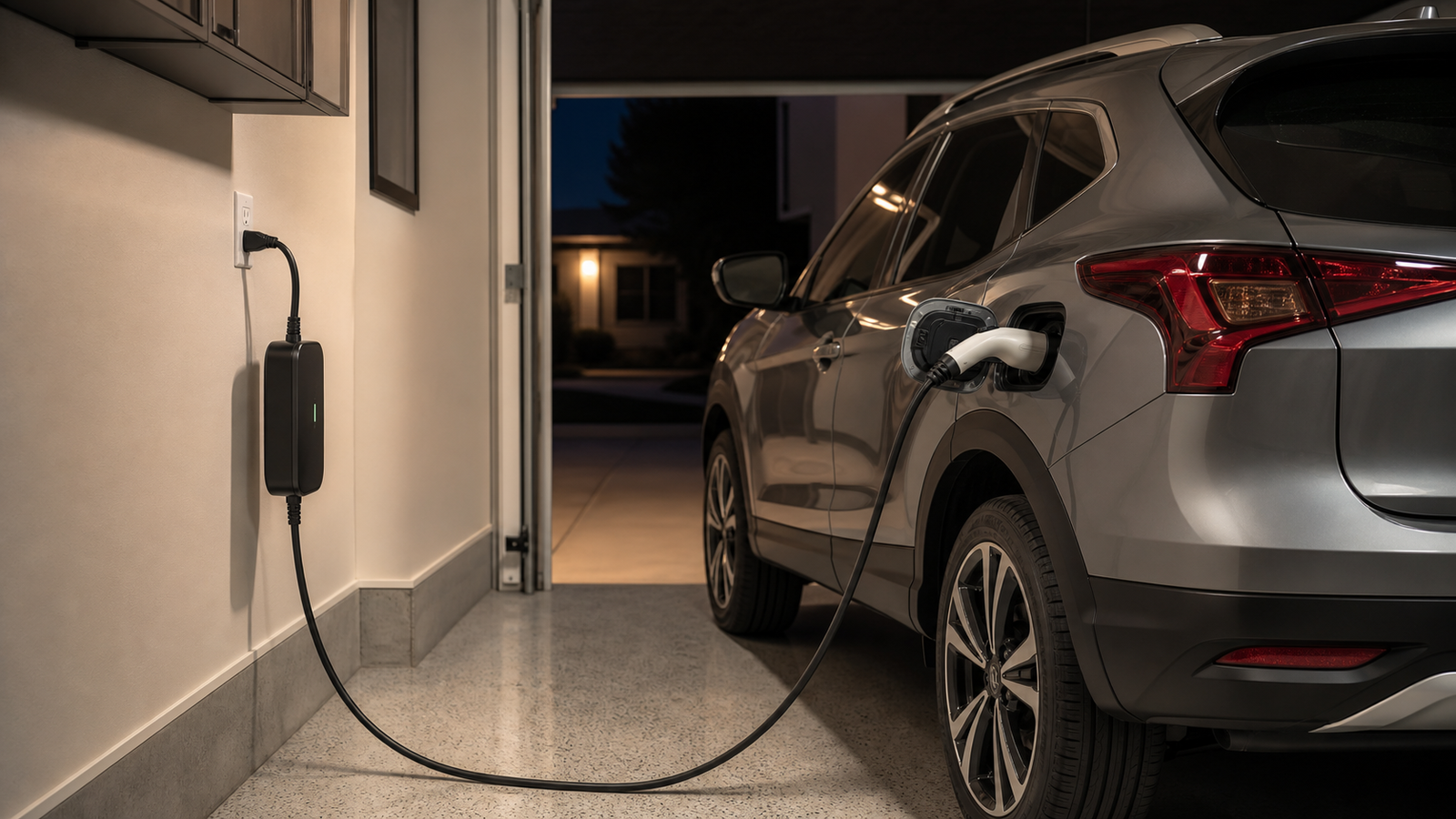
Not automatically. EPA estimates that Level 1 charging adds roughly 3 to 5 miles of range per hour, while its current home-charging guide identifies Level 1 as a good fit for short commutes and PHEVs. A PHEV that returns home with a depleted 35-mile electric range could recover that range during a long overnight parking window without an expensive electrical upgrade.
Level 2 becomes more useful when the car has a larger battery, the overnight window is short, two plug-in vehicles share the circuit, or the driver wants a meaningful refill between morning and evening trips. The car’s onboard charger sets the maximum AC power it can accept, so buying a much larger wall unit does not make a low-rate PHEV charge faster.
Safety matters more than speed. EPA advises that plug-in vehicles should ideally use a dedicated circuit or one without another electrical load. Avoid treating a light-duty extension cord as permanent charging infrastructure. Have an electrician evaluate aging, damaged or frequently hot outlets and any new 240-volt circuit.
When plugging in less often makes sense
Your driving is already inside one charge
If you drive 12 miles on Monday, park Tuesday and drive 12 miles Wednesday in a PHEV with 40 real-world electric miles remaining, charging after both trips does not displace more gasoline than charging once. Daily plugging may still be easier because it removes a decision, but it is not compulsory.
Your public-charging cost is above break-even
A PHEV’s gasoline backup gives its owner leverage. Do not spend 20 minutes moving the car or pay a high session fee to save a few dollars’ worth of fuel. Compare total charging cost—including parking and session fees—with gasoline cost per mile.
The vehicle will be stored
Everyday “plug in when parked” guidance is not long-term-storage guidance. If the PHEV will sit for several weeks or months, consult its manual for the recommended traction-battery level, 12-volt-battery care and interval for operating the vehicle. Do not invent a storage percentage from advice written for a different model.
Charging creates more friction than value
If charging requires a special trip, an unreliable public station or moving the car late at night, the behavior may not last. That is a buyer-fit warning. A conventional hybrid may deliver more consistent real-world efficiency for someone without dependable charging. Our PHEV vs EV guide compares this charging-access question with range, trip and ownership tradeoffs.

A practical PHEV charging routine
- Record real electric range for two weeks. Use the range the car actually delivers in your weather and route, not only the label estimate.
- Compare it with miles between parking opportunities. If tomorrow’s miles exceed the remaining electric range, plug in.
- Check the price. Calculate electric and gasoline cost per mile. Include public session or parking fees.
- Use scheduled charging when rates vary by time. Connect when you park; let the schedule start charging in the lower-cost window.
- Precondition while connected when the car supports it. This can use grid power for initial cabin heating or cooling, although the actual range benefit varies.
- Review the routine by season. EPA notes that cold weather, accessory use and high-speed driving can reduce electric range. A commute that fits in summer may trigger gasoline use in winter.
- Follow the manual for targets and storage. Model-specific instructions outrank generic internet rules.
What changes the recommendation?
The recommendation reverses when regular charging is expensive, unsafe or so inconvenient that it adds more cost and time than the electric miles are worth. It becomes stronger when the car sits beside a low-cost plug for hours, daily miles are near or below electric range, and gasoline is expensive. A second daily charge matters only when it replaces gasoline miles; otherwise it is just another connection.
Vehicle behavior also matters. The EPA explains that some PHEVs operate almost entirely on electricity until the battery is nearly depleted, while “blended mode” models may use gasoline and electricity together even with charge remaining. Two cars showing the same electric range can therefore produce different gasoline use on the same route.
Frequently asked questions
Should I plug in my PHEV every night?
Yes, if you drive most days and have safe, reasonably priced home charging. Nightly charging is the simplest way to begin each day with the maximum usable electric range. If one charge already covers several days of driving, less frequent charging can deliver the same electric miles.
Do I need to drain a PHEV battery before charging?
No. There is no normal-use requirement to run the displayed electric range to zero. Plug in when convenient and follow the vehicle’s owner’s manual and charge settings.
Is it bad to charge a PHEV to 100% every day?
Do not assume a universal rule. The dashboard shows the manufacturer-managed usable range, not necessarily the cells’ full physical capacity. Use any charge-limit feature the manufacturer provides and follow the manual. For many PHEV drivers, a full displayed charge is what allows the next day’s miles to remain electric.
Can I own a PHEV without home charging?
Yes, because the gasoline engine keeps the vehicle usable. But the economic and emissions case weakens if you rarely charge. Dependable workplace charging can work; occasional high-priced public charging is a much less convincing routine.
Is Level 1 charging enough for a PHEV?
Often, yes. EPA says Level 1 typically adds about 3 to 5 miles of range per hour and is well suited to short commutes and PHEVs. Compare the vehicle’s battery size and charging rate with the hours it normally remains parked.
The XCarspace verdict
For most home-charging PHEV owners, plug in after the final drive every day. It is a low-effort habit that protects the reason for buying a plug-in hybrid: replacing routine gasoline miles without giving up long-trip flexibility. Charge less often only when one charge already covers several days, electricity costs more per mile than gasoline, charging is unsafe or inconvenient, or the owner’s manual calls for a different storage routine.
Methodology and sources
This guide was updated July 30, 2026. The charging-frequency model uses daily miles, usable electric range and charges per day. The cost example uses an illustrative PHEV at 0.38 kWh per electric mile and 36 mpg in gasoline operation; these are transparent scenario inputs, not claims about a named vehicle. Energy-price inputs come from EIA sources dated July 2026. Charging and PHEV-operation guidance comes from the U.S. EPA and the U.S. Department of Energy Alternative Fuels Data Center. Real results vary by vehicle, temperature, speed, route, utility tariff, charging loss and blended-engine operation.